Project owner: Texas Department of Transportation (TXDOT)
Location: Freeport, Texas
Subcontractor: Lee Composites, Inc.,
The Woodlands, Texas
Subcontractor: Orion Marine Construction
Project sector: Infrastructure
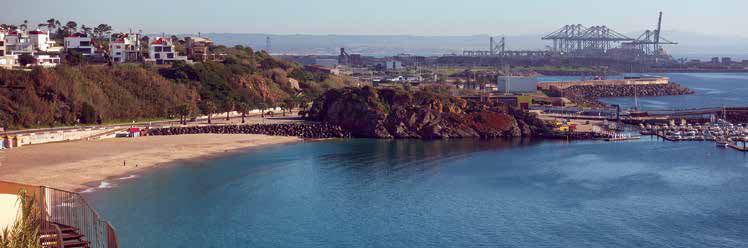
Freeport, Texas is a major petroleum refining and distribution center south of Houston on the Gulf of Mexico. The Brazos River—at 1,280 miles, the 14th longest river in the United States—runs directly by much of the energy industry facilities and the historic downtown before reaching the Gulf of Mexico.
State Highway 36 is the major road connecting Freeport to the rest of the state. The highway has been widened in recent years to accommodate the area’s growing population and provide a better hurricane evacuation route, and that work included a new bridge over the Brazos River at its terminus. The Brazos River posed challenges that included brackish water and boat traffic from vessels of different sizes.
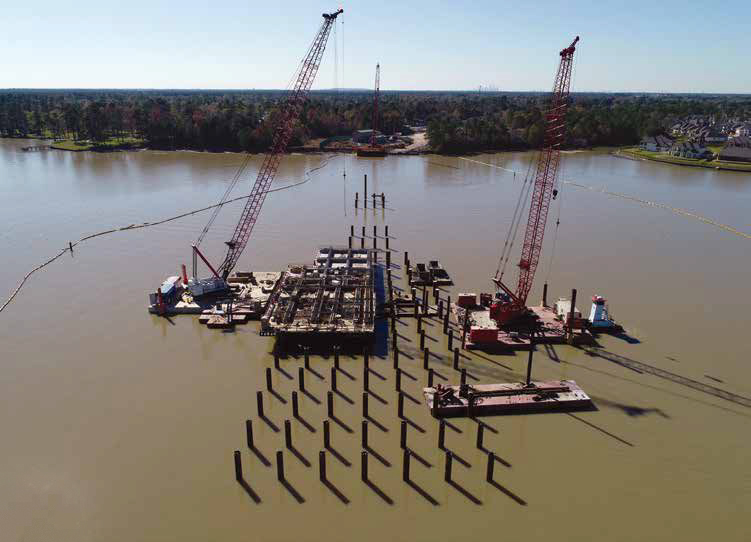
Lee Composites, Inc. supplied high-density polyethylene and FRP pilings, HDPE pile sleeves and FRP pilings to marine subcontractor Orion Marine Construction for the dolphin navigational clusters to protect the bridge.
The company supplied 76 twelve-inch-diameter fiberglass pilings and 76 HDPE SuperSleeve™ pile sleeves with fuse-welded PE flattop caps for the clusters around the Brazos River bridge. Each of the four clusters is composed of 19 piles and pile sleeves.
Bob Lee, the founder of Lee Composites Inc. and a trained engineer, has worked in the composites field for many decades. He saw an opportunity with the TXDOT Brazos project to provide sleeves that are thinner than the sleeves typically used for similar applications.
“I compete all the time against DR series water pipe used as a sleeve, but our factory makes our sleeves either .120 or .187 or .200 inches thick,” he says. “The DR series water pipe sleeves are heavier, harder to work with, and cost more, and they are not tested to the ASTM standards that our Super- Sleeves are tested to.
“This job was the first one that I am aware of on which TXDOT approved of fiberglass hollow pilings and thinner HDPE pile sleeves for a fender system,” Lee continues. “Orion Marine Construction was the marine contractor that did the installation. I believe it was their first job in Texas working with hollow FRP piles and thinner pile sleeves.”
Fiberglass and steel round piles and concrete round and square piles and sleeves are common at marinas for floating docks and mooring piles, Lee explains. Steel piles were considered but due to availability, cost and corrosion resistance, the decision was made to go with FRP piles.
“We expect the FRP piles to perform just as well as steel in this environment,” Lee continues. “Where steel is exposed to salt water and salty air, you have the potential for corrosion. I hope to prove that the pile sleeve we developed can perform just as well as steel.”