Bohl Crane installed a series of overhead cranes and hoists from R&M Materials Handling at a facility in Decatur, Indiana where Formula Boats are manufactured from raw materials.
A family-owned company, Thunderbird Products, produces the globally recognized line of Formula Boats, fiberglass boats from 24 to 50 feet in length. When the boat maker wanted to respond to demand to make larger and heavier vessels, Bohl Crane, an R&M Materials Handling Master Distributor for over 20 years, was called upon to find a solution
Application
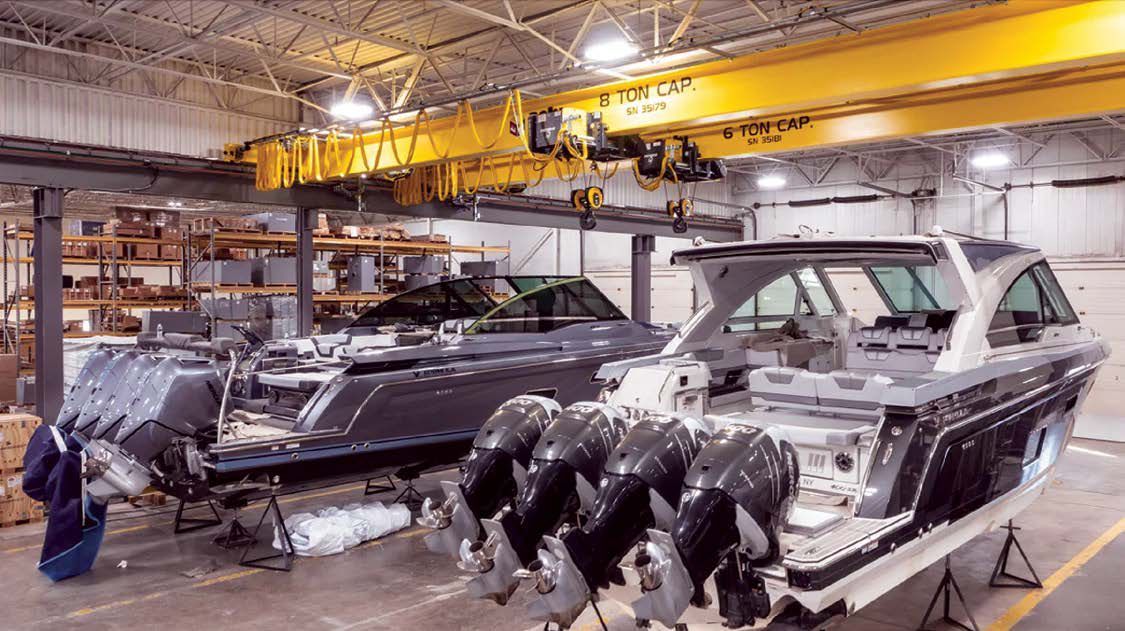
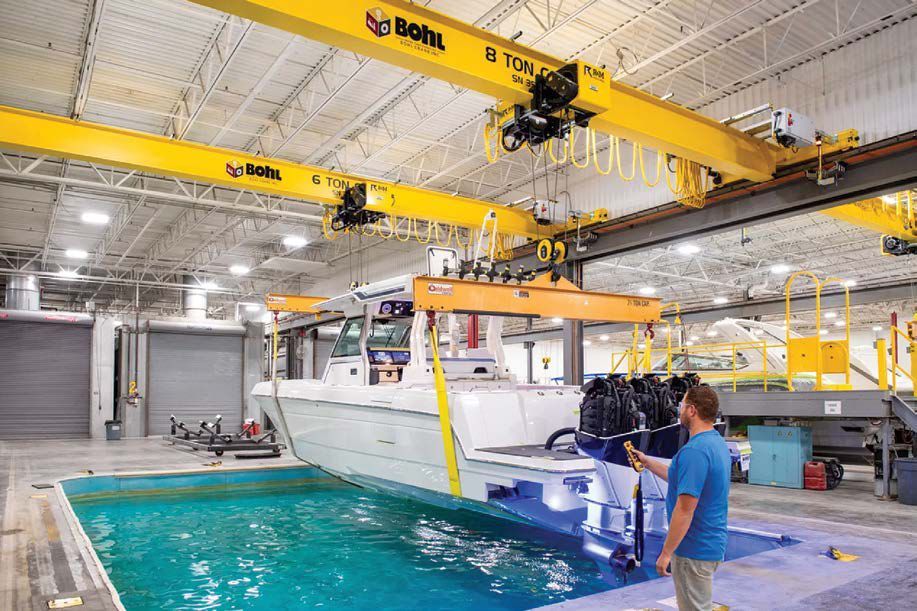
It was a tight headroom application, given that the existing building had a truss height of 20 feet, 10½ inches and crane rail height of 18 feet, 2 inches. Thomas Velker, project engineer at Bohl Crane, described the scene: “There is a pond out front and pool bays inside. The pools are used to test the motors in the boats; they use the cranes to lift the boats in and out of these pools,” he says.
The material handling needs of Formula Boats had changed over time. Most of the previously existing cranes had been removed, as they had mismatched hoists and speeds, making way for similar but updated cranes. Below-the-hook equipment, such as nylon slings and spreader bars, was retained.
Challenge
A total of eight bays needed to be covered and Velker reiterated that the major challenge was confined space.
“They were working within an existing building with an already tight lifting application,” he says. “We had to come in and reinforce their building steel along the runways and building columns so that the runways for the cranes could handle the additional capacity. We had to keep our sizing within the existing crane window despite the need for even bigger cranes; we did this by notching the girders and other methods.”
Additionally, the customer did not want to go through the process of changing out all of their runways for the added capacity, which would have been expensive and would require a lot of downtime. John Workinger, facility maintenance manager at Formula Boats, says, “We had concerns about continuing production during the hoist upgrades.”
Bohl Crane worked with Formula to uncover how much weight the bow of each boat required as compared to the stern in regard to capacity. The stern, being heavier, required an 8-ton crane; and the bow, being lighter, required a 6-ton crane. Tandem radio remote controls are utilized to get the two cranes to lift the boat together. And while the lifting equipment is only required for moderate duty, they are operated daily, during every shift.
Solution
“One of our more experienced salespeople had the idea to add intermediate columns in the middle of the runway. This alone allowed them to keep all the runways and have minimal downtime,” says Velker.
Bohl Crane selected standard SX wire rope hoists and crane kits, utilizing fully side-mount end trucks, to keep the cranes in as tight a window as possible. The spans of each crane were comparable, at approximately 47 feet, 6 inches. Each bay got an 8-ton and a 6-ton capacity crane to cover the weight of the bigger boats. Bohl Crane added a radio remote control with A/B/Both selector switch. This allows them to be able to move the bridges at the same time.
In addition to the larger bay cranes, eight new 2-ton capacity, underhung R&M cranes were installed in a smaller bay area. “All of this requires great communication on the part of Bohl Crane employees and our on-the-floor supervisors and employees,” says Workinger, who oversees the production facility and two other storage buildings.
Results
The low headroom of the SX wire rope hoists allowed Bohl Crane and Formula to avoid any unnecessary costs that would have been caused by structural alterations. Workinger says, “It went flawlessly. Bohl Crane did an excellent job of communicating with our production supervisors and staff to accommodate our schedule, even in this crazy world of shipping delays.”
The entire process lasted from January to September. Velker says, “We can learn a great deal from the experience of our team, from sales to engineering to our field crews. Our crew leader, Durke Ferris, is very cognizant of safety anytime he is on a job site. The goal was to remove and install bridges all while they are running production. Durke and the crew worked diligently around all existing equipment and Formula workers to safely and efficiently get the job done.”
Workinger adds, “Our hoists are working and performing to perfection; they run really smooth, and all the support has been greatly appreciated.”
Reprinted from Marine Construction Magazine, Issue I, 2024.