Mason Sears has spent his life on or near the ocean. Born in Massachusetts and a long-time resident of Maine, he’s worked a wide range of jobs in the maritime industries and earned a college degree in marine studies. Throughout his career, Sears has drawn from his experience and training in coastal issues.
Fresh out of college, Sears was put in charge of a marina construction project, only to see the project destroyed—just before its opening—by a major storm and surge. His research to find a proven concept for dockage that could withstand the elements in coastal Maine led to his current position as vice president of sales and marketing for the U.S. division of a Swedish company, SF Marina Systems.
You’ve said that you’ve spent most of your life on or near salt water.
Yes. I was born in Massachusetts but have always spent summers in Maine. And I’ve always been on the water, racing powerboats, tinkering with boats. My first jobs were as dock staff and as a sailing instructor. In high school I did an apprenticeship with Sun Yacht Charters, which was based in Maine, and worked in their Caribbean charter bases, and helped with marketing for boat shows.
When I was a junior in high school, I attended a Canadian school that was held on a 188-foot-tall ship, the Concordia. I was able to sail around the world. That exposure to different marinas, local traditions and infrastructure continued to spur my interest.
Did your family have a nautical background?
My grandfather was a Seabee [a member of a U.S. Navy Construction Battalion] in the Pacific theater in World War II, building infrastructure on the islands. I was always fascinated with what they did.
You also have a college degree in the field.
I went to the University of Rhode Island and got a bachelor of arts in marine affairs. That’s a fairly niche study, but it includes all the issues you might find in the coastal zone—permitting, stormwater management, maritime law, marina design, regulation, fishing, coastal communities and social issues. I also did a half-year at the University of Technology Sydney, in Australia, in their coastal resource management program.
My education all points to the marine industry. I think I knew early on, as early as eight years old, that I wanted to find myself somewhere in the industry. I just didn’t know where.
How did you get your career started?
In 2000, fresh out of college, I went to work for a group that was building a marina in Portland. It started out as Yacht Haven and we renamed it Maine Yacht Center. The site had been an oil terminal behind a baked-bean factory. The investors who bought the property had had a few false starts in years prior, but they hired me as the project manager and we went into it with full energy. We got the site re-permitted to build a 100-foot marina and a 35,000-square-foot storage building.
Wasn’t that unusual, to hire a generalist without direct experience in construction as the project manager?
The history of the project gave me the opportunity. The owners said, let’s see what this individual’s thoughts are on how to take it forward. There was an existing office and they said, here, you can live in the office. It wasn’t a huge wage but it was a fantastic challenge.
I spent a few years attending permitting meetings, shoveling the snow and working hand-in-hand with the contractors to work through all the details. It was quite a diverse role.
And then the storm hit.
Weeks before the grand opening, we had a really bad nor’easter.
The marina was heavily damaged. We had a storm surge and very big waves. It was a nor’easter but also a localized cyclonic event in our area, so we got a 1-2-3 punch. The marina system as designed couldn’t handle it. It was quite a shock for me, considering how much I had personally invested in it in terms of time.
But we got through it. After the waves had settled and we cleaned up, it became clear that the marina, if it were to exist in that location, needed a much better dock system that could handle the conditions of that site.
I went back to my colleagues in the educational world and got all sorts of concept ideas of how to protect the marina. But the mandate from the ownership group was that the solution had to be proven. The SF Marina product was the one we could look at around the world and see examples of it working in similar conditions.
The group made the decision to purchase a concrete attenuator from SF Marina Systems. I worked with the contractors and the company to install this new attenuator and built a relationship with the company throughout the process.
Was the technology that SF Marina used then similar to what they use now?
Yes, it was. And it had already been in place for decades. The company’s history stretches over 100 years, so we could look at how it performed in severe locations.
How do you get concrete to float?
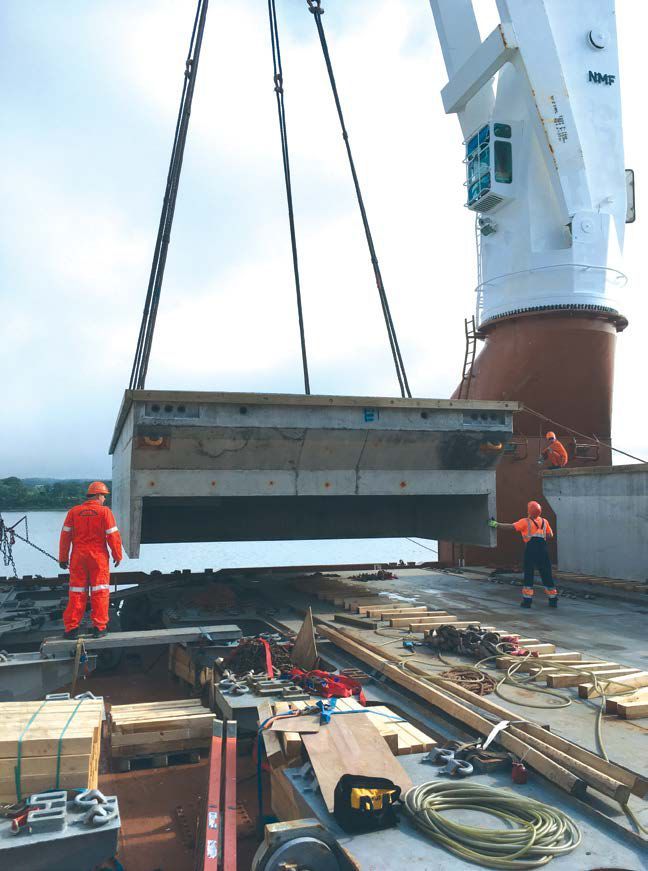
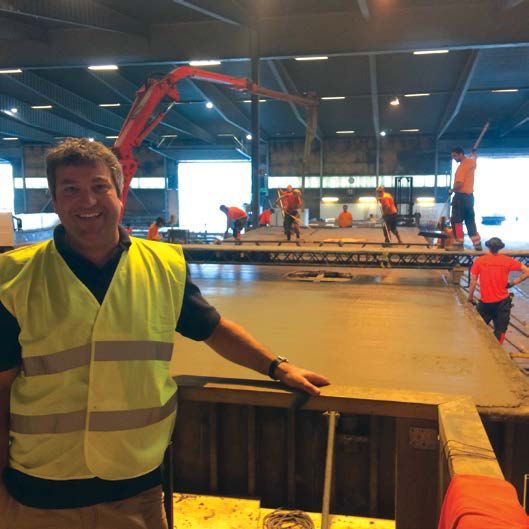
You use large, polystyrene EPS blocks, giant pieces of closed-cell styrofoam. We cast concrete around them similar to a bridge or parking garage structure. If you have, let’s say, 100,00 pounds of buoyancy from the styrofoam and 75,000 pounds of concrete, it will float.
It’s not rocket science to build a single concrete floating structure. Where our company shines is in combining multiple pieces into larger systems to create floating breakwaters that will protect a marina from wave energy.
The floating concrete blocks can serve as a foundation for anything from a bathroom building or a home up to a floating hotel.
The technology for the fingers that attach to the attenuators has evolved as well. In some locations, we could have a 50-foot finger with no pile at the end. We also can accommodate other material types for fingers, and others attached to our concrete docks. A customer might want a galvanized steel, or aluminum or a wood finger … all of those can be accommodated with our designs.
What is the state of the marina industry today? Are projects now mostly rebuilds?
To an extent. All the calm locations are taken. Our emphasis now is on our floating attenuators, which are concrete structures that go deeper in the water. They can be eight to 10 feet in the water and as wide as 32 feet.
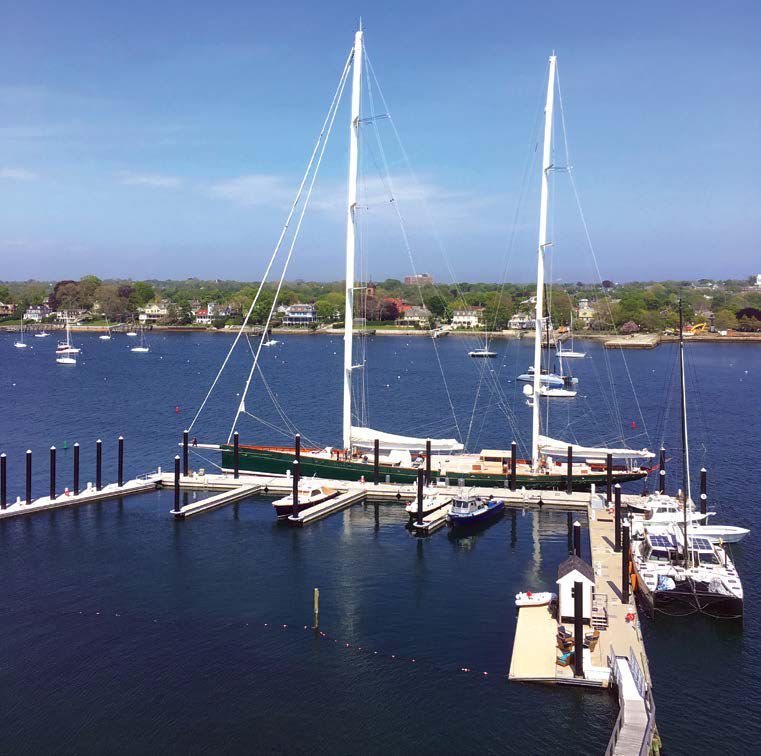
The trend is reconfiguring older facilities to accommodate larger boats and the demands of those larger boats and their customers. In those redesigns, many times they will increase the wave protection with an attenuator, which has the additional value of creating longer side ties for superyachts. An attenuator looks like a regular dock from the surface. On the outside, they can serve as transient docks, and many times on the inside as permanent dockage.
What are the greatest challenges facing the marina industry?
One is the cost of materials. Overall, construction costs have risen, and combined with higher interest rates, that’s made some projects too costly to undertake. Changes in climate and the coastal zone, with more frequent severe weather events and sea level rise. On the other hand, climate change also presents opportunities, as floating structures are adapted to solve these issues.
What else is driving change in the marina industry?
The consolidation of individually-owned marinas into larger groups that own many marinas. There are fewer mom-and-pop, independent marinas. One of the first of the consolidations was the Brewer Marina Network many years ago on the U.S. East Coast. Jack Brewer figured out that providing consistency, service and additional benefits to customers was an advantage.
The trend has spurred major upgrades of marina infrastructure and customer services worldwide because these big companies are really investing in these waterfront locations.
You’re the point man for the U.S. operations of a Swedish-based company that operates world-wide. What’s it like to work in a global environment?
There are 26 countries represented by SF Marina Systems operations. These groups cover all the major marine markets of the world. It can be a challenge to coordinate between the various countries with time differences, but Zoom and similar platforms have been helpful.

Working in metric can be a challenge! We give out tape measures that have both standard and metric on them for people to visually convert. But after you’ve used it for a while, it makes sense and is easy to work with.
On the plus side, there’s a deep bench of knowledge and experience with such a large collection of reps and decades of projects worldwide.
Local maritime traditions and practices in marina design and methods can vary in each country and region. The sharing of experiences between the family of representatives enhances our ability to provide the best solutions to our customers.
Where do you see yourself in 10 years?
Continuing to work in the marina industry. Talking about the issues of the coastal area, because that’s where my professional passion is.
There are challenges ahead for coastal areas all around the world. We think floating concrete structures will continue to be part of the coastal infrastructure, to support the industries not only of today – fishing and recreational boating – but also the industries of the future, like offshore energy. The coastal zone has always evolved and we think we’re of benefit as the industry changes.
Reprinted from Marine Construction Magazine, Issue I, 2024.