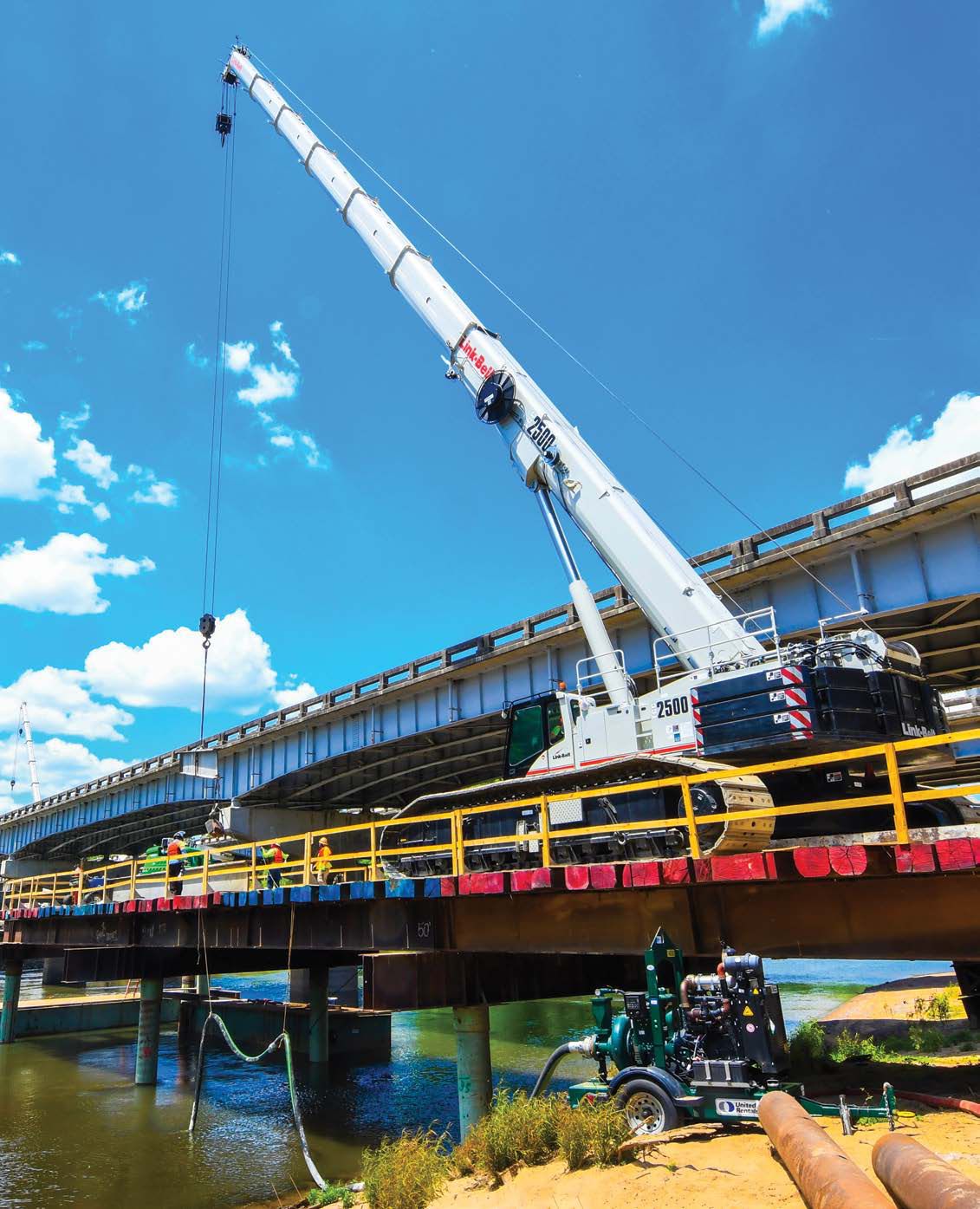
The Lane Construction Corporation is utilizing two Link-Belt 250-ton TCC-2500 telescopic crawler cranes to construct two bridges over the Wateree River in Kershaw County, S.C. The bridges will replace two preexisting overpasses along Interstate 20 as part of a South Carolina Department of Transportation bridge rehabilitation project.
Lane received a contract from the department to oversee the project, which included the construction of the new bridges, the demolition of the old structures, which were built in the 1970s, and rehabilitation work on two additional pairs of I-20 overflow bridges built in the ‘70s. Along with this, the company will complete approach roadway work to incorporate the new bridges into I-20.
Renting the TCC-2500s from Lomma Crane & Rigging of Bridgeville, Penn., Lane first used the TCC-2500s to drive piling to build temporary trestles on both sides of the river. As the river is a navigable waterway and requires maintained access through its middle, the Lane work crew is using the TCC-2500s concurrently, one on each trestle, to begin foundation work for the replacement bridges.
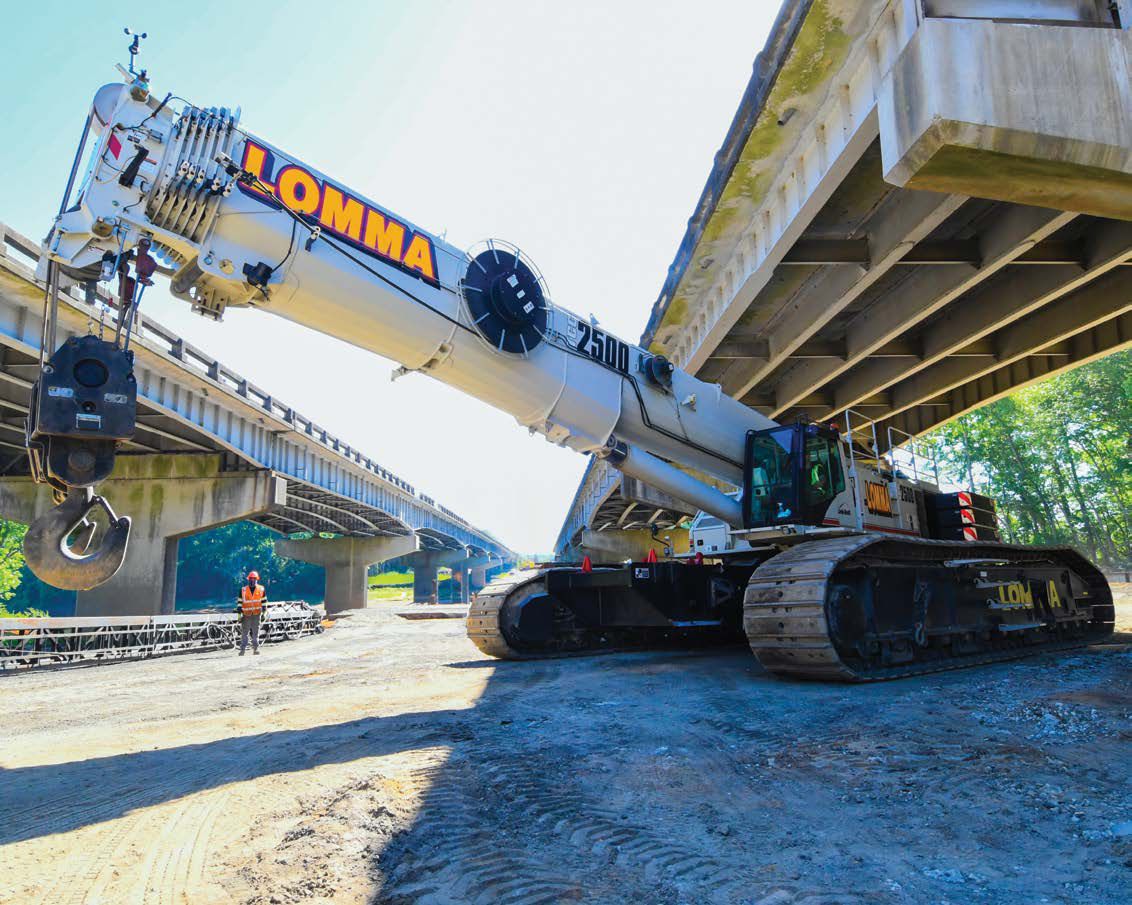
Although a traditional lattice boom crane was used to start the project, Lane project director Eric Pruemer soon realized it was not optimized for the tight, confined job site, stating it was constantly in the way and difficult to move efficiently. He said the TCC-2500s’ unmatched maneuverability was exactly what was needed to do the job right.
“These allow us to easily go underneath the bridge back and forth to facilitate work on both the outside and the median of this bridge,” Pruemer said of the TCC-2500s. “The cranes are very sleek, and they work very well.”
Pruemer noted that the cranes’ ability to quickly retract and extend their booms mean they can travel under each bridge easily and work on either side when driving the steel tubular pile needed to construct bracing for the existing bridges throughout the demolition process, saving the crew time and money.
“Without that, it would’ve been a half day to a day of dismantling the crane, moving it over, and then reassembling it,” Pruemer said.
The TCC-2500s’ ability to work and maneuver efficiently in close quarters made the difference to Lane, as it elected to utilize them exclusively for the job. With a high priority to keep road and water traffic open throughout the duration of the project, the TCC-2500s have been a perfect solution to make that possible.
Pruemer said the company will likely utilize the cranes for six to eight months as it finishes construction of the new bridges. These bridges will ultimately serve the local community by providing optimized roadways to enhance driver safety.
Link-Belt Cranes, headquartered in Lexington, Kentucky, is a leader in the design and manufacture of telescopic boom and lattice boom cranes for the construction industry worldwide. Complete crane specifications are available at www.linkbelt.com.