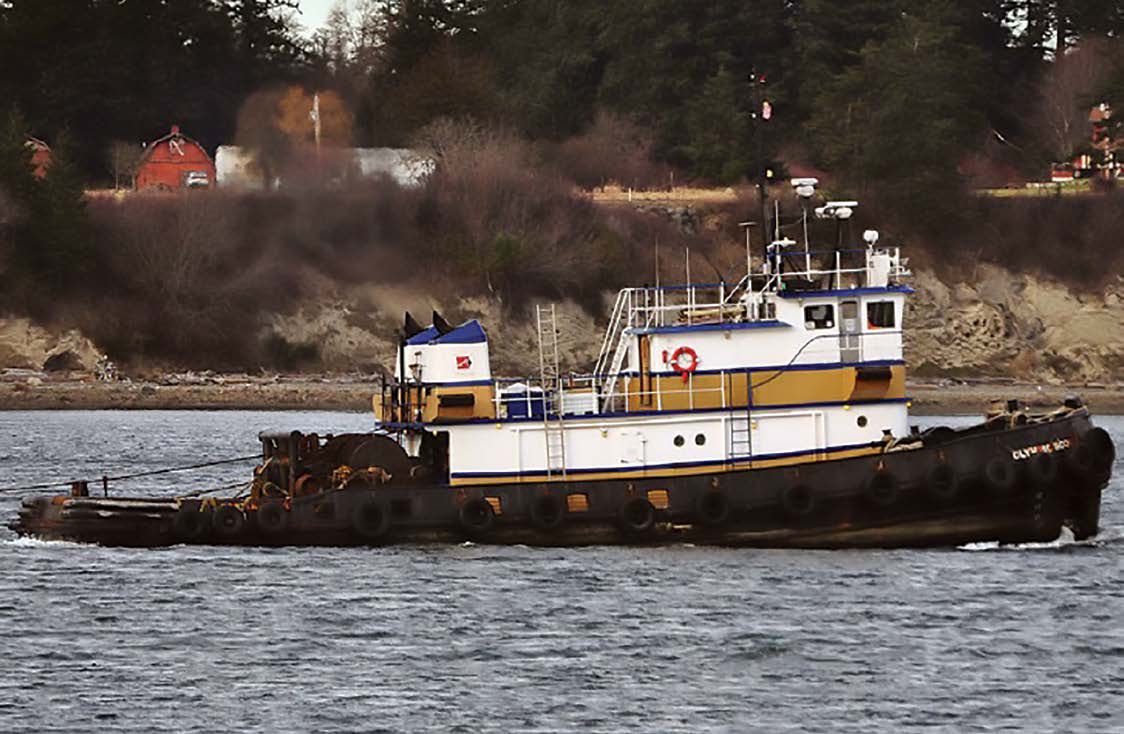
On October 12, 2023, at 2341 local time, the tugboat Olympic Scout was assisting the articulated tug and barge Montlake (tugboat) and Sodo (barge) as it headed outbound on the Hylebos Waterway in Tacoma, Washington (see figure 1 and figure 2). As the vessels attempted to transit through the Hylebos Bridge, the starboard quarter of the Olympic Scout struck the bridge’s protective fender system. There were no injuries, and no pollution was reported. The Olympic Scout sustained superficial damage; the south side of the bridge’s fender system was damaged beyond repair and was replaced at a cost of $2.43 million.

Background
The 92-foot-long, 26-foot-wide towing vessel Olympic Scout was constructed of welded steel. The vessel was built in 1976 by the Pacific Towboat and Salvage Company in Long Beach, California, as the Avenger. In 2007, Harley Marine Special Leasing LLC acquired the vessel; Harley Marine Services Inc. became the operator and renamed the vessel the Olympic Scout. In 2020, Olympic Tug & Barge Inc. (OTB) became the operator. The Olympic Scout had two 1,125-hp main-propulsion diesel engines (2,250 hp combined), each driving a fixed-pitch propeller, with two plate-type rudders behind each propeller.

The 112-foot-long, 34-foot-wide tugboat Montlake was constructed of welded steel. The vessel was built in 1990 by the Bollinger Machine Shop and Shipyard Inc. in Lockport, Louisiana, as the Doc Candies. In 2022, EEF SPV 3 LLC acquired the vessel; OTB became the operator and renamed the vessel the Montlake. The Montlake had two 2,100-hp main-propulsion diesel engines (4,200 hp combined), each driving a fixed-pitch propeller, with two shaped-foil rudders behind each propeller. The Montlake was coupled to the barge Sodo, and they operated together as an articulated tug and barge, or ATB (see figure 3).
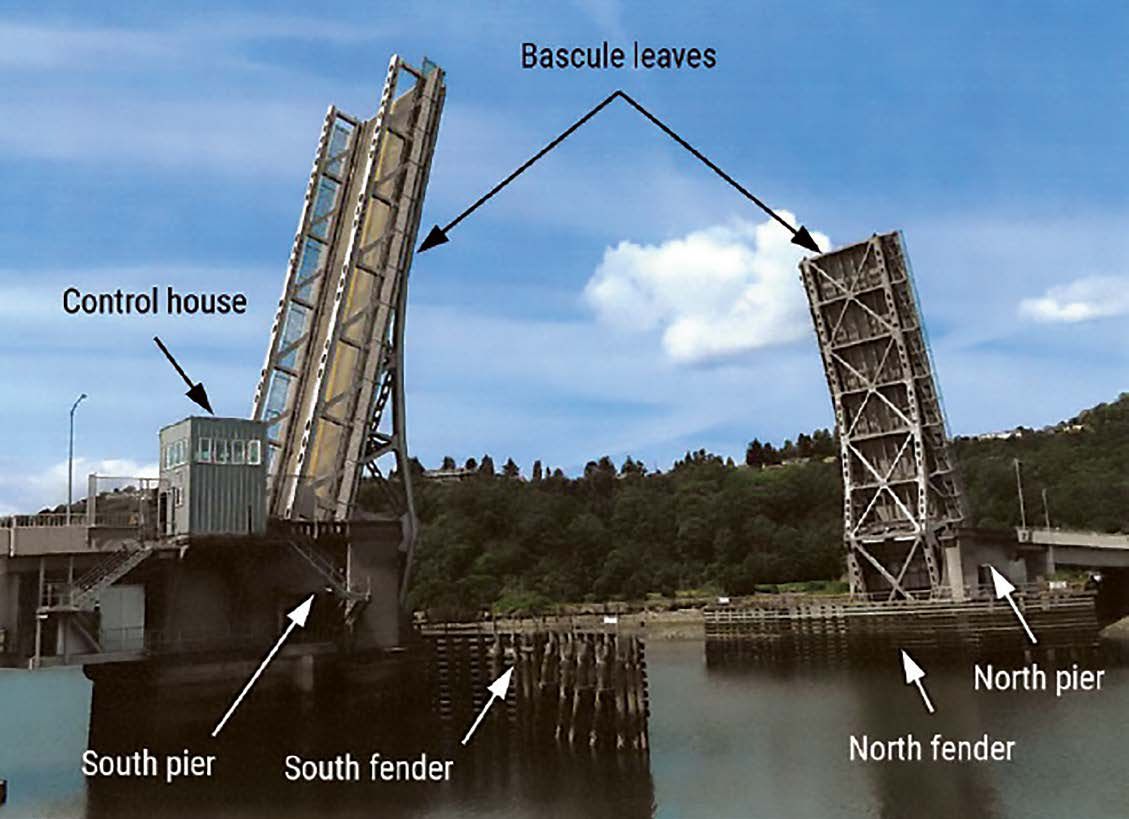
The 289-foot-long, 78-foot-wide Sodo was a double-hull tank barge constructed of welded steel. The barge was built in 2011 by the Zidell Marine Corporation in Portland, Oregon, as the DBL-55. In 2022, EEF SPV 3 LLC acquired the vessel; OTB became the operator and renamed the vessel the Sodo. At the time of the casualty, the barge was carrying 15,083 barrels of ethanol, which was 27% of the total cargo carrying capacity of the barge. The Hylebos Bridge was a double-bascule road bridge that crossed the Hylebos Waterway about 0.9 miles east of the waterway’s entrance at Commencement Bay in Puget Sound (see figure 4).
(A bascule bridge is a moveable bridge with a leaf, or span, that pivots upward with the assistance of a counterweight. A double or double-leaf bascule bridge has two leaves, one on each side of a waterway, that meet when the bridge is closed.)
The bridge was originally constructed in 1939 and was rebuilt in 2012. The bridge piers on the north and south sides of the waterway were protected from vessel strikes by a fendering system constructed of wood piles and timber facing boards. The center section of each fender ran roughly parallel to the channel under the bridge spans, while the sections on the east and west sides were angled outward forming broad funnels. Each of the fenders was equipped with red navigation lights marking the ends of the angled sections, the ends of the center section, and the centerline of the bridge span (five lights per fender). The navigational channel between the center sections was 150 feet wide, according to the National Oceanic and Atmospheric Administration electronic navigation chart for the area (US5WA22M).
Event Sequence
On the night of October 12, 2023, the ATB Montlake/ Sodo, with a crew of five, was scheduled to depart from the SeaPort Sound Terminal, located on the north side of the Hylebos Waterway, bound for Seattle, Washington. The ATB was moored starboard side to the terminal wharf, with the bow oriented in the westerly (outbound) direction. While at the wharf, the bow of the Sodo was 1,276 feet from the center of the Hylebos Bridge.
The Olympic Scout, with a crew of four, was dispatched to assist the Montlake/Sodo while getting underway and navigating out of the narrow waterway. Upon arrival at the terminal at 2302, the Olympic Scout made up to the Montlake/Sodo on the barge’s port side, near the bow, using three lines. The tugboat’s stern was facing forward on the bow of the barge, commonly called a “heads and tails” makeup. The Olympic Scout captain said that this makeup was common for barge and ATB assist jobs, providing the most maneuverability.
Before getting underway, the Montlake/Sodo crew conducted a pre-departure brief/navigation assessment; then, the Montlake captain notified Vessel Traffic Service Puget Sound and the Hylebos Bridge operator of the ATB’s pending departure.
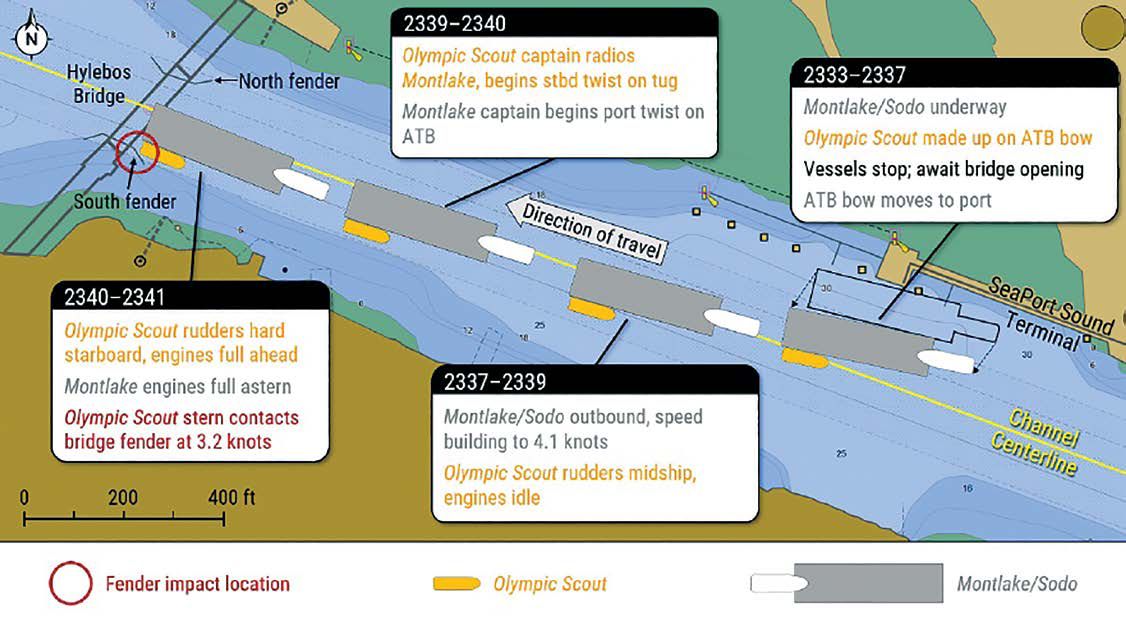
At 2333, the Montlake/Sodo got underway in darkness, with the assistance of the Olympic Scout. After pulling away from the pier, they paused in the channel because the Hylebos Bridge had not been opened. The Montlake captain called the bridge operator again, and the bridge began to open. According to the City of Tacoma website, the amount of time it took for the bridge to open was about 2 minutes. While awaiting the bridge opening, the bow of the Montlake/Sodo, along with the Olympic Scout, drifted to port toward the south side of the channel (see figure 5).
At 2337, the Montlake/Sodo began heading toward the bridge. A Montlake/Sodo crewmember was stationed at the starboard bow of the barge in order to report the distance to the bridge as the ATB approached. The crewmember stated that the Olympic Scout crew was responsible for reporting distances on the port side.
According to the Olympic Scout captain, his vessel’s engines were at idle and the rudders were midship while he awaited instructions from the Montlake captain for any required maneuvering. The Olympic Scout captain stated that he had no difficulty seeing the bridge, and all the bridge fenders’ navigation lighting was on.
The Montlake captain stated that, when setting up for the bridge transit, he usually tried to center the ATB in the channel, allowing enough room for the assist tugboat to pass between the bridge fenders. As the ATB’s speed slowly increased, the ATB was set to the port to the south side of the channel. Consequently, the Montlake captain attempted to steer back toward the middle of the channel.
The ATB’s speed built to 4.1 knots. As the distance between the ATB and the bridge decreased, the Olympic Scout captain radioed the Montlake captain, telling him that the ATB needed to come more to starboard in order for the assist tugboat to make it through the bridge opening. The Montlake captain told the Olympic Scout captain to “do what he needed to do” to bring the tugboat and ATB back toward the center of the channel. The Olympic Scout captain stated that he then put a “right [starboard] twist” on the tugboat’s rudders and engines (port engine ahead, starboard engine astern, rudders to starboard).
The Montlake captain was concerned that, with the Olympic Scout moving the ATB’s bow to starboard, the stern of the ATB would move to port, toward the south bank of the waterway. Consequently, he put a port twist on his tugboat: port engine astern, starboard engine “punch[ed] ahead,” rudders to port. The Montlake captain stated, “If he’s going to be pushing my bow, I got to work against him.”
The Olympic Scout mate, who had stepped out onto the main deck, radioed the captain, informing him that the tugboat needed another 15 feet of lateral movement to starboard (north) to make it through the bridge opening. The captain stated that the “right [starboard] twist wasn’t giving us anything,” so he put both engines ahead, with the rudders hard to starboard.
The Olympic Scout captain radioed the Montlake captain, informing him that the situation was not improving. The Montlake captain responded that the Olympic Scout captain should take whatever action he needed to, so the assist tugboat captain increased both engines to full ahead. The Montlake captain put his vessel’s engines to full astern in an attempt to slow and stop the ATB.
At 2341, the Olympic Scout’s starboard quarter contacted the fender protecting the south pier of the Hylebos Bridge. The ATB’s speed over ground at the time was 3.2 knots. When the Olympic Scout made contact, one of its three lines to the ATB parted.
The fender redirected the Olympic Scout and Montlake/Sodo toward the center of the channel, and momentum carried the vessels through the bridge opening. Once through the opening, the Olympic Scout crew took in the assist tugboat’s remaining lines from the ATB. The Olympic Scout then turned around and transited parallel to the ATB until the vessels had exited the waterway into Commencement Bay.
After the vessel operators reported the incident to the US Coast Guard and operating company representatives, the Olympic Scout returned to its berth in Tacoma’s Sitcum Waterway, while the Montlake/ Sodo proceeded to its destination in Seattle.

Damage
Damage to the Olympic Scout was superficial, consisting of scraped paint along the top of the bulwarks on the starboard quarter.
There was no damage to the Hylebos Bridge piers, mechanical structure, or roadway. However, the center section of the south fender was displaced about 50 feet to the west, with the supporting piles pushed over at angles up to 40º. Timber facing boards were broken or missing along the full length of the fender. Dolphins, which were constructed of timber piles and located at the east end and the junctions of the center and west end section of the fender, were also pushed over (see figure 6). Navigation lights mounted on the fender were damaged or destroyed. The damaged south fender was replaced with a steel fender at an estimated cost of $2.43 million.
Vessel Crew
The captain of the Olympic Scout held valid Coast Guard-issued merchant marine credentials as master of towing vessels upon Great Lakes, inland waters, and Western Rivers and master of self-propelled vessels of less than 100 gross register tons on near coastal waters. He had worked for the operating company (including its precursor companies) for 30 years and had been employed as a vessel master since 2015. The captain stated that he had captained the Olympic Scout “off and on” for five years. He stated that he had not worked with the Montlake/ Sodo before the harbor assist assignment on the night of the casualty.
The captain of the Montlake held valid Coast- Guard-issued merchant marine credentials as master of towing vessels upon oceans and master of self-propelled vessels of less than 1,600 tons upon oceans. He had worked in the towing industry for 28 years, including 6 years with the Montlake/ Sodo’s operating company. He had been employed as a vessel master since 2012.
The captains of the Olympic Scout and Montlake/ Sodo had at least 9 hours of sleep each 24-hour period in the 4 days before the casualty, with the exception of one period in which the Olympic Scout captain had 6 hours of sleep. The Olympic Scout captain stated that he “felt well rested” at the time of the casualty, and the Montlake/Sodo captain stated that he had adequate rest before getting underway. Both captains were tested for drugs after the casualty, and the results were negative. Postcasualty alcohol testing was conducted too late after the casualty to be valid.
Bridge Fender Condition
In October 2022, about a year before the casualty, a civil/marine engineering consulting firm conducted an underwater inspection of the Hylebos Bridge, including the fendering system. Inspectors found that the fenders were in “overall fair to good condition.”
The report further stated: Inspection of the piling noted localized areas of minor to heavy marine borer damage identified in the intertidal and submerged zones of several piling, as well as heavy fungal decay noted above water in a number of piling. The majority of the significant damage, both above and below water, was found in the piling located within the timber dolphins
An underwater inspection conducted 5 years prior to the 2022 inspection had found similar results with the fender system.
After the Olympic Scout casualty, another marine consulting and surveying firm conducted an above-water survey of the Hylebos Bridge fender system, observed an inspection of the underwater portion of the fenders, and examined the condition of the old piles as they were removed during repair of the fender. They concluded:
Although the fendering above the waterline can be considered as being in a generally fair condition, where sighted, the supporting structure below the waterline displays significant areas of wastage, rot, and marine worm and borer tracks….As such it is our considered opinion, based on our above comments and observations, that the timber fendering structures… are subject to an inherent loss of structural strength, and that the damage caused by the allision [Olympic Scout contact] resulted in significantly more damage being sustained as would have been, had the fendering structure been of sufficient structural strength.
Analysis
While made up to and assisting the ATB Montlake/ Sodo as it transited outbound on the Hylebos Waterway, the tugboat Olympic Scout contacted the south fender of the Hylebos Bridge, significantly damaging the fender.
Before getting underway from the SeaPort Sound Terminal, the captain of the Montlake/Sodo radioed the Hylebos Bridge operator requesting that the bridge be opened. Shortly after, the Montlake/Sodo got underway, but the bridge had not yet opened, prompting the captain to again request it be opened.
While awaiting the bridge opening, the ATB had to pause, and the bow of the ATB drifted to port, toward the south side of the channel. Once the bridge was opened a few minutes later and the Montlake/ Sodo began to move forward, the ATB was set further to port. The Olympic Scout was made up on the port bow of the Sodo with its stern facing in the direction of the ATB’s travel. Initially, the Olympic Scout’s engines were at idle and its rudders midship. In its position on the bow of the Sodo, the Olympic Scout caused drag on the forward port side of the ATB. The captain steered to starboard attempting to line up for the bridge, but likely due to the drag from the Olympic Scout on the port bow, he was unable to move the ATB appreciably to starboard. Consequently, the ATB was on the port side of the channel as it approached the bridge, with the Olympic Scout in danger of hitting the fender.
In an attempt to avoid hitting the Hylebos Bridge fender, the Olympic Scout captain used a starboard twist on his vessel’s rudders and engines. Soon after, the Montlake captain initiated a port counter twist out of concern that the stern of the Montlake would approach the southern bank of the waterway. According to the Olympic Scout captain, the starboard twist on his tugboat “wasn’t giving us anything.”
When a vessel is underway and steering and propulsion are applied, a turning moment is created, and the vessel will pivot around a point, generally located centerline aft of the bow. The actual location of the point varies depending on the shape of the hull, speed, and other factors, but a common tenet is that, for a vessel moving forward under its own power, the location is about one-third of the length of the vessel aft of the bow. When a vessel moves astern, the pivot point will move aft.
Figure 7 shows the Montlake/Sodo with the Olympic Scout made up as it was during the Hylebos Bridge casualty. In this simplified illustration, the pivot point is assumed to be onethird of the total length of the Montlake/Sodo aft of the bow of the barge, and both the Montlake and Olympic Scout are applying a turning moment through the centerline of the ATB via their respective rudder and engine orders. Note that the moment arm for the Montlake is longer than the moment arm for the Olympic Scout, and thus the Montlake would require less effort to impart a turning moment on the ATB. (The moment arm is the distance between the turning axis, or pivot point, and the applied force.)
In addition to requiring less effort to turn the ATB, the Montlake had almost twice the engine power of the Olympic Scout (4,200 hp compared to 2,250 hp). Given the advantages in moment arm and power (turning moment), the Montlake’s port counter twist effectively negated the efforts of the Olympic Scout to move the ATB’s bow back toward the center of the channel. The Olympic Scout captain applied progressively more rudder angle and engine speed, and the Montlake captain began backing down on his vessel’s engines, but, by the time these actions were taken, the fender was too close for the Olympic Scout to avoid contact.

The width of the channel between the Hylebos Bridge fenders was 150 feet. The combined breadth of the 78-foot-wide Montlake/Sodo and the 26-footwide Olympic Scout was 104 feet, leaving a maximum clearance of 23 feet on either side of the combined unit, if it was perfectly centered in the channel. The Montlake captain stated that his normal practice was to center the ATB in the channel (not the ATB and assist tugboat combined), which would have left only 10 feet of clearance between the Olympic Scout and the bridge’s south fender, if the bridge transit was executed as intended. With such a tight clearance, the margin for error was slim.
The distance between the bow of the Montlake/ Sodo at its berth and the bridge was 1,276 feet, providing a short distance for the ATB and its assist tugboat to line up to pass through the narrow opening between the protective fendering for the bridge. After getting underway, while the ATB waited for the bridge to open, the bow of the ATB moved to port. As the ATB began moving forward and accelerating to 4.1 knots, it was set further to port and, consequently, was not lined up properly with the bridge. Because of the short distance to the bridge and the speed of the ATB, there was insufficient time to correct the lineup before the Olympic Scout struck the fender.
Given the slim margin of error for making the bridge transit and the short distance to make the approach, slowing or fully stopping the ATB’s forward motion earlier would have provided the operators more time to correct the lineup and successfully transit through the opening between the bridge’s protective fendering.
Protective fender systems are installed to prevent damage to abutments, piers, and other critical bridge structures by redirecting errant vessels back toward the navigable channel. After striking the south bridge fender, the Olympic Scout and Montlake/Sodo moved back toward the center of the channel, and the combined unit continued through the bridge opening. The Hylebos Bridge was undamaged, but the fender was catastrophically damaged. Precasualty inspections of the bridge’s fenders in 2017 and 2022 noted significant deterioration of the fender piles from marine borer damage and fungal decay. A postcasualty inspection found similar damage, and a marine surveying and consulting firm stated, “the damage caused by the [Olympic Scout contact] resulted in significantly more damage being sustained as would have been, had the fendering structure been of sufficient structural strength.” It is notable that the entire fender sustained catastrophic damage when the Olympic Scout struck it at one end (at an angle— not directly), yet the tugboat sustained almost no damage. The Hylebos Bridge fender system prevented damage to the bridge structure by the Olympic Scout; however, the system’s degraded condition contributed to its extensive damage.
Probable Cause
The National Transportation Safety Board determines that the probable cause of the contact of the assist tugboat Olympic Scout with the Hylebos Bridge fender was the captain of the articulated tug and barge (ATB) Montlake/Sodo not stopping or slowing the ATB’s forward motion to correct the ATB’s lineup before attempting the bridge transit. Contributing to the severity of damage to the bridge’s fender system was the system’s deteriorated condition.