South Carolina Ports Authority
RUSSELL MARINE LLC
NUCOR SKYLINE STEEL
The South Carolina Ports Authority (SCPA) is nearing the completion of a major wharf replacement and expansion in the state’s main city, Charleston.
The Wando Welch Terminal is the center of that city’s port activity, and the state has committed to investing $500 million to expand the port’s wharves to handle post-Panamax cargo ships.
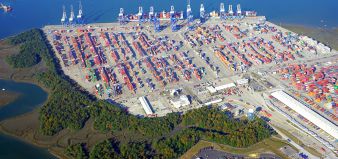
“Wando Welch Terminal is SCPA’s largest container terminal, moving approximately 80 percent of the port’s annual container volume,” SCPA states on its website. “The terminal has an overall capacity of 2.4 million TEUs [Twenty- foot Equivalent Units, the standard size for a container]. Wando Welch Terminal is designed to handle three mega container ships at one time, with the ability to handle up to 20,000-TEU vessels. Fifteen ship-to-shore cranes now stand 155 feet above the wharf deck at Wando Welch Terminal.” The Wando Welch wharf extends 3,905 feet to accommodate those three container ships, and the first contract awarded was to replace the existing surface and walls with infrastructure strong enough to handle the newer, larger container ships.
The design specified a face of 94- foot steel sheet pile and toe walls to anchor it. The $15.2-million contract was awarded to Russell Marine LLC. And that was when the real planning began.
The Wando Welch job was a logistical feat.
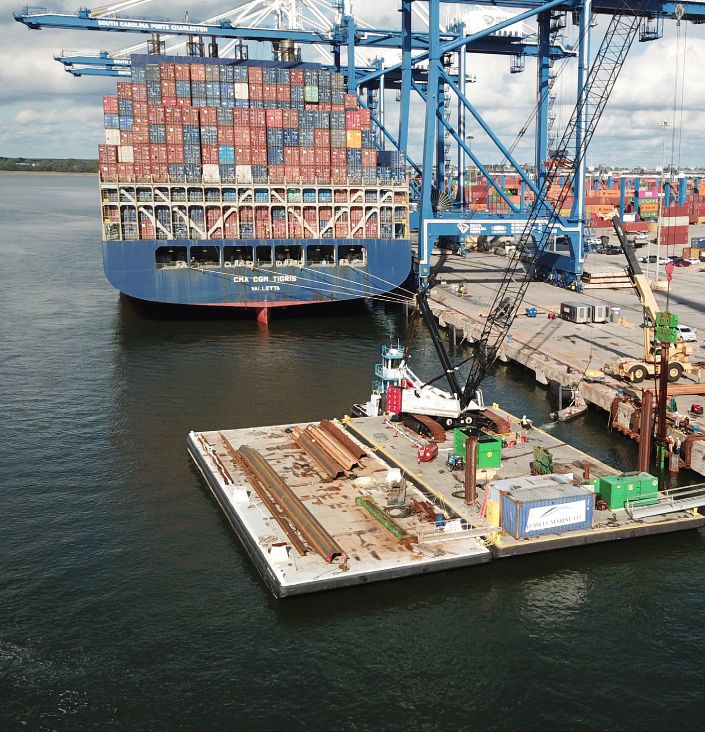
“The biggest challenge was the vessel and truck traffic,” explained Sean Vandedrinck, Russell Marine’s East Coast regional director. “Even though it would have been allowed by contract, at no point was a berth shut down from vessel traffic. Wando’s 3,900-foot length allows three large ships to come in. And even though we could have closed one berth down at a time, we found that we could just keep our construction area small and everyone could move down the wharf. There were times when they couldn’t get three large ships in, but they would find a small, Tetris-style vessel to fit in there. Right now, I believe we’re at Station 900, 900 feet from the end of the project, and they’re still capable of finding of vessels to fit in.”
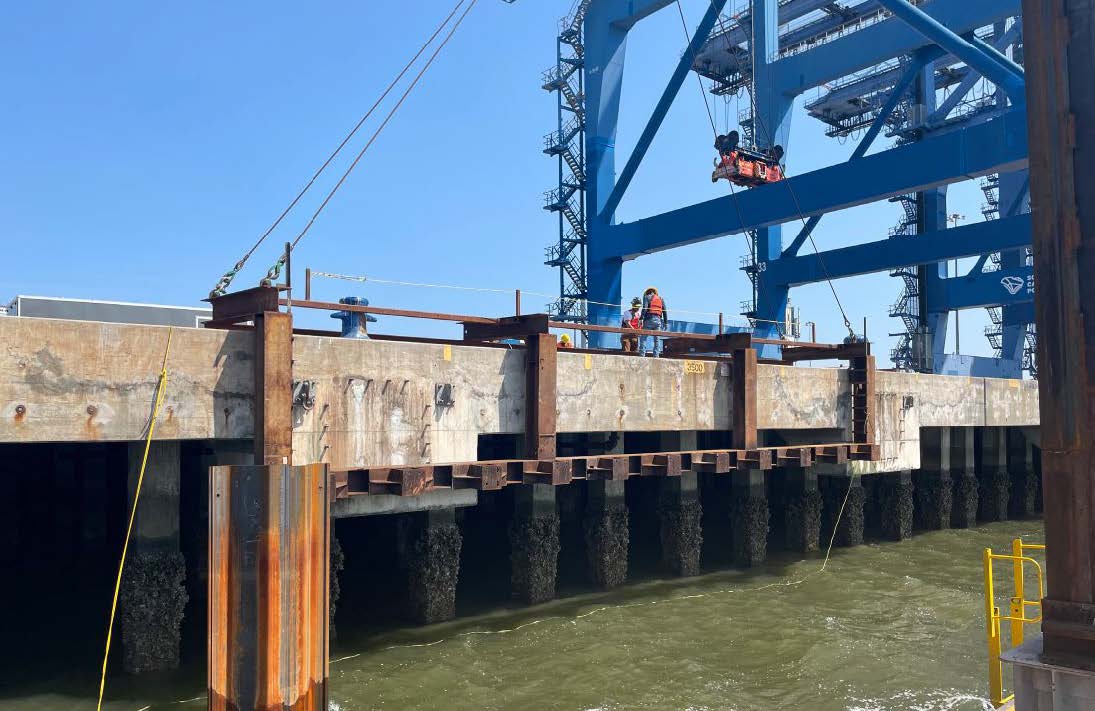
Topside truck traffic in the middle of construction was safely accommodated using highvisibility barriers with strobe lights to delineate the traffic and ensure personal safety.
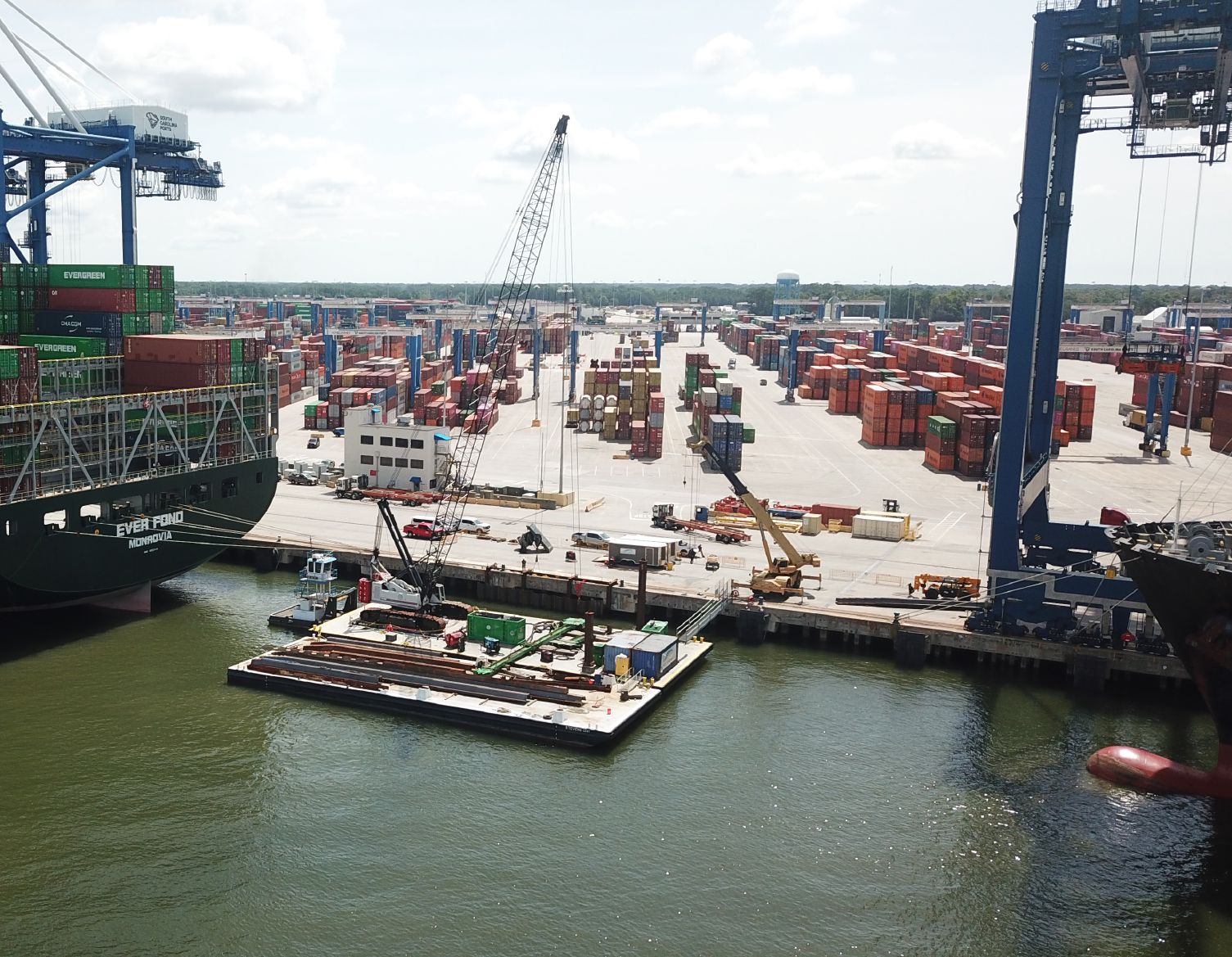
But perhaps the biggest challenge was bringing in 94-foot lengths of steel sheet pile to a job site that had very little area in which to store it.
Skyline provided Russell Marine with a unique delivery plan, which included transport of the large sheets into the congested port on a predetermined schedule. The joint management teams worked seamlessly together to coordinate deliveries. Once at the port, Russell Marine employees would escort the truck into the port. The 94-foot sheet stacks were immediately loaded from the truck onto the flat material barge where they were staggered and prepped for piledriving. Shorter sheet stacks were simply unloaded on land.
That degree of precision scheduling was possible because Nucor – the largest U.S. steel producer and the 16th largest in the world – has a number of mills in the southern U.S.
“Nucor Skyline, the foundational steel branch of Nucor, specifically manufactures sheet piling,” said Louis Nash, the head of business development for Nucor’s southern region. “Our main market is domestic jobs. We control our own mills; we don’t broker our sheet piling. So were able to offer Russell Marine exactly what they needed, particularly the 94-foot lengths of sheet pile, from our mill in Arkansas.”
“We devised a plan to work with three vessels in there with little impact to their operation.”
Russell designed and fabricated a 50-foot installation template that would sit over the existing bulkheads to get the large sheet piles in place to be driven and keep the exciter of the vibrating hammer dry while the sheet is driven 48 feet underwater. The template was a single-sided frame with bolt-on features and stub outs to allow the vibratory hammer to advance past the template.
Russell also devised a piledriving sequence, using the templates to ensure that piles would fit properly with the already-driven piles next to them without affecting adjacent piles that had been driven to spec. This gave the team opportunity to see how the sheet was reacting.
“We learned different means and methods on the job,” Vandedrinck explained. “There was a learning curve. For example, the drivability of the sheets and the vibratory hammer. We had an ICE 110 which we downscaled early on to an ICE 66 in the interests of shedding some weight. We put the ‘tattletail’ ropes on the sheets, which could tell the guys what the sheet next to the one they were driving was doing.
“Another challenge was how to 27 check and verify that our sheets are at grade before advancing, instead of waiting for a diver to come a week or two later. We devised a probe to check the elevation before advancing the template. It would tell you in real time whether you’re good to go.”
Retrofitting ports for post-Panamax ships is likely to be a growing market niche for marine construction.
In that sense, Russell’s and Nucor’s experience may prove valuable in future work.
“I think all ports have plans to grow, but some ports don’t have the luxury of shutting down an entire wharf,” Vandedrinck said. “Wando is a great money-maker for South Carolina. They did not want to turn that off. We devised a plan to be able to work with three vessels in there with little to no impact to their operation, and it worked successfully.
“Even though our contract allowed us to close one berth down at a time, we found that we could just keep our construction area small and everyone could fit in. We worked tightly with the SCPA operations and scheduling team so they knew exactly where we were, what fenders we’re taking out and where they can sneak a vessel in and out.”
Russell Marine became, in effect, part of the Wando Welch port operations during the construction.
“Absolutely,” Vandedrinck agreed. “It’s a matter of serving the community. And that’s what we’ve accomplished.”
The Takeaway
OWNER:
South Carolina Ports Authority
PRIME CONTRACTOR:
Russell Marine LLC
ENGINEER OF RECORD:
WSP
STEEL SHEET PILE SUBCONTRACTOR:
Nucor Skyline Steel
CONTRACT VALUE:
$15.2 million
SCOPE:
Refurbish 3,900 feet of Wharf
EQUIPMENT LIST