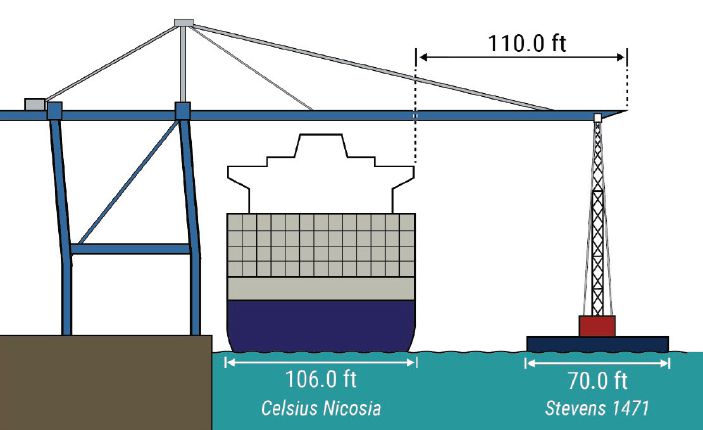
On January 4, 2024, about 1620 local time, the towing vessel Royal Engineer was transiting the Cooper River near North Charleston, S.C., while pushing the crane barge Stevens 1471 when the barge crane contacted a ship-to-shore crane at the North Charleston Terminal (see figure 1). There were no injuries, and no pollution was reported. Damage to the terminal’s crane was estimated to be over $4.5 million.
Background
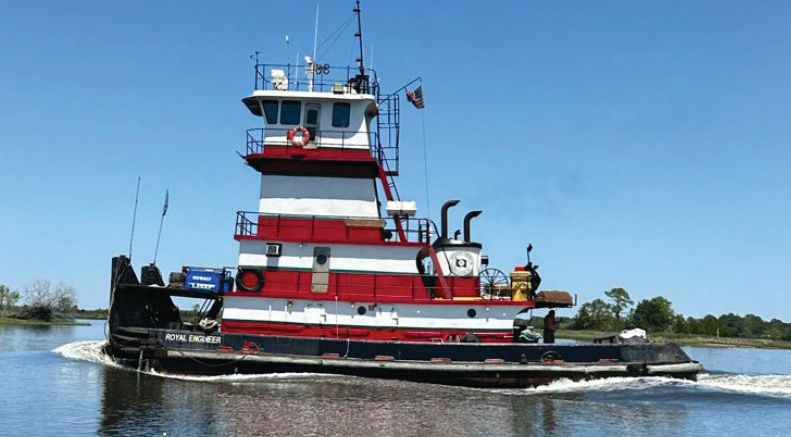
The 61-foot-long Royal Engineer was a twin propeller, 800-hp, steel-hulled towing vessel built in 1965. The vessel was owned and operated by Stevens Towing Company Incorporated of Yonges Island, S.C.
The Stevens 1471 was a 140-footlong, 70-foot-wide crane barge that held a Manitowoc 4100w Ringer crane with a 130-foot-tall fixed mast and 200-foot-long boom.
The North Charleston Terminal was a 201-acre container terminal located on the Cooper River, about one mile north of the Don Holt Bridge, in North Charleston, S.C. The terminal, which had a capacity of 500,000 TEUs, operated five ship-to-shore (STS) cranes.
Event Sequence
On January 4, 2024, about 1448, the towboat Royal Engineer and crane barge Stevens 1471 departed the Nexans Charleston facility along the Cooper River and headed south en route to the Pierside Docks, located 2.3 miles south of the Don Holt Bridge. The voyage plan indicated the expected transit time to be 2 hours and 50 minutes. The Cooper River was at the beginning of an ebb current that would reach about 0.6 knots by 1620 and a maximum current of 0.9 knots at the Ordnance Reach Harmonic Station, located near the North Charleston Terminal.
The crew of the Royal Engineer consisted of a captain, mate, and two deckhands. Each worked a 6-hours-on/6-hours-off rotation. The captain and a deckhand stood watch from 0530 to 1130 and 1730 to 2330. The mate stood the opposite watches, from 1130 to 1730 and 2330 to 0530, with the other deckhand.
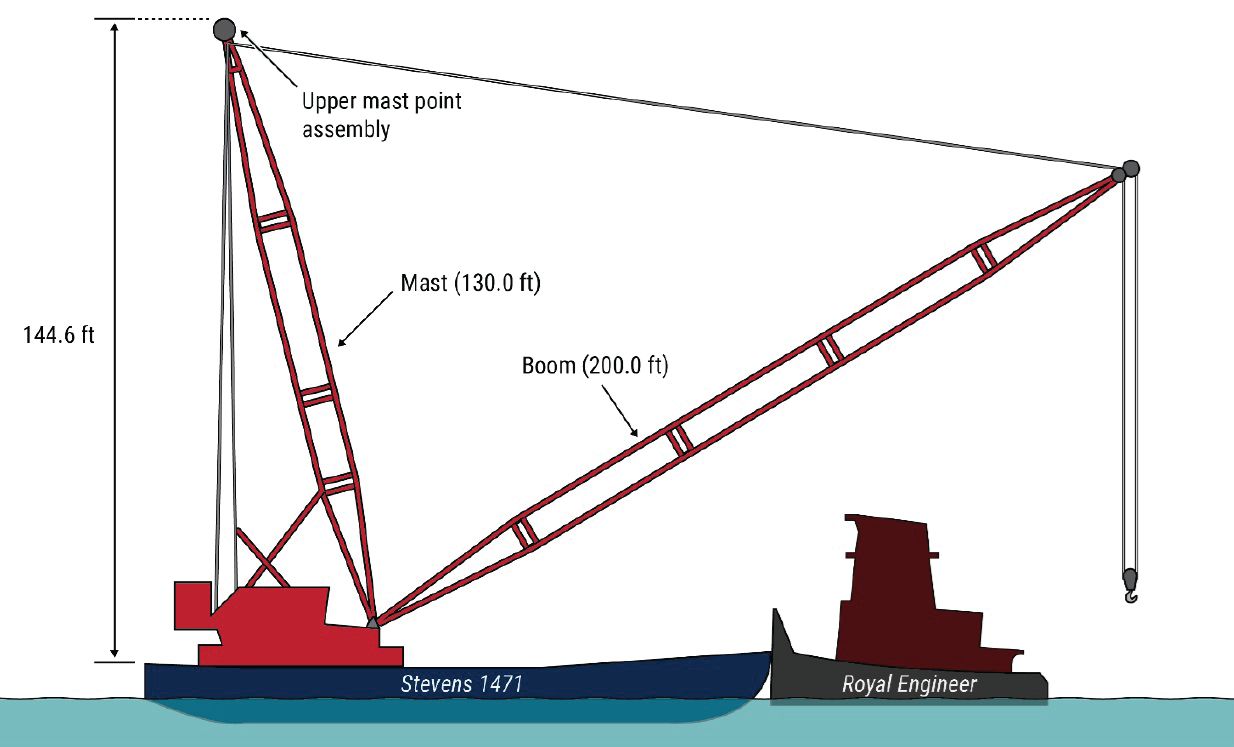
While in transit, the crane boom on the Stevens 1471 was positioned over the wheelhouse of the Royal Engineer toward the stern of the tow (see figure 3). The fixed mast of the crane created the highest air draft of the tow while stowed for transit.
According to technical drawings, the mast reached a height of 144.6 feet above the deck of the barge. The air draft of the crane barge was noted on the towboat’s voyage plan as 145 feet.
Along the Royal Engineer tow’s route, the Brunswick, a 315-foot-long dredge and barge, was dredging the Cooper River channel adjacent to the North Charleston Terminal, located about 1 mile north of the Don Holt Bridge. The Brunswick’s floating discharge pipeline extended eastward across the Cooper River channel, where dredge spoils were discharged near the eastern bank, effectively blocking the channel to traffic moving north and south. The dredging operation was published in the Local Notice to Mariners, along with a request for vessels to arrange safe passage when transiting nearby.
To pass the area where the Brunswick was dredging, a vessel would need to either (1) request that the Brunswick move the floating discharge pipeline so that it was not extending across the river, or (2) pass to the west of the Brunswick, along the west bank of the Cooper River. The dredge crew moved the floating discharge pipe frequently to accommodate passing traffic during normal operations.
On the Royal Engineer, the mate was on watch in the wheelhouse. During the transit south, he attempted to hail the dredge via VHF radio about 1 hour before the tow reached the dredge’s location. According to the mate, he intended to request that the dredge “break the pipeline,” and was attempting to give the dredge crew enough time to do so. However, the Brunswick crew did not respond to his radio call. The mate again attempted to contact the Brunswick crew via VHF radio about 45 minutes before meeting, again with no response from the dredge crew.
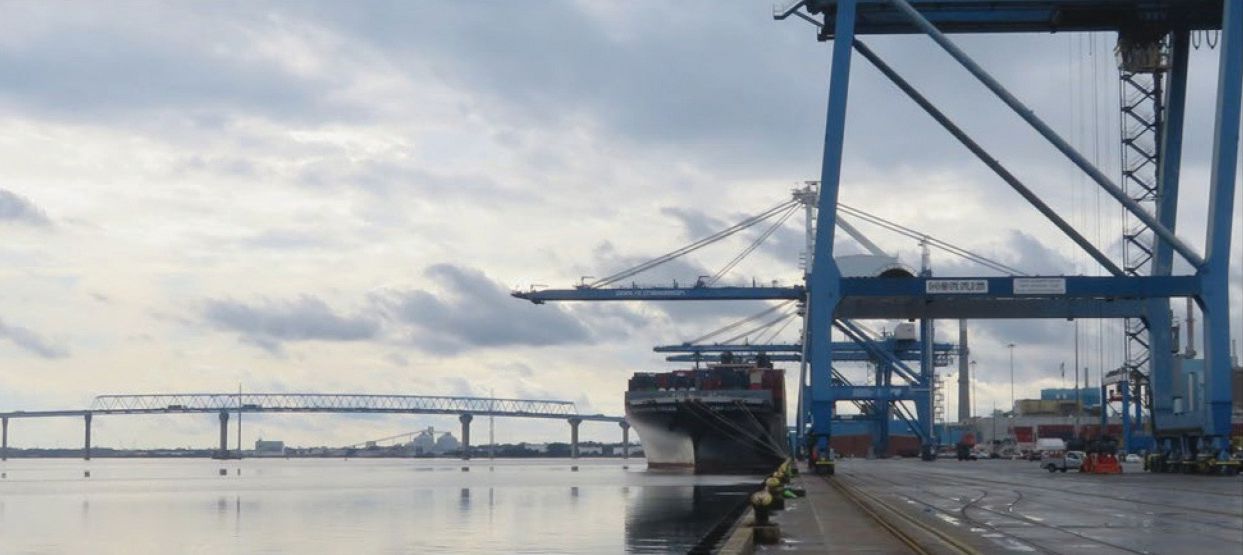
At 1605, the Royal Engineer passed green buoy 69, about 1.3 miles from the North Charleston Terminal, where the 784-footlong, 106-foot-wide containership Celsius Nicosia was berthed and terminal employees were conducting cargo operations with two of the terminal’s STS cranes. The Royal Engineer tow was within sight of the Brunswick, which was working about 300 feet east of the northern end of the North Charleston Terminal seawall, close to where the Celsius Nicosia was berthed. The mate was then able to reach the Brunswick crew over VHF radio to make passing arrangements.
The dredge captain informed the Royal Engineer mate that his preference was for the tow to pass between the dredge and the dock because “I had guys downstairs that were working on something. … and I’d have to stop them to go do something else.” He said he could swing the dredge around and provide about 300 feet of clearance to the seawall, not including the width of the Celsius Nicosia. The mate informed the dredge captain that he would have enough room to maneuver the Royal Engineer tow so it would pass between the Brunswick and the Celsius Nicosia.
Due to the expected close passage, the mate sent the deckhand on watch to the bow of the barge to relay lateral distances from the barge to the Celsius Nicosia and the Brunswick.
At 1619, the mate maneuvered the Royal Engineer tow past the Brunswick at a speed of about 4.5–5 knots. According to the mate, “that’s when I realized the ship-to-shore crane was overhanging the ship [Celsius Nicosia]. … I didn’t realize that they would be boomed out past the ship” (see figure 3). The mate asked the deckhand to watch the height of the STS crane, reduced speed, and continued toward the overhanging crane. As the Royal Engineer tow moved closer to the STS crane, the mate and the deckhand were in constant communication about whether the tow’s crane barge would clear the STS crane. Just after the deckhand informed the mate that he thought they would clear the STS crane, the mate stepped out of the wheelhouse and, “[I] realized we were not going to clear it.” He told investigators that he then went back into the wheelhouse and reversed the engines.
The STS crane operator, who was in the operator’s cabin on the boom, was looking down toward the Celsius Nicosia as he was positioning the crane to lift a container. As the Stevens 1471 crane’s mast came into his field of view, he became aware that it would likely contact the STS crane. The crane operator did not have a means of radio communication with the Brunswick or the Royal Engineer. He sounded the STS crane’s horn and braced himself for impact.
At 1620, the Royal Engineer and tow were making about 3.5 knots when the top of the Stevens 1471 crane mast struck the boom tip of the STS crane. Immediately after the contact, the STS crane operator exited the cabin, using the crane’s catwalks and stairs to reach the pier deck. The force of the contact abruptly stopped the forward momentum of the Royal Engineer tow. The Royal Engineer mate then reversed the tow and maneuvered to a safe area upriver from the dredge and marine terminal.
At 1630, the mate radioed the Brunswick to inform the crew of the contact and request that they break the dredge pipeline connection and allow the tow to pass. At 1650, the crew of the Brunswick disconnected the pipeline and moved the piping clear. The Royal Engineer tow then passed to the east of the dredge and proceeded on its southbound route. The Royal Engineer tow arrived at its destination at 1725. At 1740, the Brunswick relocated to the eastern side of the river and clear of the STS crane as a precaution in the event of collapse. The Celsius Nicosia sailed from the marine terminal at 2000.
Damage
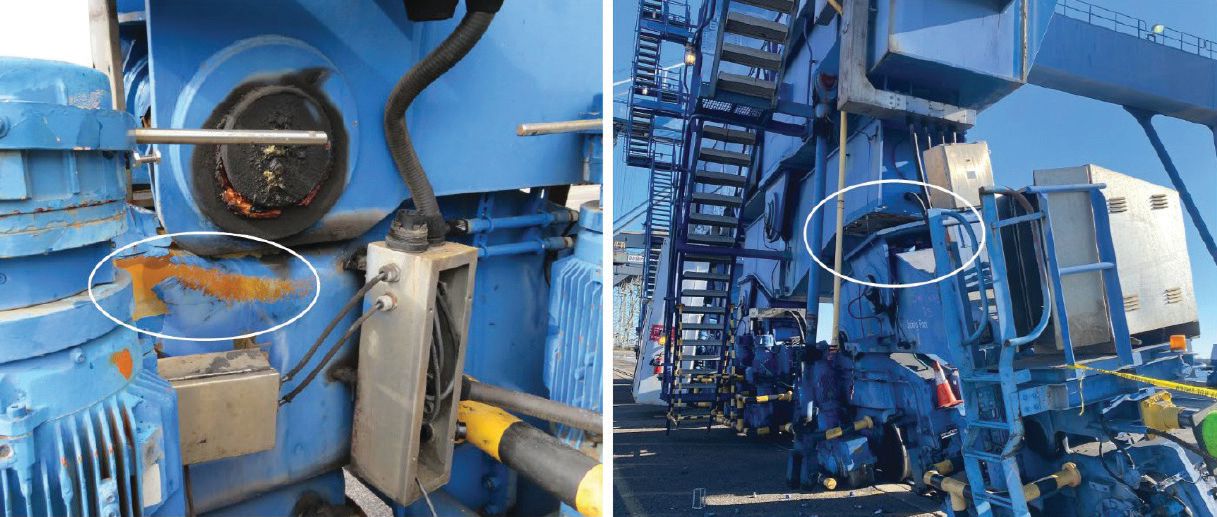
The contact caused the STS crane to twist along its vertical axis, damaging the crane and dislodging it from the pier’s gantry rail system. According to a damage assessment report, the damage to the crane included a “nearly complete wrecking” of the gantry assemblies at each corner, which compromised the crane’s stability; minor damage to the operator’s cabin; damage to the platforms and equipment at the boom tip where the contact occurred; and surface damage to the pier structure (see figure 4). The crane was deemed to be structurally unstable immediately following the incident, and it was subsequently relocated, stabilized, and stored for repairs. Repairs were completed in February 2025. Damage to the terminal’s crane was estimated to be over $4.5 million.
Probable Cause
The National Transportation Safety Board determines that the probable cause of the contact of the crane barge Stevens 1471 with a North Charleston Terminal ship-to-shore crane was the towing vessel mate not identifying that the ship-to-shore crane was an overhead hazard when he decided to maneuver the tow through a confined area between a dredge and a vessel conducting cargo operations.
Lesson Learned:
Ship-to-shore Cranes May be an Overhead Hazard Ship-to-shore cranes, when conducting cargo operations on a vessel and in the lowered position, may extend considerably beyond the side of the vessel and become a hazard to vessels with high air drafts transiting nearby. Mariners should always consider their vessel and tow’s air draft when identifying hazards to navigation.