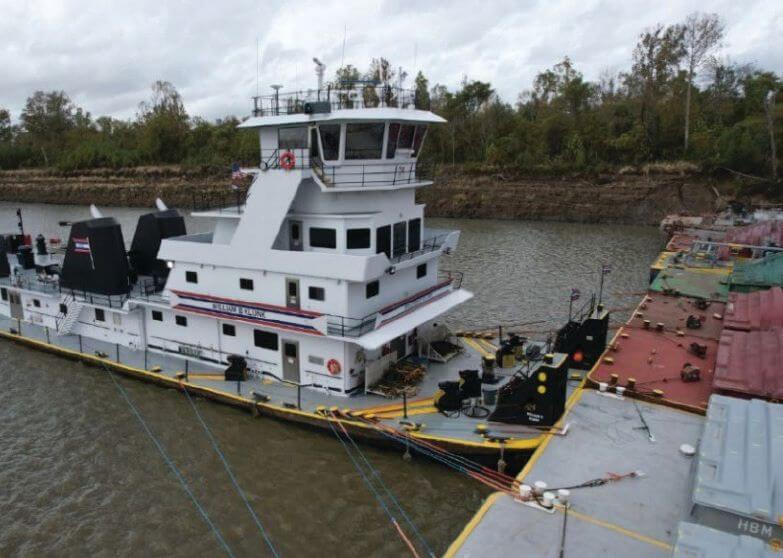
On April 17, 2024, about 1655 local time, the towing vessel William B Klunk was pushing 22 barges downbound on the Lower Mississippi River at mile 227, near Baton Rouge, Louisiana, when the tow collided with moored barges at a fleeting area (see figure 1 and figure 2). Thirteen barges broke away from the William B Klunk tow, and three barges broke away from the fleeting area, resulting in damage to the barges, a fleet crew boat, and two mooring dolphins. There was one minor injury, and no pollution was reported. Total damages were estimated to be $810,000.
Background
The William B Klunk was a 170-foot-long towing vessel constructed of steel by Quality Shipyards in Houma, Louisiana, in 1998. The vessel was operated by American Commercial Barge Line and was primarily used to transport barges on the Mississippi River.
Two 4,000-hp diesel engines, each driving a fixed-pitch propeller through a reduction gear, provided propulsion. Two rudders, one positioned behind each propeller, as well as flanking rudders positioned forward of each propeller, provided steering.
The William B Klunk operated under its company’s towing safety management system (TSMS) and had a valid US Coast Guard issued certificate of inspection documenting compliance with Title 46 Code of Federal Regulations Subchapter M.

Event Sequence
On April 13, 2024, the William B Klunk and tow departed from Cairo, Illinois, bound for Convent, Louisiana. The towing vessel was pushing 22 hopper barges loaded with dry cargo with a maximum draft of 12 feet on the barges and an overall tow length of 1,180 feet (see figure 2). Ten crewmembers were on board, including a captain, pilot, engineer, cook, and six deckhands. The captain and pilot alternated 6-hour wheelhouse watches. The captain was assigned to the 0500–1100 and 1700–2300 watches, and the pilot was assigned to the 1100–1700 and 2300–0500 watches.
On April 17, at 1050, the William B Klunk moored at a fleeting area near mile 237 on the Lower Mississippi River to take on supplies and to change pilots. At 1330, the oncoming pilot boarded the William B Klunk and relieved the departing pilot, assuming the ongoing 1100–1700 pilot watch. This was the oncoming pilot’s first time serving on board the William B Klunk (his normal vessel, the Capt Rodney E Stokes, was a sister vessel to the William B Klunk).
At 1440, the captain and pilot completed a voyage plan risk assessment covering potential hazards, including river conditions, weather, vessel mechanical condition, navigational hazards, and crew fitness for duty. In accordance with the operating company’s TSMS, the captain and pilot assigned a risk rating of green (minimum risk), amber (moderate risk), or red (high risk) for each item. Any item rated as moderate or high risk required them to notify the port captain and implement mitigation strategies before getting underway. The captain and pilot rated all items as green and noted the upcoming bridge transits, “swift currents,” and “lots of traffic” as potential concerns.
The captain, who had previously worked on the Capt Rodney E Stokes, informed the pilot that the steering on the William B Klunk was “slower” than the Capt Rodney E Stokes’s steering (meaning the rudders would take longer to respond to the pilot’s inputs made in the wheelhouse). When discussing his fatigue level, the pilot told the captain that he had been awake since early in the morning to drive to meet the vessel, but that he had stopped along the way due to thunderstorms and was able to nap. The captain told investigators that, after his discussion with the pilot, he was not concerned with the effects of fatigue on the pilot’s ability to safely navigate.
Because the pilot had joined the vessel late in the day and the William B Klunk was over 6 hours ahead of schedule, the company port captain approved the vessel and tow to remain at the fleeting area until the captain began his next scheduled watch, at 1700. The captain told investigators that, while he felt that the pilot was fit for duty, he recommended that the pilot not get the tow underway during his first watch. The captain noted that it was ultimately the pilot’s decision, but that he assumed the pilot would remain at the fleeting area.
After completing the risk assessment, the captain departed the wheelhouse. The pilot remained in the wheelhouse, while the deckhands checked the tow wires on the barges. He told investigators that he felt no pressure to depart the fleeting area and that he “was in a good state to leave the fleet and successfully transit.”
At 1530, the pilot got the William B Klunk underway and proceeded downriver. At 1625, he received a call on the company phone, or “boat phone,” from a company safety officer. To take the call, the pilot turned the volume on the VHF radio down “a little bit” but noted that he could still hear the radio. On the call, the company safety officer informed the pilot that he violated the company’s dress code upon joining the vessel (he was wearing shorts) and was going to be written up.
About 1635, the lead deckhand, or leadman, joined the pilot in the wheelhouse to introduce himself. When the leadman entered the wheelhouse, the pilot was still on the phone with the company safety officer. The pilot told investigators that the call was “every bit of 15 minutes” and ended several minutes after the leadman got to the wheelhouse. The leadman told investigators that the pilot was awake and alert but seemed “flustered” from the phone call.
After the phone call, the pilot turned the VHF radio volume up and heard a New Orleans-Baton Rouge Steamship Pilots Association (NOBRA) pilot on an upbound, 597-foot-long chemical and oil products tanker, Pennsylvania (draft of 29.9 feet), hailing him to propose a passing arrangement. At this time, the William B Klunk was about 1 mile north of the Interstate 10 bridge.
The NOBRA pilot on board the Pennsylvania told investigators that he and an apprentice pilot had been attempting to contact the William B Klunk pilot for about 15 minutes with no response. During this time, the NOBRA pilot observed the William B Klunk “swing towards the Baton Rouge side [of the river]” and then “towards the [Interstate 10] bridge,” and that “something was out of the ordinary.”
Initially, the pilot on board the Pennsylvania intended to propose a port-to-port arrangement but instead proposed a starboard-to-starboard passing, to which the William B Klunk pilot agreed. The NOBRA pilot preferred the starboard-to-starboard passing arrangement because he “didn’t like the way [the William B Klunk] was positioned.”
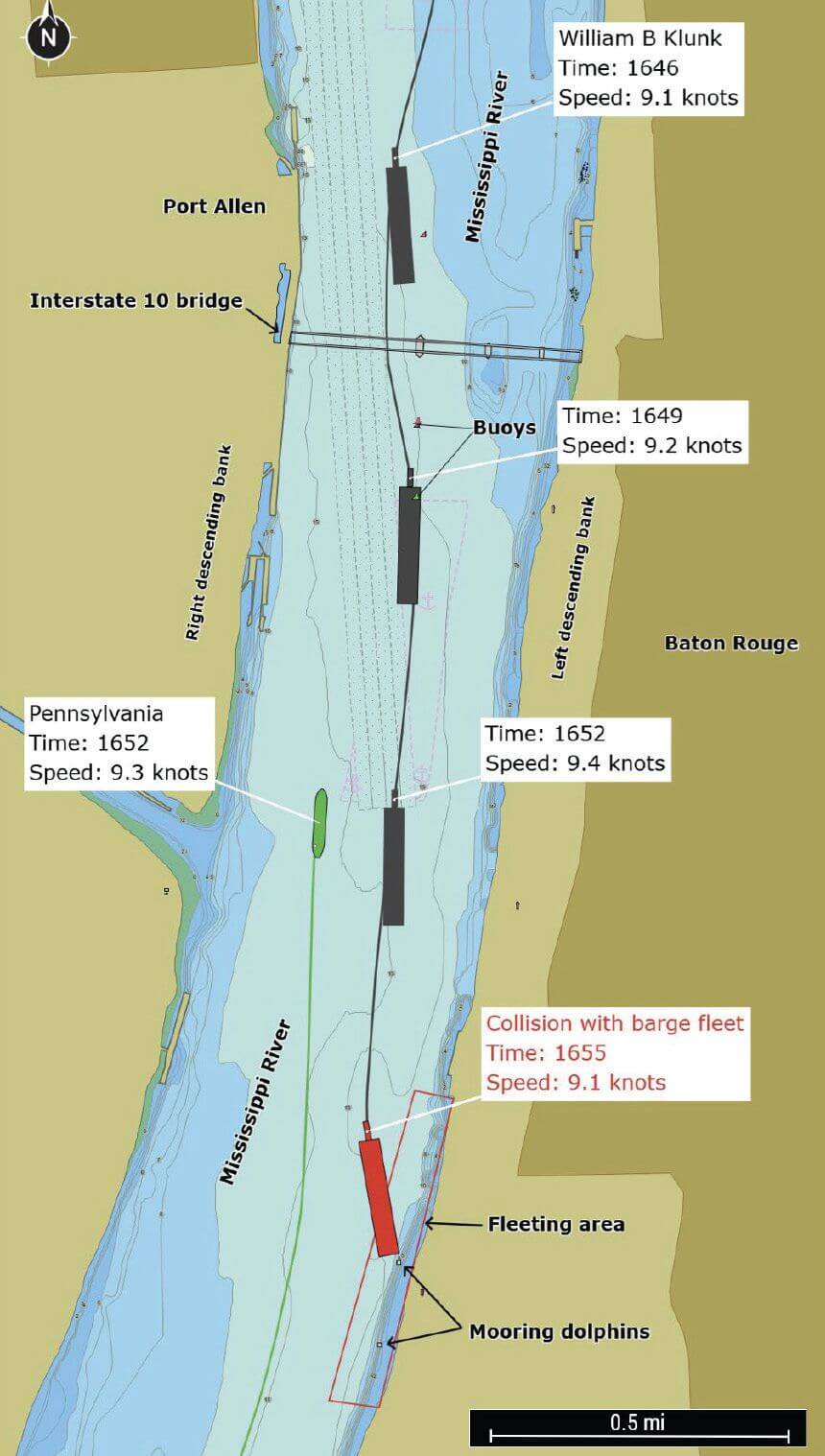
About 1647, the leadman was still in the wheelhouse as the William B Klunk transited under the Interstate 10 bridge (see figure 3). As the tow approached the bridge, the leadman told investigators, “The way he was set up, it didn’t look right to me,” and that, as the tow went under the bridge, it was pointed directly at two buoys on the downriver side of the bridge. When the leadman asked the pilot about the buoys, the pilot told the leadman that the tow would “slide” off them. Shortly after, both the leadman in the wheelhouse and the NOBRA pilot on board the Pennsylvania observed the barges contact the buoys. The leadman noted that the William B Klunk pilot did not say anything or otherwise react after contacting the buoys. Shortly afterward, the leadman departed the wheelhouse. At 1648:43, the onboard image recorder system positioned over the wheelhouse operating console showed the pilot move the steering tillers for the stern rudders to midships; the recorder system also captured the rudder angle indicator for the stern rudders responding to the pilot’s input. About 1651, the William B Klunk and tow began to swing to port, toward the left descending bank, and, about 1 minute later, automatic identification system (AIS) data showed the William B Klunk pass the upbound Pennsylvania starboard-to-starboard. (The inland towing industry refers to the shorelines of Western Rivers as the left and right banks when traveling downriver. The left bank is called the left descending bank, and the right bank is called the right descending bank.) The pilot did not make any additional steering or throttle inputs. For the next several minutes, the onboard image recorder system showed the pilot moving in the wheelhouse, and, about 1654, the pilot was holding a cell phone with the screen illuminated.
At 1654:38, the onboard image recorder system showed the pilot move the steering tillers for the stern rudders to starboard; the rudder angle indicator responded to the pilot’s inputs. About 15 seconds later, the pilot pulled the throttles back toward neutral before moving them astern. The captain was exiting his stateroom to report for his scheduled 1700 watch when he noticed that the tow was pointed “directly into a fleet no more than a couple hundred feet [away] … [with] no change in engine speed.” At 1655, another onboard image recorder system pointed toward the head of the tow showed the lead barges in the William B Klunk tow colliding with three moored barges (two hopper barges and one container barge) at a fleeting area on the left descending bank. The captain felt the impact and went to the wheelhouse.
The tow continued into the fleeting area, pushing the container barge it had just struck. At 1655:46, the pilot activated the general alarm. The pilot later told investigators that about this time he believed that the William B Klunk had lost steering and went to the steering control panel located in the aft part of the wheelhouse to resolve the issue. The pilot “turn[ed] the knob once, and then back to its original position,” but recalled that he “didn’t really know what it would do.” At 1656:37, the onboard image recorder system in the wheelhouse showed that the rudder angle indicator for the stern rudders was not responding to steering inputs from the pilot.
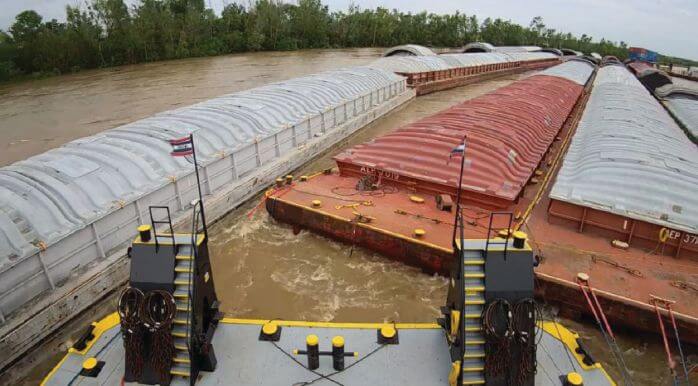
At 1657, the captain arrived at the operating console. About a minute later, the tow began to break apart (see figure 4). The captain took the helm from the pilot, and he noticed that the rudders were not responding to steering inputs. The captain radioed the chief engineer to notify him that the vessel had lost steering. The chief engineer advised the captain to switch to the other steering pump using the wheelhouse steering control panel. The captain relayed this information to the pilot, who switched to the other pump; steering was restored.
The captain remained at the helm and, with assistance from tugs in the area, secured the William B Klunk at the fleeting area. One crewmember who was on board the towing vessel Neil Martin at the fleeting area was injured during efforts to recover barges that had broken away.
Damage
The operating company reported damage to the hulls of two barges in the William B Klunk tow and to a safety stanchion on board the William B Klunk. Also, a section of tow wire had become lodged in the vessel’s port flanking rudder. A diver removed the wire the following day.
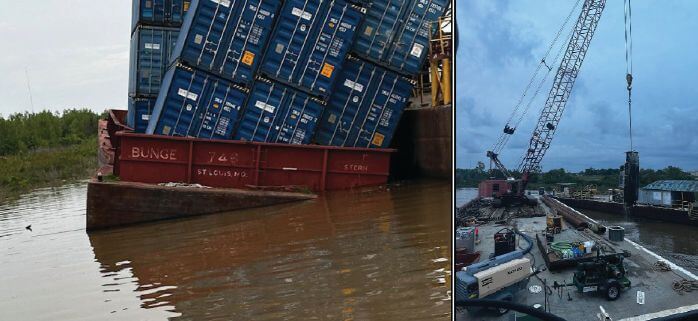
Three barges, a floating dock, a crew boat, and two mooring dolphins were damaged in the fleeting area. The container barge BUNGE 746, loaded with empty containers, was a total loss, and a fleeting area crew boat, Mr. Bubba, sank but was later recovered (see figure 5). Two mooring dolphins were destroyed. Total damages to the William B Klunk and tow, and the fleeting area (barges, floating dock, crew boat, and mooring dolphins) were estimated to be $810,000.
Personnel
Before joining the William B Klunk, the pilot had been off for 28 days. He was notified on April 15 that he would be meeting the William B Klunk in Baton Rouge on April 17 to serve as pilot for 1 week. The pilot reported getting 7–10 hours of sleep each night from April 13–15, and that he maintained a typical awake and sleep cycle. On April 16, the pilot woke up at 0600 and went to sleep at 2000. On April 17, the day of the casualty, he woke up about 0030 to drive from his home in Tennessee to Baton Rouge. When talking about the night before the casualty, the pilot told investigators that he “obviously didn’t have any sleep that night.”
Per the operating company’s TSMS, crewmembers were required to report on board “fit for duty,” which included being “well-rested” and cautioned commuting crewmembers to “be aware of the potential for fatigue.” Commuting hours were not counted toward work/rest hour limitations prescribed in the operating company’s TSMS. The crew dispatcher who coordinated the pilot’s travel to Baton Rouge reserved him a rental car for the drive, and, in accordance with the TSMS, because the drive was over 150 miles, the dispatcher asked if he needed a hotel, but the pilot declined.
The captain told investigators that, in the moments after the collision, the pilot seemed “confused” about what had happened, was “unable to communicate effectively,” and was “overly concerned” and “angry” about the earlier call from the company safety officer. About 40 minutes after the collision, the pilot left the wheelhouse to sleep and did not wake up for his scheduled 2300 watch. The captain attempted to wake the pilot at 2315, 2330, and 2350, but was unsuccessful. The captain ultimately decided that the pilot was unfit for duty and requested a relief pilot from the company port captain.
In addition to the call from the company safety officer on the boat phone, the pilot told investigators that he used his personal phone to send text messages throughout the transit, and that he also made a phone call. Investigators reviewed the onboard image recorder system footage from the wheelhouse, which showed intermittent cell phone use by the pilot throughout the 1.5-hour transit. The recorder system footage also showed that the pilot was using his personal cell phone about 40 seconds before the collision at 1655.
The operating company’s TSMS contained a section titled “Maintaining the Watch,” which discussed the use of company and personal cell phones while on watch. The section stated, “Watch Officers are strictly prohibited from using personal or company cell phones, computer, or any PED [personal electronic device] to make personal calls, send or receive personal text messages or e-mails, or access the internet other than for business purposes while operating the vessel.”
The operating company investigated the casualty and found that the pilot was using his personal cell phone just before the collision and was distracted. According to the operating company’s investigation report, the pilot did not make any steering inputs for about 6 minutes before the collision.
Probable Cause
The National Transportation Safety Board determines that the probable cause of the collision of the towing vessel William B Klunk and tow with moored barges was the William B Klunk pilot becoming distracted due to cell phone use in the minutes leading up to the collision. Contributing was the pilot’s fatigue due to limited sleep the night before the casualty, which decreased his attentiveness and vigilance while operating the vessel.
Use of cell phones and other personal electronic devices by on-duty crewmembers in safety critical positions has been a factor in casualties and accidents in all transportation modes. Using cell phones can be visually, manually, and cognitively distracting. Use of cell phones, including company cell phones (particularly for nonoperational conversations), should never interfere with a watchstander’s primary task to safely navigate a vessel and maintain a proper lookout. To reduce the risk of cell phone distraction, operating companies should establish protocols regarding both personal and work-related cell phone use, and vessel personnel should understand the importance in following them.