A Technical Bulletin of FEMA and the National Flood Insurance Program

This 2019 guide explains the importance of using corrosion-resistant metal connectors and fasteners in the construction of coastal structures, areas using preservative-treated lumber, and any locations subject to contact with floodwater or windblown rain.
Post-disaster assessments of wood-framed buildings following natural hazard events such as high winds, floods, and earthquakes have revealed that structural failures frequently occur at connections rather than in framing members. In coastal areas, where higher moisture and humidity levels exist and buildings are exposed to salt spray, corroded metal connectors and fasteners have been observed to contribute to the loss of an adequate load path. The loss of an adequate load path often results in damage to or failure of the structure.
This article—Part 1 of a three-part series—presents guidance on addressing and avoiding the corrosion of connectors and fasteners.
Selecting Proper Connectors and Fasteners for a Continuous Load Path
Buildings are exposed to numerous forces (loads), including those associated with wind events, floods, snow accumulation, and earthquakes. For a building to survive exposure to such forces, loads must be transferred through the building’s structure to the soils that support the building along what are typically referred to as load paths. Load paths consist of structural elements (e.g., beams, columns, bearing walls) and the components that connect these elements. In light-frame construction, structural elements are often connected with metal connectors and fasteners (fasteners include screws, bolts, and nails). Examples are shown in Figure 1.
Metal connectors are pre-manufactured components that are usually cut from flat steel sheets and formed into a shape to efficiently transfer loads from one structural element to another. The load capacities of metal connectors, often determined by the manufacturer through testing or analysis, are published for use by design professionals and contractors to meet the load requirements for their project.
Metal connectors and fasteners are important elements in transferring loads from natural hazards (e.g., flood, wind, seismic) through a building. Corrosion rates for metal are dramatically higher in coastal environments than in less harsh, non-coastal environments. Therefore, it is important to increase the corrosion protection for metal connectors and fasteners in coastal environments. Studies have shown that stainless steel and thick hot-dip galvanized (G185 or higher) metal connectors and fasteners improve corrosion protection. Selecting metal connectors and fasteners made of the same metal and either hot-dip galvanized or stainless steel will improve performance.
Regardless of the metal that is selected, routine inspection is important to identify when replacement is necessary.
Preservative-treated lumber, which is commonly used in many buildings, requires special attention when selecting connectors and fasteners.
Light Gauge Metal Connectors and Corrosion
The term “light gauge metal connectors” is used in this Technical Bulletin to highlight the importance of corrosion protection for lighter gauge connectors such as the prefabricated connectors that are used to facilitate wood connections. However, metal connectors fabricated from thicker steel will also benefit from this guidance.
Light gauge metal connectors are commonly used in several locations throughout wood-framed buildings. Concrete and masonry structures may also use them. Although light gauge metal connectors are not unique to wood-framed buildings, this Technical Bulletin highlights aspects of using them in wood-framed buildings in areas where corrosion can occur.
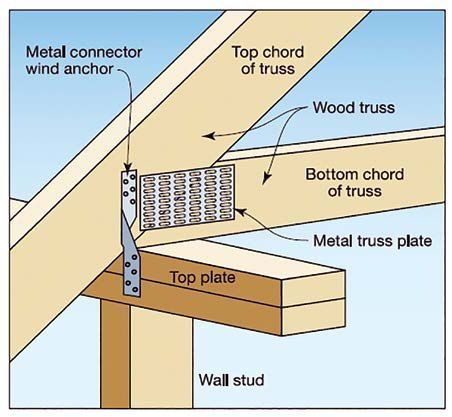
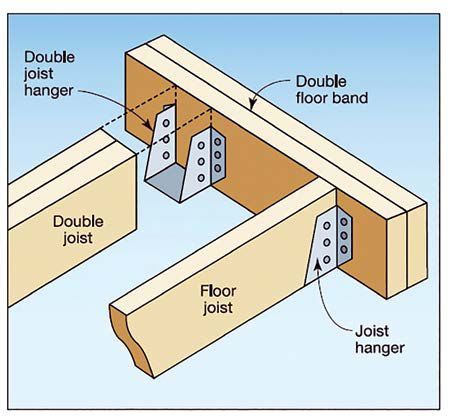
Light gauge metal connectors are often used to create a load path by securing roof framing to the tops of load-bearing walls, connecting walls of upper floors to lower floors, and connecting walls to foundations. The selection of the type of metal connector to use for specific applications may be dictated by the building code or may be based on the relative ease a type of connector offers in making complex framing connections. Metal connectors such as wind anchors may be used instead of toe-nailed connections to increase the strength of connections of a roof truss to a top plate (see Figure 2). In some cases, such as when attaching floor joists to floor band joists, metal connectors can both improve the connection and also reduce labor costs (see Figure 3). In some portions of a building’s load path, light gauge metal connectors can make the connection several times stronger than a connection that is readily achievable by nails alone.

Despite the benefit of being stronger than nails alone, light gauge metal connectors have drawbacks in coastal environments. Metal connectors that are prone to corrosion can lead to load path failures and structural damage during natural hazard events. The following are examples of important metal connectors potentially subject to corrosion:
• Hurricane straps and wind anchors used to connect roofs to walls (see Figure 2);
• Truss plates that connect the members of pre-manufactured roof and floor framing systems;
• Joist hangers used on floor joists (see Figure 3), beams, and rafters;
• Other metal connectors such as those used to improve lateral load resistance.
Reprinted from Marine Construction Magazine Issue I, 2023