In the early 17th century, shortly after the Dutch established the trading post at the southern tip of Manhattan island that would become the capital of their New Netherland colony, they built a fort at the southern tip of the island. A few decades later, a British fleet laid siege to the island and the Dutch surrendered the island to their trading rivals in exchange for other colonies.
The first artillery battery at the site was installed by the British in 1683. After the American Revolution, the Americans demolished the fort and used the materials to expand the open space that became known as The Battery.
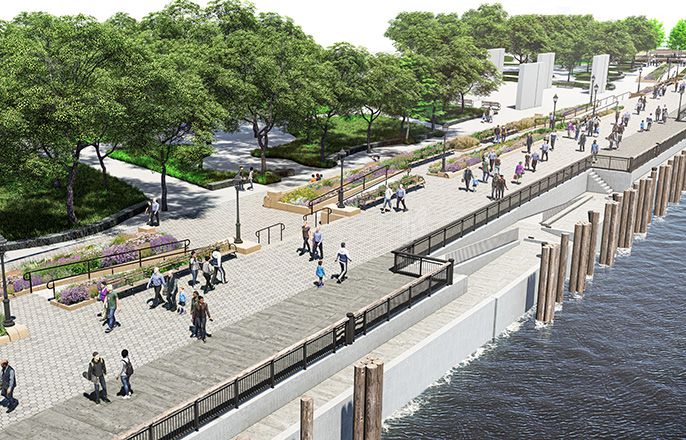
Today, parts of The Battery are again being demolished and the materials used to fortify the site against a new threat — rising sea levels.
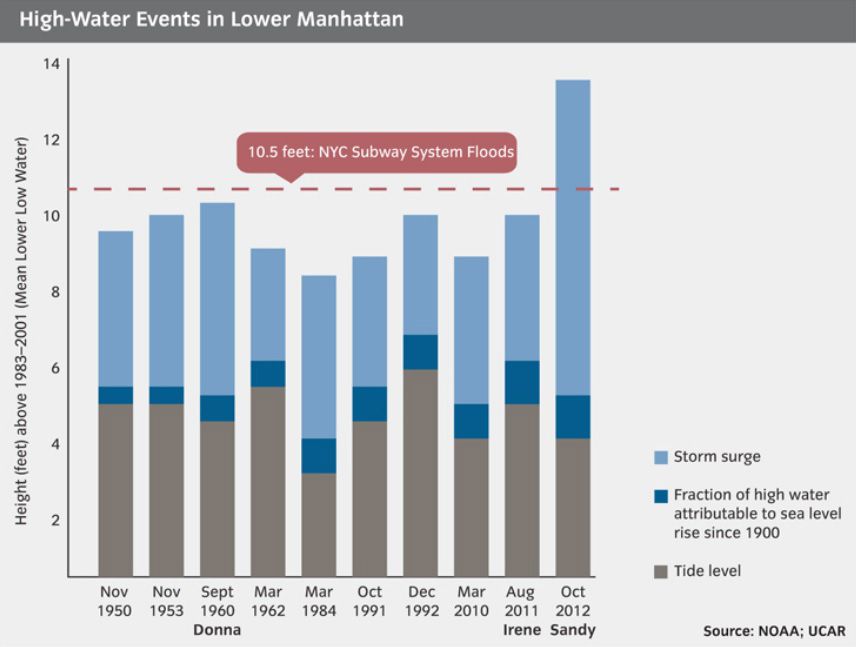
Hurricane Sandy, the largest Atlantic hurricane on record, struck New York City on October 29 and 30, 2012.
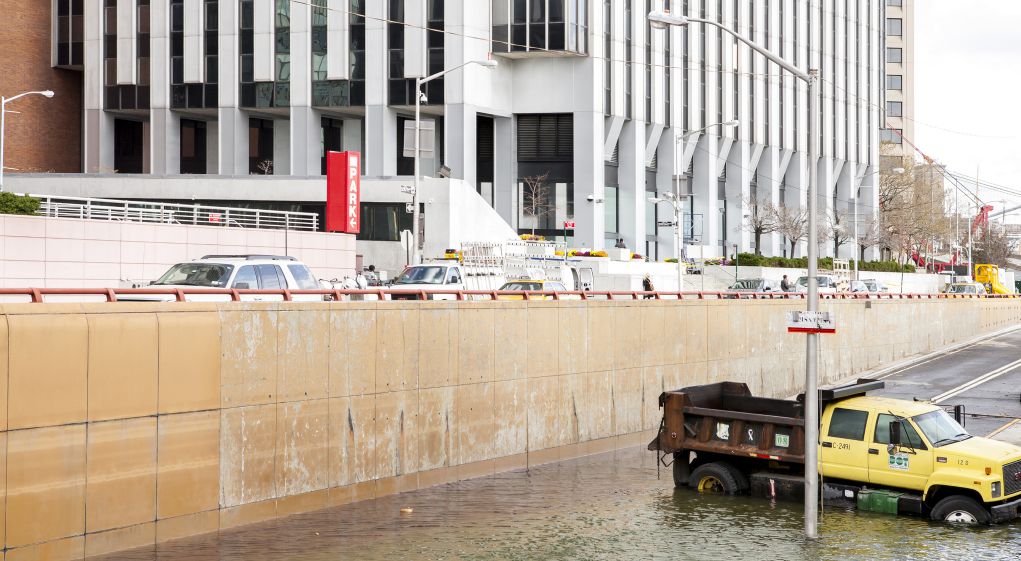
The storm killed at least 43 people in the city. Flooding and fire destroyed thousands of homes and businesses. Flooding in Lower Manhattan closed the subway system and all of the road tunnels entering Manhattan (except the Lincoln Tunnel, which was further north). The economic losses were estimated at $19 billion.
After several years of study, the New York City Economic Development Corporation (NYCEDC) and NYC Parks, in conjunction with the Mayor’s Office of Climate and Environmental Justice (MOCEJ) and the non-profit The Battery Conservancy, developed the Lower Manhattan Coastal Resiliency project (LMCR).
Although a wide range of protections and mitigations will eventually protect the entire southern tip of Manhattan, a critical component of the project is rebuilding The Battery’s waterfront.
There were many challenges in the planning to increase The Battery’s resilience to floodwater, said Matt Paquet, the senior project manager with the Walsh Group, a construction company working with LMCR prime contractor Hunter Roberts Construction on the waterfront portion of the LMCR project.
“Accommodating the number and variety of stakeholders involved in this project – DOT, TBTA [Triborough Bride and Tunnel Authority], MTA [Metropolitan Transit Authority, which runs the New York subway system], as well as The Battery Conservancy – was a challenge,” Paquet said. “All the agencies that touch The Battery had something to say about what was going to be done, whether on a technical level or on an aesthetic level.
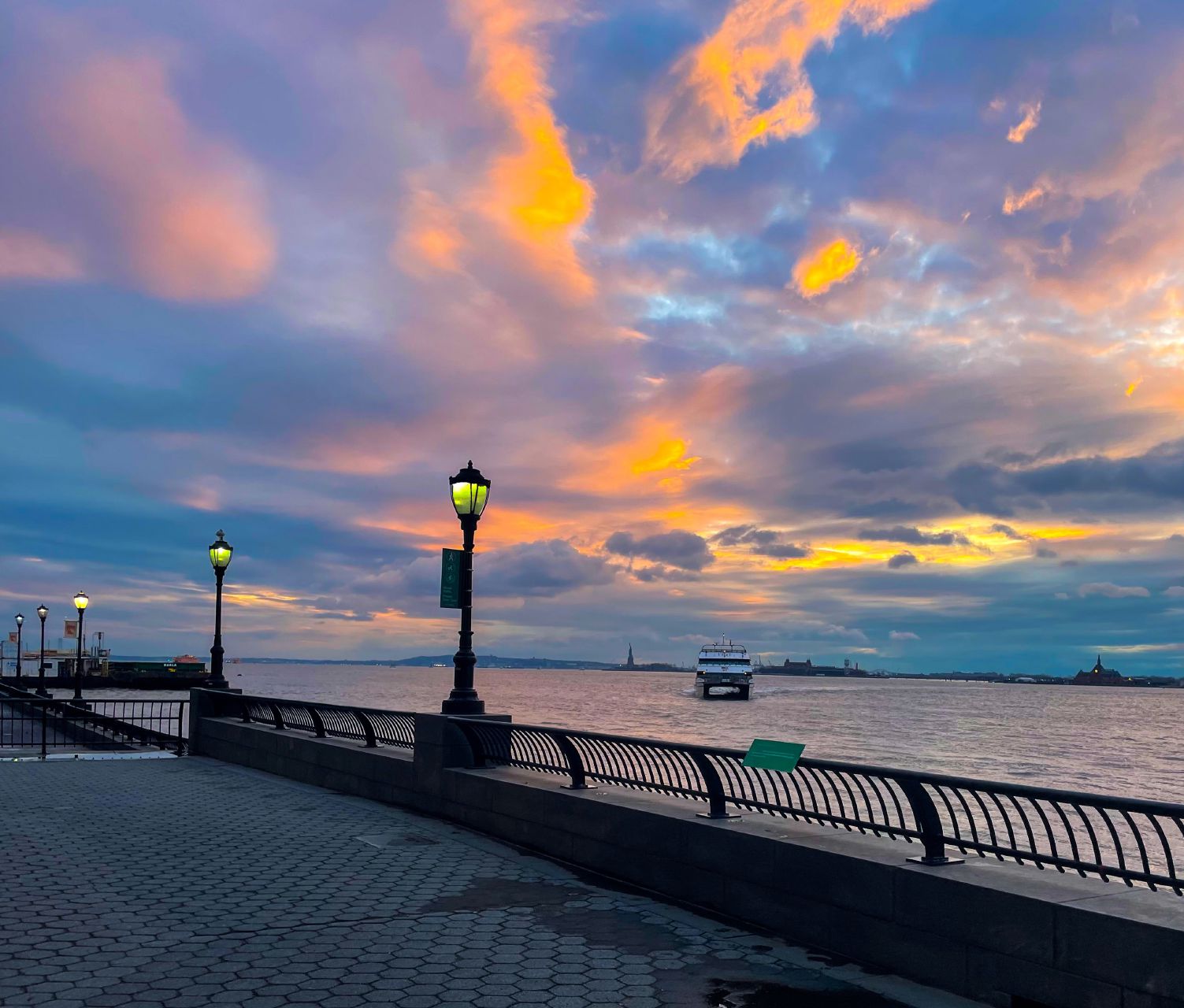
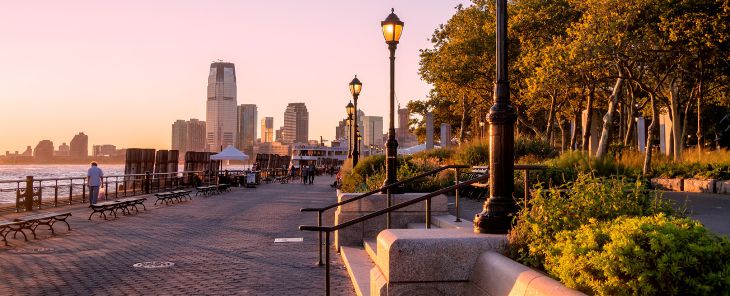
“In the end, there was a meeting in the middle between being fully resilient to the projected sea level rise in the year 2100 versus maintaining the current commercial uses and aesthetics,” Paquet continued. “We needed to upgrade the functional uses of the wharf for the ferry service to Liberty Island while maintaining the views that are so cherished, views of the harbor and the Statue of Liberty that would have been eliminated if we had just come in and said ‘this is what we need to do to protect the flood plain.’ We would have lost a lot of the character of the area by looking at it from just that perspective.”
The final design of the project was completed in late 2022 and preconstruction/exploratory work was completed in 2023. Reconstruction of the wharf and seawall were planned in two phases to minimize disruption of the park and ferry services. Work on Phase I began in 2024 and is expected to be completed ahead of schedule by this summer. Phase II will begin once Phase I ends.
CLIENT: New York City Economic Development Corporation
LEAD DESIGNER: Stantec Consulting Services, Inc.
CONTRACTOR: Hunter Roberts Construction Group, New York, N.Y
SUBCONTRACTOR: Walsh Group, Little Falls, N.J.
PROJECT COST: $200 million
PROJECT TIMELINE: Phase I will be completed by Summer 2025; Phase II will begin at the completion of Phase I.
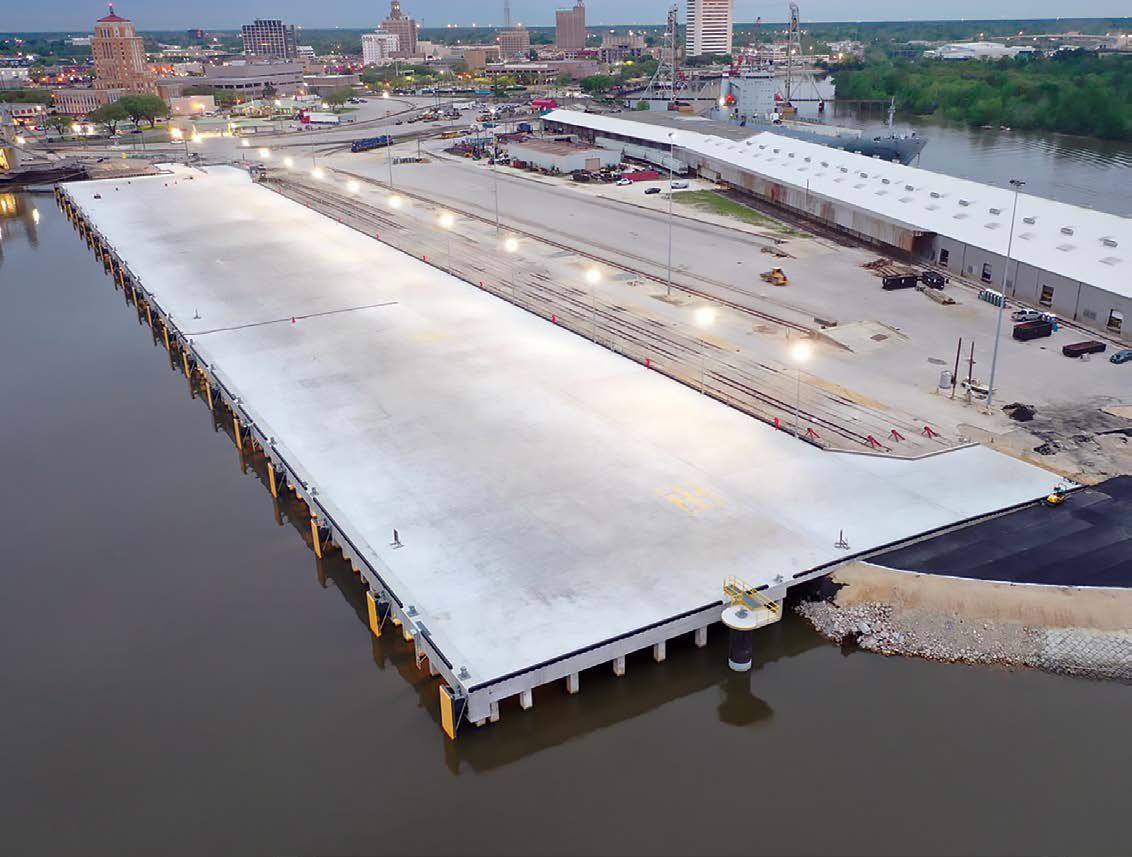
“We’re a few months away from completing Phase I, which is the two-thirds of the Battery waterfront on the west side,” said James Nocito, the project executive for Hunter Roberts who specializes in waterfront resiliency and marine construction. “We’ve done wholesale demolition of the existing wharf, moving it back about 40 feet, and then putting a backwall of sheet piles that serves as a cutoff wall during the temporary addition, and then building a new wharf at a higher elevation that includes driving 220 sticks, precast concrete and friction piles. Then we added pile cap and beam, superstructure, ultimately with precast elements. All in all, it’ll raise the wharf and the waterfront esplanade it supports five feet above the original elevation.”
A key part of the planning was looking into the feasibility of digging up and reusing the granite fascia of the wharf that dates back to the 19th century. Nocito said that even though it was a technically and physically challenging part of the seawall renovation, the many-faceted benefits made it worthwhile.
“We’re enrolled in the Institute for Sustainable Infrastructure’s Envision program, and this is the first project in Manhattan to receive a platinum verification award,” Nocito said. “A big part of that endeavor was reusing not only the granite fascia for the wharf but also the stone in the upland park features. Reusing the existing fascia granite was a very difficult task. To have it removed, we had to do some feasibility studies upfront to understand what we were working with, eliminate as much risk as possible, and making sure we had the right people taking it out of the ground and putting it back together at the end of the day.
“The design intent was to closely mimic what the historic wharf looked like, but on a higher elevation,” Nocito continued. “That involved re-facing the granite and cutting the pieces to size. but it was a big part of maintaining the historical use and character. The historic granite will be placed at the loading and berthing slips. Passengers will be able to actually touch and feel the granite as they’re walking toward the boat. They’ll be touching a piece of history.”
Residents of and visitors to New York City won’t be the only the ones to experience the rebirth of one of America’s first maritime trading ports.
“It’s an amazing project to be a part of,” Nocito said. “It has very high optics—millions of people can see the cranes and work. And all of us on the job will leave our mark on history.”
Lower Manhattan
THE BATTERY COASTAL RESILIENCY PROJECT
The Battery Coastal Resiliency Project is part of the Lower Manhattan Coastal Resiliency (LMCR) Project.
The Battery Coastal Resiliency Project will rebuild and elevate the wharf promenade in The Battery, staying true to the character and uses of the park while elevating it out of the projected sea level rise in the year 2100. The project will address the following design goals:
- Reconstruct the deteriorating wharf
- protect The Battery from rising seas over the next 80 years
- Accommodate passenger ferry uses
- Preserve and enhance park character and gardens
- Design for universal accessibility to create a welcoming and accessible esplanade
- Protect the park’s historic and cultural resources
The Battery Coastal Resiliency project will integrate two layers of protection: an elevated waterfront edge to mitigate risks from sea level rise and future storm surge protection built on higher ground. Together, the Project and adjacent resiliency efforts form a coordinated set of coastal protections that maintain the uses and character of the park today, while providing protections for storm events in the future.