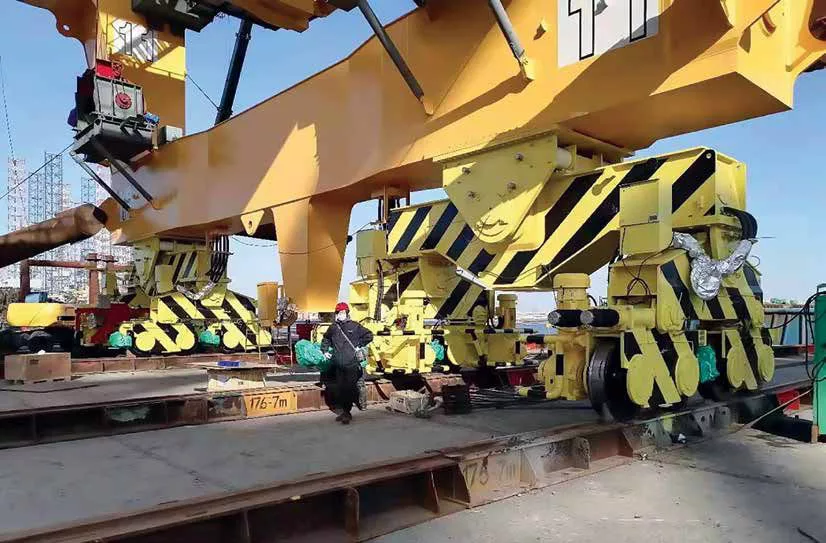
A revolutionary seismic isolation system provided by Casper, Phillips & Associates Inc. (CPA) has been installed on two quayside container cranes for the first time this year.
The crane base anti-seismic isolation system (BASIS) is built on non-linear time history analysis (NLTHA) and can protect the crane main structure from damage even in contingency level earthquakes. BASIS has been successfully installed and commissioned on two cranes that are in a major seismic zone in Turkey. The cranes, installed at Asyaport, have a 100-foot (30.48m) gantry span, 223-foot (68m) outreach, 66-foot (20m) back-reach, and 152-foot (46.3m) lifting height above the gantry rail.
CPA, which has been utilizing NLTHA for research and engineering projects since 1991, offers a wide variety of heavy-duty industrial services, including procurement, specification, design, manufacturing review, modification, and accident investigation. BASIS is installed between the sill beam and main equalizer beam, about 13 feet (4m) to 16 feet (5m) from ground level, depending on the crane’s size. It includes two friction damper assemblies, two energy restoring device assemblies, a guiding device, and two friction damper locking devices.
Mike Zhang, the head mechanical engineer at CPA, said: “The initial container crane isolation system that we developed included dampers in both gantry travel and trolley travel directions. [NLTHA] analysis revealed that the base shear in the gantry travel direction varied within only 5 percent between a crane with a seismic isolation system and a crane without it. However, in the trolley travel direction, the base shear is significantly reduced by incorporating our seismic isolation system. Therefore, to reduce costs while maintaining a high level of effectiveness, our final seismic isolation system is designed to operate only in the trolley travel direction.”
Zhang, who has co-authored a white paper on the BASIS concept with Jeffery Hubbell, the head structural engineer at CPA, explained that ports located in seismic zones and crane manufacturers are both taking note of the system. Typically, he said, the ports specify the seismic requirements, while the crane manufacturers propose the isolation system. The port then makes the final decision on the proposed purchase.
Aerospace proving ground
This type of friction damper was used extensively at the Boeing commercial aviation factory in Everett, Washington, about 20 years ago. The same type of dampers were tested on a ship-to-shore (STS) crane in 2020.
STS cranes have historically been designed for 0.2g static horizontal acceleration in major seismic areas. This is adequate for lighter Panamax or Post-Panamax container cranes with a gantry rail gauge less than 80 feet (24m). However, for Super Post-Panamax size or larger cranes with 100 foot. (30m) or wider gantry rail gauge, the crane may be seriously damaged or even collapse in a major earthquake event. These cranes can be subjected to more than 0.6g lateral acceleration in the trolley direction even during a moderate earthquake.
The friction dampers are manufactured by the Canadian company, Quaketek, the restoring device is based on a Conductix-Wampfler buffer, while the mounting base and system assembly are provided by the crane manufacturers. BASIS, which received a Chinese patent in 2018, can thusly be installed on new cranes or as part of a seismic upgrade of existing cranes. To verify the effectiveness of the system for different sizes of quayside cranes, CPA teamed up with Dalian Huarui Heavy Industry Group Co. Ltd. (DHHI) engineers. Zhang added: “There are alternative crane seismic systems on the market, but BASIS outperforms them. The friction damper does not slip under normal operations, so the structure maintains the same dynamic and static stiffness as a crane without the seismic device. During a hurricane, when the tie-downs are engaged, the seismic system can be locked to prevent the dampers from slipping. We have also developed a special stowage pin assembly that can accommodate the crane movement during an earthquake, even during a microburst or storm wind when there are no tie-downs engaged. Also, the same profile damper can be set at a different sliding force to accommodate various cranes and seismic zones.”