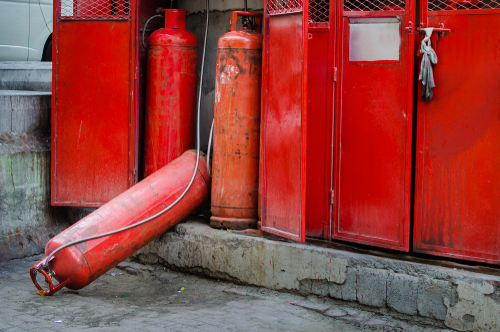
Cylinders typically contain oxygen or gas, which means they are susceptible heat. For this reason, all compressed cylinders will be stored in an upright position, capped when not in use, and chained securely to prevent them from accidentally tipping over or being knocked over. Cylinders must also be stored away from heat sources.
Gas cylinders in portable service should be conveyed by suitable hand trucks to which they are securely fastened, or safely carried where job conditions require. All gas cylinders in service shall be securely held in substantial fixed or portable racks, or placed so they will not fall or be knocked over.
Valve protection caps, when provided for, should be put in place before cylinders are moved, transported or stored.
Gas cylinders raised or lowered by crane, hoist, or derrick must be handled in suitable cradles, nets, or skip boxes, and shall never be lifted by magnet or by rope or chain slings.
Cylinders should never be placed where they might form a part of any electric circuit.
No attempt should be made to transfer acetylene from one cylinder to another, or to mix gases in a cylinder.
Oxygen cylinders in storage shall be separated from fuel-gas cylinders or combustible materials (especially oil or grease), a minimum distance of 20 feet or by a noncombustible barrier at least 5 feet high having a fire-resistance rating of at least one-half hour.
Cylinders shall be kept far enough away from the actual welding or cutting operation so that sparks, hot slag, or flame will not reach them. When this is impractical, fire resistant shields shall be provided.
LP-Gas vessels used for roofer’s tar pots, plumber’s pots and torches, space heaters, etc., shall be so installed that heat from the burner will not increase the temperature of the tank more than 10 degrees Fahrenheit after one hour of operation of the burner at full capacity.
LP-Gas vessels installed on mobile equipment shall have the bottom of the container, and/or any outlet connection, not lower than the lowest horizontal edge of the vehicle axle when fully loaded. Such units shall be adequately secured to prevent jarring loose, slipping, or rotating.
The cylinder valve shall be opened slowly to prevent damage to the regulator. For quick closing, valves on fuel gas cylinders shall not be opened more than 1 1/2 turns. In the case of manifolded or coupled cylinders, at least one such wrench shall be available for immediate use. Nothing shall be placed on top of a fuel gas cylinder, when in use, which may damage the safety device or interfere with the quick closing of the valve.