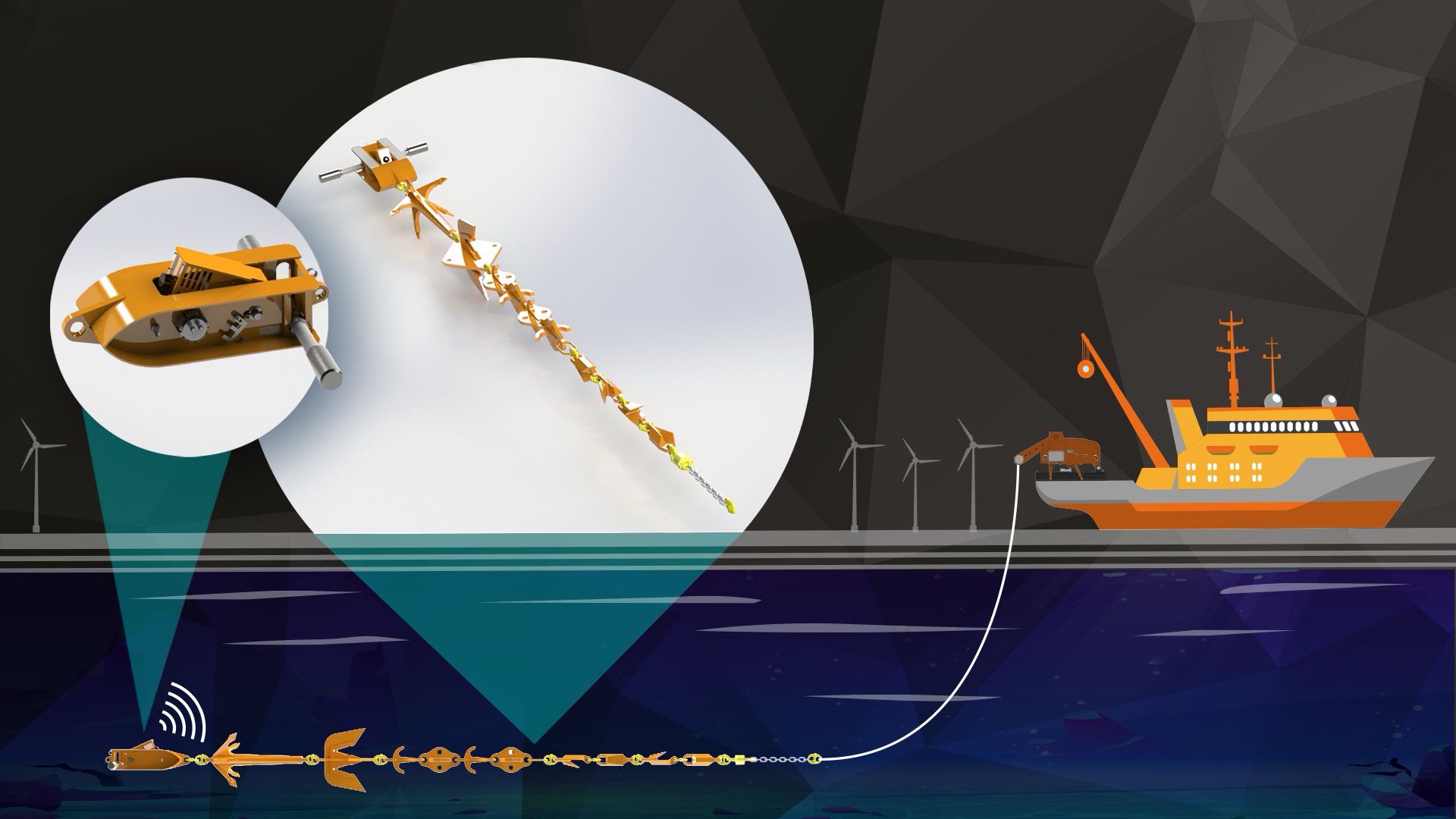
Dynamic Load Monitoring has launched a new Acoustic Positioning Grapnel – the Stingray – that sends a signal to a vessel towing a grapnel train.
DLM, a Nursling, Southampton, UK company, provides design, manufacture, repair and calibration of load cells, load monitoring, and cable working equipment for the wind energy, renewables and telecommunications sectors. It has steadily grown its grapnel range, used for recovering lightweight, fiber optic or heavier-duty armored cables on the seabed. The products are used by subsea cable-lay companies and ship operators for pre-lay grapnel run (PLGR) and route clearance operations.
Stingray, which gets its name from being relatively flat and moving along the seabed, can be connected in the grapnel train and uses acoustics to send a signal to a vessel towing the train to communicate where it is on the seabed. It is positioned at the rear of a train of multiple grapnels attached together and towed behind the vessel when a PLGR is being undertaken. It is located the furthest away from the ship’s stern.
Stingray is 1,343 mm long and 308 mm high with the beacon closed; with it open, it is 473 mm high. The main body is 500 mm wide and, depending on what type of stabilizer is fitted, it is 900mm or 1,500mm wide. While there is only one body size, there will be options in that customers will be able to fit different sized stabilizers to suit deployment chutes. There will also be the ability to fit different manufacturers’ ultra-short baseline (USBL) beacons to meet the client’s preferences and what receiver is already fitted onto the vessel. The acoustic grapnel is manufactured from high-strength structural steel and covered with a special marine paint.
Van Oord tests, uses Stingray
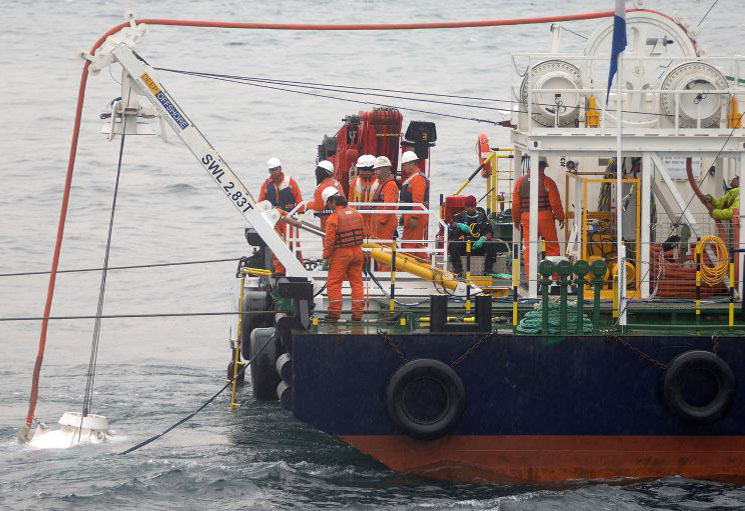
Stingray was conceptualized during a project being completed by international marine contractor Van Oord, a longtime user of DLM’s load cells, load monitoring equipment, and grapnels. The company was involved in one of two sea trials of the product, following prototyping and testing. Van Oord needed to ensure an accurate grapnel location at all times and didn’t want to utilize a remotely operated underwater vehicle (ROV).
Prior to any such works, a survey is conducted to determine what is on the seabed, including any obstructions that need to be cleared. The type of seabed (sand, clay, or rock, etc.) can also be investigated to decide on the type of grapnels to be used. A PLGR operation is conducted where the grapnels are towed behind a vessel and the route where the cable is going to be laid is effectively cleared of obstructions and debris, along with perhaps grappling and recovering out-of-service cables, ready for the cable lay operations to commence afterwards.
Halford explained, “There have been instances in the past where an operator is grappling for an out-of-service cable that needs to be recovered and removed from the seabed. The operator would position the vessel at what is believed to be 90 degrees to the cable and then the operator would move the vessel forward to grapple for the cable. If this fails because the vessel is in the wrong location in relation to where the cable is, then the process needs to be repeated at extra time and cost. Having an ROV and the related equipment required to launch one of these onboard the ship incurs much larger cost than the Stingray system.
“We are increasingly being asked for a device that does exactly what the Stingray does — especially if [the PLGR] is in a tight corridor, where perhaps it is critical that the grapnels do not wander, due to the locality of pipelines or other no-go areas.”
DLM continues to develop smart grapnels, fitted with radiofrequency identification (RFID) chips from RiConnect, a cloudbased Software as a Service (SaaS) provider. While Stingray doesn’t have RFID, it can be fitted with a DL-3.0 data logger, which is able to log the movement of the product against time using its onboard microelectronic mechanical systems (MEMS) sensors.
Stingray is available to be purchased or sourced as a rental asset.