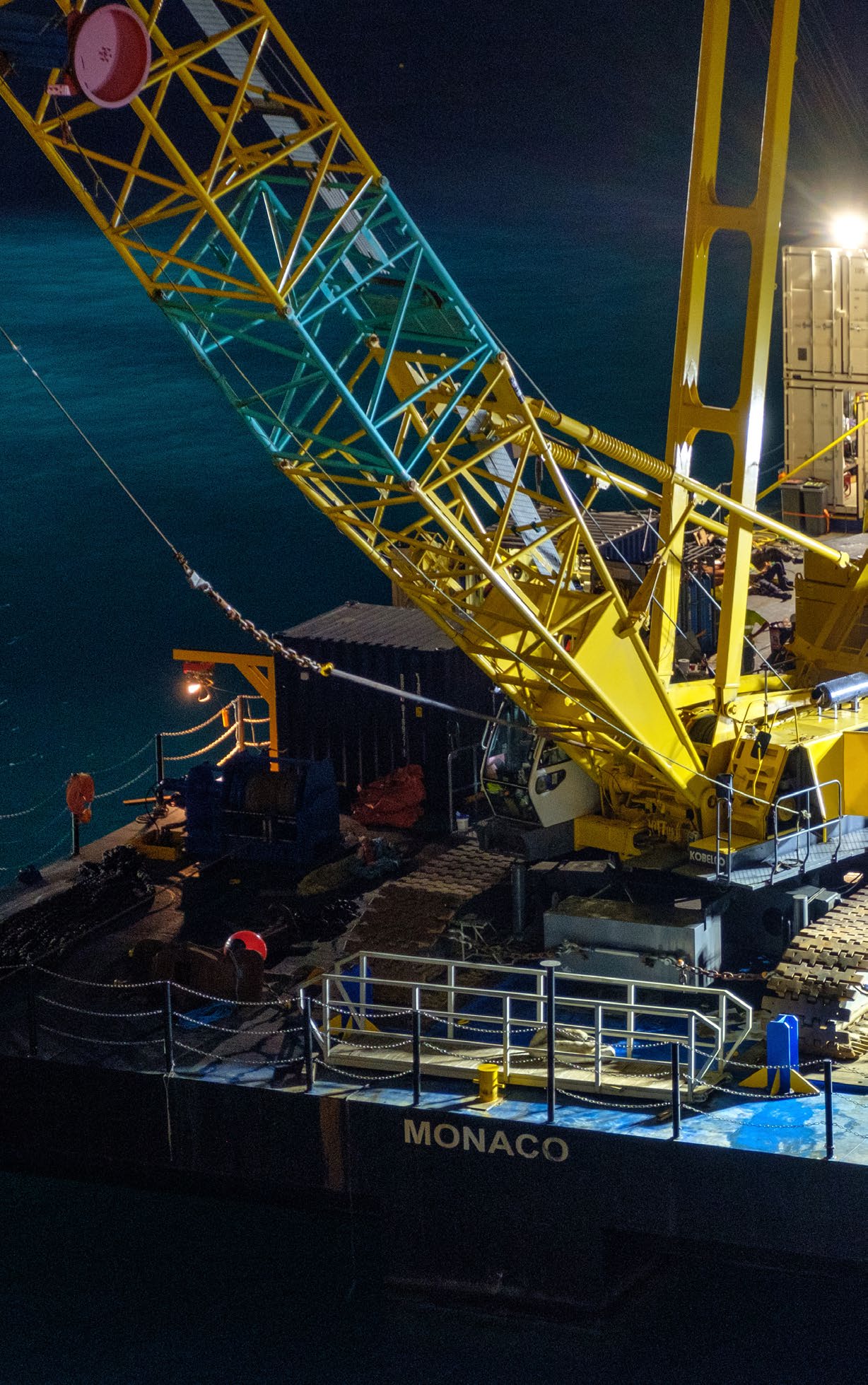
When pile drivers are working over water, all relevant precautions for work over water should be taken in
accordance with this code and in particular a suitable boat should be kept readily available at all times.
More specifically…
- All members of floating pile driving crews should be trained to handle boats.
- Floating pile driving rigs should be provided with a whistle, siren, horn or other effective signaling equipment.
- Floating pile driving rigs should be provided with adequate fire-fighting equipment.
- The weight of machinery on a floating pile driving rig should be evenly distributed so that the deck of the installation is horizontal.
- Steel barge hulls should be divided into watertight
compartments. - Watertight compartments should be provided with siphons
for the removal of water seepage. - Barge deck hatches should have firmly fastened covers that
fit flush with the deck. - Sufficient sheaves should be provided on the barge deck to
enable the crane or pile driving rig to be safely maneuvered
in any direction and safely secured in position. - Regular headcounts should be taken of the pile driving
crewmembers.
During lifting operations, the stability of the floating crane/
derrick or vessel with an auxiliary shipboard crane shall meet
the USCG requirements for “Lifting”.
The load rating of a floating crane/derrick shall be the
maximum working loads at various radii as determined by the
manufacturer or qualified person considering list and trim for
each installation. The load rating shall specifically reflect the:
design standard; machine trim; machine list; and dynamic/
environmental loadings anticipated for the operational
envelope of the floating crane/derrick or auxiliary shipboard
crane.
The load rating is dependent upon the structural competence
of the crane or derrick, rope strength, hoist capacity, structural
attachment to the floating platform, and stability and freeboard
of the floating platform.
When deck loads are to be carried while lifting, the situation
shall be analyzed for modified ratings.
When mounted on barges or pontoons, the rated loads
and radii of land cranes and derricks shall be modified as
recommended by the manufacturer or qualified person. The
modification should always be evaluated by the qualified
person specific to the floating platform mounting the crane.
Load charts should be generated based on the crane load rating
for floating service. In addition, the load charts for floating
service must comply with the specific standard it was designed
for and clearly explain the floating platform and dynamic/
environmental parameters that apply to the load chart.
The load chart should, at a minimum, identify the following:
-
- Draft limits (with deck cargo considered)
- Vessel motion limits
- Vessel and crane list/trim limits, and
- Vessel condition (e.g., dry bilges, watertight integrity, etc.).
- Crane manufacturer Notes, or reference to them.
Safe Working Load Chart with: - Mode of operation
- Environmental limit
- Capacity (net or gross)
- Load, boom elevation, radius (with list/trim considered), and Crane configuration, such as:
- Boom length
- Amount of counterweight
- Parts of wire, and
- Block size.
Cranes and Derricks Mounted on Barges or Pontoons:
Barge- or pontoon-mounted land cranes require modified
ratings due to increased loading from list, trim, wave action,
and wind. This rating will be different for each size of pontoon
or barge used. Therefore, the load rating of barge or pontoonmounted
land cranes and derricks shall not exceed that
recommended by the manufacturer for the particular barge or
pontoon under the expected environmental conditions.
All deck surfaces of the pontoon or barge shall be above the
water. Tie-downs should be provided for derricks to transmit the
loading to the barge or pontoon. …and finally, all Cranes shall
be blocked and secured to prevent shifting.
As with any Marine Construction project, safety comes first!