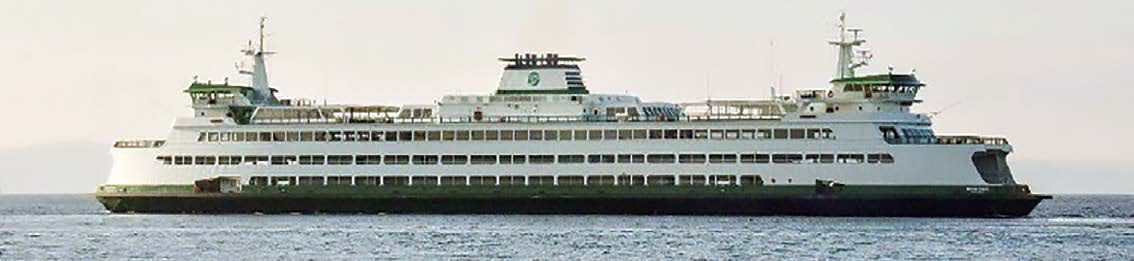
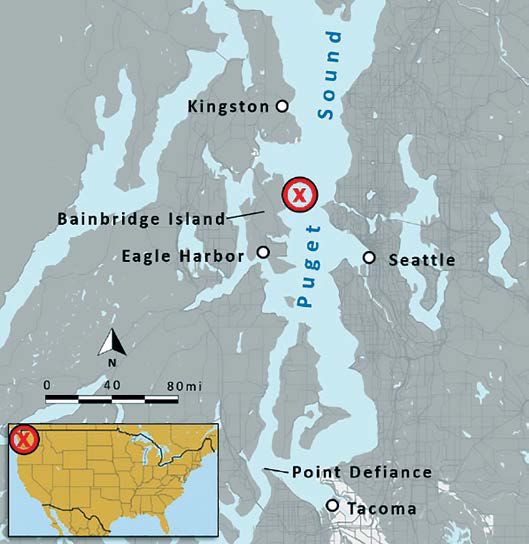
On April 22, 2021, about 1330 local time, the no. 3 main engine aboard the passenger and car ferry Wenatchee suffered a mechanical failure during a sea trial in Puget Sound near Bainbridge Island, Washington. The failure led to the ejection of components from the engine and resulted in a fire in the no. 2 engine room. The crew isolated the space, and the fire self-extinguished before it could spread throughout the vessel. There were 13 crewmembers aboard and no passengers. No injuries or pollution were reported. Damage to the Wenatchee was estimated at $3,790,000.
BACKGROUND
The Wenatchee, a 460-foot-long, steel-hulled passenger and car ferry, was built in 1998 and operated by Washington State Ferries (WSF). The 3,926- ton vessel had a service capacity of 202 automobiles and was certified to carry 1,812 persons. The Wenatchee was inspected under Title 46 Code of Federal Regulations Subchapter H, which applies to passenger vessels of greater than 100 gross tons. The ferry’s run was typically between Seattle and Bainbridge Island.
The diesel-electric vessel was powered by four EMD 710 series diesel engines, each driving a 4,160-volt AC generator. The generators supplied electrical power for both the main propulsion motors and the electrical system for other vessel services. The vessel was double ended—it had identical wheelhouses, engine rooms, and propulsion systems at each end. This allowed the vessel to approach and depart the terminals without turning around. Main engines nos. 1 and 2 were located in the no. 1 engine room, and main engines nos. 3 and 4 were located in the no. 2 engine room. The vessel’s propulsion was provided by two fixedpitch propellers, one at each end of the vessel, with each propeller shaft powered by two electric drive motors.
In November 2020, the Wenatchee was taken out of service for maintenance. The vessel was drydocked for hull inspection and painting, various steel repairs, propulsion shaft seal renewals, and repair of worn propulsion shaft bearings. During the maintenance period, the nos. 2 and 3 diesel engines, upon reaching operating-hour maintenance requirements, were overhauled by factory-trained technicians in accordance with manufacturer’s guidelines. The lead technician had nine years of experience, the other had five years of experience, and both were required to exhibit satisfactory performance while under peer review. The overhauls included renewal of power packs (16 cylinder heads, cylinder liners, connecting rods, pistons, and associated bearings), pumps, gears, and turbochargers, plus replacement of exhaust insulation blankets. According to their company, the rebuild was completed in standard fashion, and the technicians did not report any issues throughout the overhaul.
In February 2021, after the engine overhauls were complete, vessel crews conducted initial dockside engine break-ins. The nos. 2 and 3 engines were operated for specific time intervals, and bearing temperatures were recorded after each interval in accordance with original equipment manufacturer procedures. Later that month, on February 18 and 19, the engines were operated while renewing the vessel’s certificate of inspection. Shortly after starting the no. 3 main engine for the inspection, a lowlube oil pressure alarm and a low turbocharger-oil pressure alarm activated. Crewmembers stopped the engine, inspected the lube oil system, and found pieces of plastic in the lube oil system relief valve. Technicians were notified and returned to the vessel. They identified the plastic as parts of a cigarette lighter. The technicians drained the oil and searched the lube oil system for 2 days, recovering about 70% of the cigarette lighter’s plastic and metal components from the engine. After their debris removal efforts, the technicians advised WSF that it was acceptable to run the engine.
None of the engines were run again until the vessel made departure preparations for a sea trial in April.
A 1-day sea trial was planned for April 22 to verify functionality of all engineering systems, particularly the systems that had been affected in the shipyard. During the sea trial, the crew would monitor the four newly installed propulsion shaft bearings and shaft seals while operating at full power. They would also sequentially load the nos. 2 and 3 main engines for specific time intervals in order to condition the newly manufactured surfaces for rated power operations, ensure piston rings were seated sufficiently, and monitor engine performance. The engines were to be operated at idle (no load) for 35 minutes, at 25% load for 90 minutes, at 50% load for 75 minutes, at 75% load for 60 minutes, and at 100% load for 60 minutes.
EVENT SEQUENCE
At 0830 on April 22, after running all four engines at idle, the Wenatchee departed the WSF Eagle Harbor Maintenance Facility for the sea trial with all four engines and drive motors running. The planned route of about 50 miles for the sea trial in Puget Sound was to head south to Point Defiance after departing Eagle Harbor, then north to Kingston, and afterward south to return to Eagle Harbor.
Thirteen crewmembers were aboard the Wenatchee to conduct the sea trial. The deck crew consisted of a captain, chief mate, bosun, three deckhands, and one quartermaster. The engine crew was made up of four chief engineers and two oilers. The staff chief engineer, who had worked for WSF for more than 26 years and was normally assigned to the Wenatchee, was in charge of the engine department. Another chief engineer with 22 years of experience with WSF was assigned as an assistant engineer, and the two others, both with over 20 years’ experience with WSF, were observers. All the chief engineers had experience aboard this class of vessel.
While under way, the chief and assistant engineers typically remained in the Wenatchee’s engineering operating station (EOS), while oilers made frequent rounds of the machinery spaces, including the engine rooms and motor rooms. The no. 1 engine room was visible through a window in the EOS, and the no. 2 engine room’s center walkway was visible when the door connecting the two engine rooms was open. Both engine rooms had cameras that did not have recording capability. Neither engine room was equipped with a fire or smoke alarm system, nor were they required by regulations.
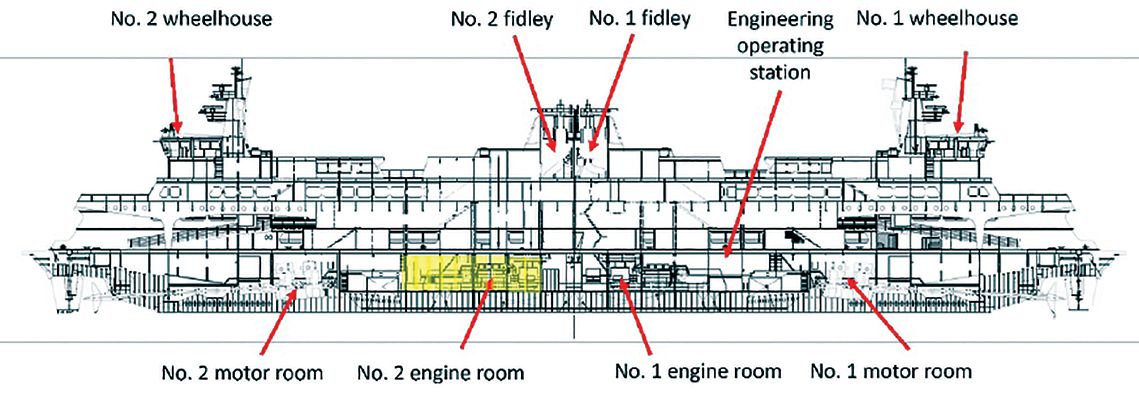
Shortly after departing the pier, engine loading according to the trial plan began at 25% as the vessel headed south toward Point Defiance. At 0955, the Wenatchee changed course, began traveling north, and, about 25 minutes later, the engine load was increased to 50%. Later, at 1135, the engine load was increased to 75%.
During the sea trial, engineers monitored the newly overhauled nos. 2 and 3 main engines; they did not notice any abnormalities, and no adjustments were needed. A crankcase high pressure switch activated for the no. 3 main engine at engine start up and remained active for the day, but an alarm was not visible or audible on the alarm monitoring system (AMS). (High crankcase pressure is an early indication of combustion gases passing into the engine sump, which could cause a crankcase explosion.) The actual crankcase pressure as read at the local gauge during the sea trial was within proper parameters, but the switch sent numerous notifications to a printer. (During the February 18-19 certificate of inspection renewal testing, the switch and alarm had functioned properly.)
At 1238, the vessel’s speed was increased to bring the engine loads up to 100% as the vessel headed south. A few minutes later, a drive motor tripped offline, and the crew found all its fuses blown. The vessel was slowed down for troubleshooting. The staff chief engineer determined further inspection was needed shoreside for the drive motor controller and requested to return to Eagle Harbor for investigation and repairs.
Using the three remaining propulsion motors, the engine loads were brought back to 100% as the vessel transited toward Eagle Harbor. At 1331, an oiler near the watertight door between the engine rooms observed white smoke in the no. 2 engine room near the no. 3 engine and saw “red glowing items that was just popping out of no. 4 [main engine].” He ran to the EOS, yelled to the other crewmembers that there was fire in the engine room, and shut down the no. 4 main engine from the EOS console. About the same time, he saw several alarms displayed for no. 3 main engine on the AMS, felt the vessel shake, and noticed the no. 3 main engine shutting itself down. Another crewmember in the EOS saw “fire, smoke, and debris flying everywhere.” On deck, several crewmembers felt the vessel shake and saw smoke rising from an engine room hatch that had been lifted by the sudden change in pressure, and the captain observed black smoke billowing from the stack.
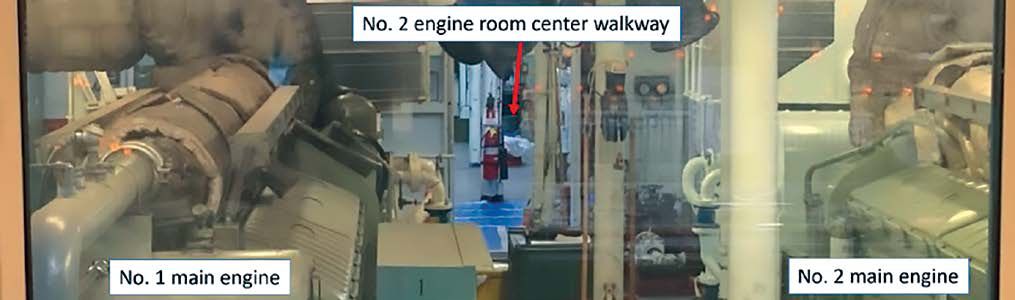
The captain used a handheld radio to communicate with crewmembers about the situation in the no. 2 engine room, since each crewmember had a radio, and no passengers were aboard. The general alarm was not sounded. Deck and engine crewmembers took action by starting a fire pump and stretching out hoses on the car deck. To isolate the no. 2 engine room from oxygen and fuel, crewmembers closed all watertight doors, stopped ventilation fans, closed ventilation fan dampers, and closed all fuel valves from tanks feeding the no. 2 engine room. Three deck crewmembers donned firefighting gear and reported to the car deck to monitor boundaries. Two engine crewmembers also donned firefighting gear, verified all hatches and doors were closed in the fidley (the space above a vessel’s engine room extending into its stack, usually comprised of grated decking that allows for ventilation), and monitored the boundaries for heat. Crewmembers estimated that isolation of no. 2 engine room took about 2–3 minutes, and several crewmembers stated that most of their monthly training drills were similar to this scenario.
The captain called the WSF Operations Center. The shoreside team activated an Incident Command System, and contacted the local Coast Guard, vessel traffic service, and fire department. The deck crew prepared the anchor in the event it was needed.
Engineers shut down the two propulsion motors in the no. 2 engine room, isolated the switchboard, and shifted the entire vessel’s electrical load and controls to the no. 1 engine room. One drive motor and one main engine remained online for limited propulsion. Firefighting water was not used, as fire teams reported boundaries to be cool to the touch, and other crewmembers observed the smoke to be dissipating as the fire extinguished itself. Based on this, engineers determined it was unnecessary to discharge the vessel’s fixed CO2 fire extinguishing system.
At 1350, the captain requested that the vessel be towed back to Eagle Harbor. About 30 minutes later, a Seattle fireboat arrived alongside, and two firefighters boarded the Wenatchee. The firefighters met with crewmembers in the EOS and observed the smoke to be dissipating in the no. 2 engine room. Two tugboats arrived at 1435 and began towing the Wenatchee toward Eagle Harbor. At 1447, the fire was reported out.
About 1630, Wenatchee moored at the Eagle Harbor Maintenance Facility. Firefighters from the Bainbridge Island Fire Department, a senior port engineer, and a marine chemist boarded the vessel, verified the no. 2 engine room was safe for entry, and entered the space with the staff chief engineer to assess the situation.
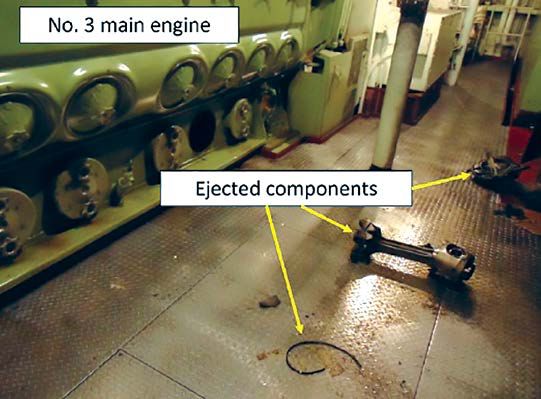
Engineers inspecting the affected engine room found a broken connecting rod, part of a piston, and an inspection cover laying on the deck outboard of the no. 3 engine. Inside the engine, part of the piston had fallen down and was resting on top of the crankshaft.
DAMAGE
The no. 3 main engine sustained damage to its block and required repairs to the block and a complete engine overhaul. The no. 4 main engine also required a complete engine overhaul due to internal contamination and damage sustained as a result of flames, combustion gases, and other debris that were ejected from the no. 3 main engine. Both engines’ attached electrical generators required cleaning and repairs. The control system for the no. 1 boiler required renewal. There was heat and smoke damage to the main switchboard, engine room cable runs, overhead insulation, and space coatings, which required cleaning, inspection, and some renewals.
POSTCASUALTY FORENSIC EXAMINATIONS
On June 30, 2021, an independent engineering firm began a failure analysis to determine the root cause of the no. 3 main engine failure. Engineers inspected the damaged engine aboard the Wenatchee and obtained information from crewmembers. Selected engine components were removed from the vessel and brought to their laboratory for in-depth examination and testing.
Engineers examined the lube oil system to determine if the cigarette lighter could have caused the engine failure. During the examination, parts of the lighter were found throughout the system, but no damaged surfaces, bearing damage, or clogged passages were found that “would suggest having been initiated to fail by physical contact with parts of the cigarette lighter.”
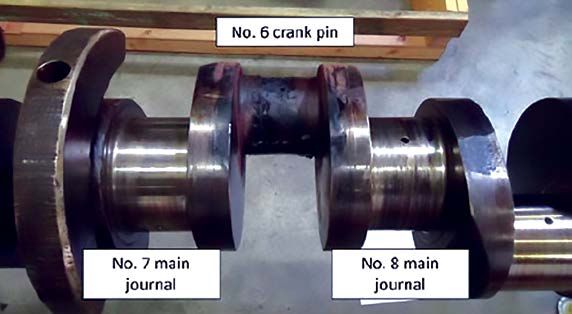
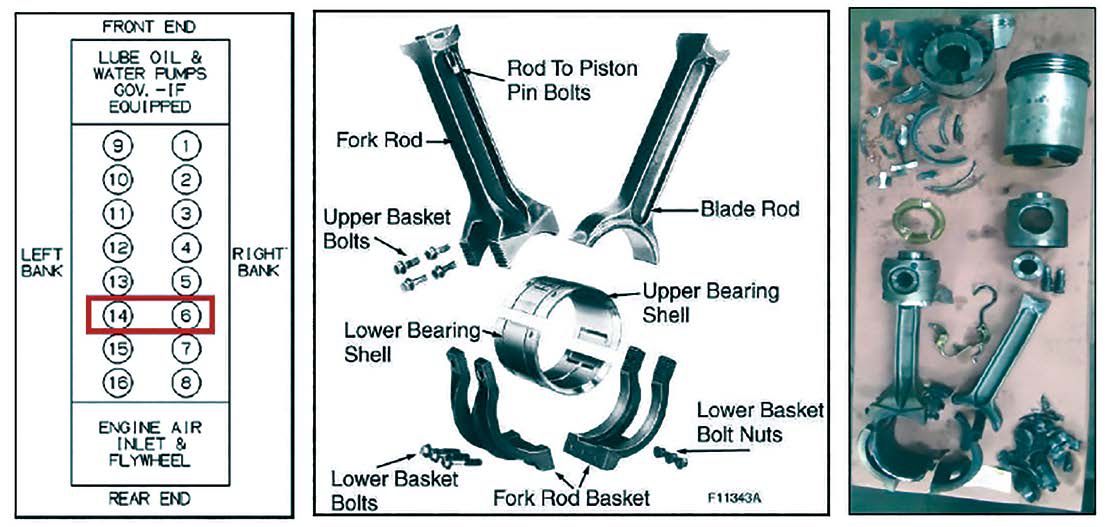
The ejected connecting rod, cylinder, and cover portion were determined to be from cylinder no. 14. Engineers examined the crankshaft and found the most severe damage in the area of the no. 6 crank pin, which was destroyed “with deep impressions of hard contact,” and its lube oil passage was plugged with “coked oil, ash, and metal shavings.” Adjacent to this crankshaft pin, the no. 8 main journal had “spun its main bearing shells and had undergone some material loss.”
Afterward, engineers examined each of the connecting rod and cylinder pairs throughout the engine. All were undamaged, except for the nos. 6 and 14 connecting rod and piston pair, which had been clamped to the crankshaft at the destroyed no. 6 crank pin. The pair (consisting of two connecting rods: one called a fork rod, and the other a blade rod) was determined to be in a “state of complete destruction,” with broken blade and fork rods (connecting rods) and basket, and also showed evidence of overheating. The four upper basket bolts (which clamp the connecting rod pair around the crankshaft pin) were found in position but deformed in a “manner consistent with overload.”
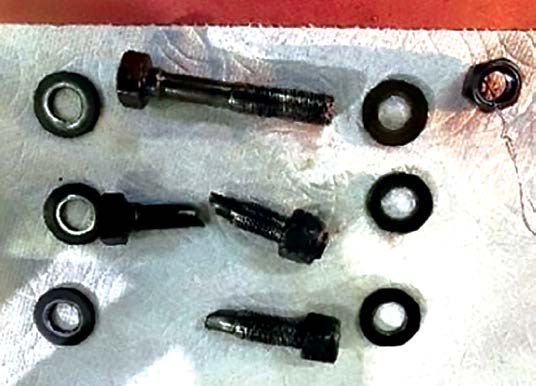
The three lower basket bolts were out of position; several damaged pieces of the bolts were found in the no. 3 engine’s oil pan. The bolts were examined, and engineers determined that two bolts were deformed and showed evidence of being pulled apart (tensile overload). The third bolt was found separated from its securing nut and relatively undeformed compared to the other two bolts.
Based on the condition of the third bolt, engineers determined that the nut had backed off (unfastened) while the engine was running. These nuts were required to be torqued to 75 foot-pounds during assembly using a torque wrench connected to a special extension tool that rotated the nut via a socket. Under magnification, engineers inspected the condition of the grooves on the lower basket nuts. Flattening was observed on properly torqued exemplar nuts but was not seen on the recovered nut that had unfastened from the no. 3 engine’s lower basket assembly, indicating the nut had not been properly torqued.
The report concluded that the root cause of the catastrophic engine failure was an “engine assembly error,” which occurred because one of the three nuts on the no. 14 fork rod lower basket had not been fully tightened. The bolt unfastened during operation, which caused the lower sections of the nos. 6 and 14 connecting rod and piston pair to become misaligned with the crankshaft. This misalignment caused the rod bearing to lose its oil film and resulted in a loss of lubrication in the lower bearing shells, generating severe heat and destroying the rod bearing shells of the no. 6 crank pin. The high temperatures were then transferred along the crankshaft, which thermally expanded, damaged nearby journal bearings, and caused the no. 8 journal bearings to be spun, generating more heat. Once all oil flow had ceased at the no. 6 crank pin and its rod bearing shells were destroyed, the no. 14 connecting rod broke and became deformed. The rotating parts of the engine struck the broken components and ejected part of the connecting rod and piston out of the engine through the lower inspection cover. As a result, hot pressurized crankcase gases were released into the engine room and ignited.
In a separate postcasualty examination, the crankcase high-pressure alarm sensor was removed from the no. 3 main engine and evaluated for proper operation. The sensor had activated when the engine was started for the sea trial and remained active for the day. However, the alarm was not visible or audible on the AMS before the engine failure. The sensor had been removed and reinstalled several times during the overhaul. The sensor worked properly when it was tested after the incident. It is unknown why an alarm did not activate on the AMS at any time before the engine failure.
POSTCASUALTY ACTIONS
WSF management reviewed the incident and concluded that the crew’s isolation and containment of the fire in the no. 2 engine room was timely and effective. They determined that communication was effective, propulsion was maintained as needed, electrical power was not disrupted, and there were no injuries. Further, the shoreside operations team center provided immediate support to the crew during the incident. The review did, however, identify some areas for improvement. To enhance communication and accountability, the report recommended that, in the future, crewmembers use all available means of communication during emergencies, including the general alarm, and ensure that all spaces remain isolated during a fire.
WSF provided several internal recommendations for their fleet, including a requirement for secondary verification for critical component installations, assemblies, measurements, cleanliness, and testing during maintenance and repair activities. Company management also updated their firefighting training module for vessel-specific firefighting training and increased emergency training drills using alternate communication systems. A video camera system with fire and smoke metrics was being designed and installed for the Wenatchee and other vessels in its class with the possibility of an additional recording system.
RELATED CASUALTIES
The NTSB has investigated other casualties caused by improperly torqued fasteners. In 2015, the cruise ship Carnival Liberty experienced an engine room fire when an inadequately torqued bolt on a fuel injection pump unfastened and triggered an uncontrolled fuel spray from a flange onto a hot surface of the running engine. The resulting fire caused over $1.7 million of damages to the vessel.
In 2016, the bulk carrier Nenita grounded following the failure of a main engine cylinder cooling jacket that impacted the vessel’s ability to maneuver; the condition of three of the four bolts removed from a cylinder’s cooling jacket indicated that they had been improperly or excessively torqued. Damage was estimated at $4 million.
In 2017, the offshore supply vessel Red Dawn suffered an engine failure after a connecting rod assembly came loose and separated from the crankshaft due to improper tightening (torqueing) of associated bolts during an overhaul. Damage to the vessel was estimated at nearly $1 million.
ANALYSIS
While the passenger and car ferry Wenatchee was conducting a sea trial in Puget Sound, the no. 3 main engine experienced a catastrophic failure after operating about 5 hours and being sequentially loaded up to 100% per the manufacturer’s recommendations following an engine overhaul by factory-trained technicians. Cylinder components were ejected from the crankcase, and hot pressurized crankcase gas was released and ignited, further igniting nearby equipment, and causing heat and smoke damage in the no. 2 engine room.
After the casualty, an independent forensic analysis determined the root cause of the engine failure was an inadequately torqued bolt on the nos. 6 and 14 cylinder’s fork and blade (connecting rods) lower basket assembly. The bolt unfastened while the engine was running, disrupted lubrication in this section of the crankshaft, and resulted in extremely high temperatures, which led to disassembly of the connecting rods and lower connecting basket assembly. After the broken engine parts were struck by rotating components in the engine, they were ejected from the crankcase through an inspection port.
The AMS indicated that no. 3 main engine shut down automatically, and the crew secured the adjacent no. 4 main engine located in the same engine room (no. 2). Upon feeling a sudden pressure change and observing smoke in the no. 2 engine room, the crew effectively isolated all fuel supplies, shut down engine room ventilation systems, and closed the space’s air dampers to starve the fire of fuel and oxygen—actions which successfully prevented the spread of the fire. The crew’s timely and effective response limited damage and prevented injuries. They extinguished the fire without putting crewmembers at risk by having to enter the space.
Additionally, the crew switched electrical and propulsion systems to the unaffected engine room no. 1 and maintained the vessel’s ability to maneuver.
PROBABLE CAUSE
The National Transportation Safety Board determines that the probable cause of the mechanical failure of the no. 3 main engine aboard the passenger vessel Wenatchee was a connecting rod assembly that came loose and separated from the crankshaft due to insufficient tightening (torqueing) of a lower basket bolt during the recent engine overhaul.
LESSONS LEARNED
Tightening of Fasteners
The NTSB has investigated several recent casualties that likely were caused by a failure to tighten fasteners on marine engines to the manufacturer’s recommended torque settings. Undertorqueing a fastener may cause excess vibration or allow the fastener to come loose, while overtorqueing may lead to failure of the fastener or the machinery component being secured. When installing fasteners, personnel should use a calibrated torque wrench, follow the manufacturer’s recommended tightening guide and torque values, and verify that all required torque requirements have been completed.
Containing Engine Room Fires
Engine rooms contain multiple fuel sources as well as mechanical ventilation, making the spaces especially vulnerable to rapidly spreading fires.
The crew of the Wenatchee effectively contained the spread of a fire by removing fuel and oxygen sources. Vessel crews should familiarize themselves and train frequently on machinery, fuel oil, lube oil, and ventilation shutoff systems to quickly act to contain and suppress engine room fires before they can spread to other spaces and/or cause a loss of propulsion and electrical power.