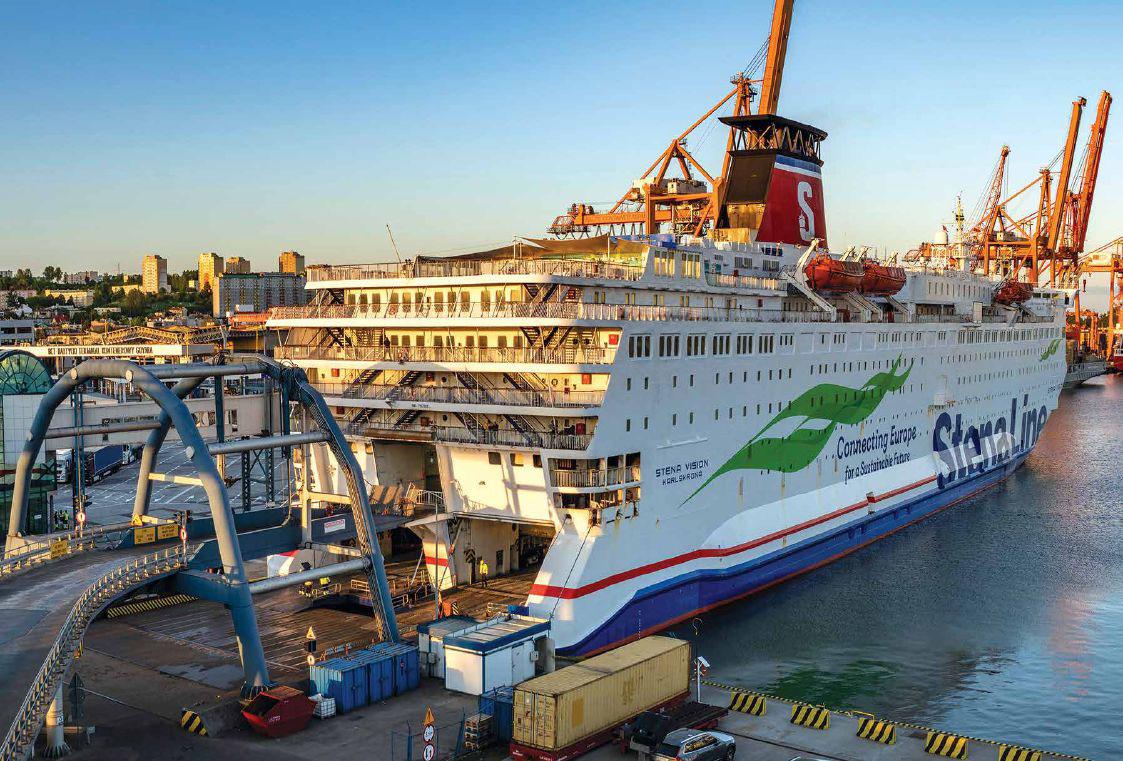
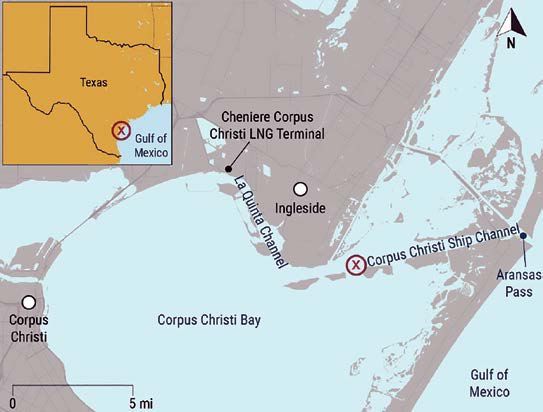
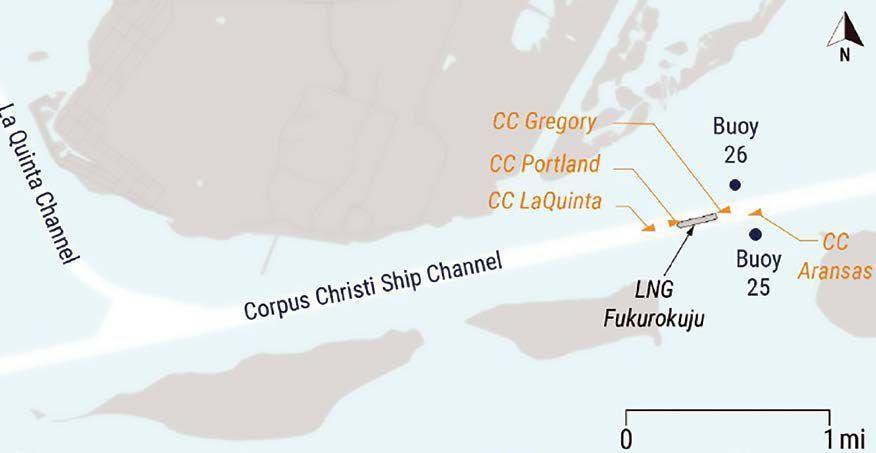
On August 7, 2022, at 1625 local time, the tugboat CC Portland grounded outside the Corpus Christi Ship Channel, near Ingleside, Texas, while repositioning to secure a tow line on the bow of the inbound liquefied natural gas carrier LNG Fukurokuju.
No injuries were reported by the five crewmembers aboard the CC Portland or the 27 crewmembers aboard the LNG Fukurokuju. An estimated 4–5 gallons of diesel fuel were released from a hull breach on the tugboat.
Damage to the CC Portland was estimated at $1.3 million.
BACKGROUND
Owned by CC Tugs LLC and operated by Edison Chouest Offshore LLC, the CC Portland was a 102.5-foot-long, U.S.-flagged, steel-hulled, inspected towing vessel constructed in 2018. The CC Portland, a tractor tug, was primarily used to escort inbound and outbound liquefied natural gas (LNG) vessels through the Corpus Christi Ship Channel and La Quinta Channel to and from the Cheniere Corpus Christi LNG Terminal in Corpus Christi, Texas. Two 2,240-hp diesel engines provided propulsion, each driving an azimuthing stern drive, or “Z-drive” with a fixed-pitch propeller. Each Z-drive was able to rotate 360° via integral hydraulic motors. This rotation, used in conjunction with the throttle inputs from the diesel engine driving the unit, allowed for variable thrust in all directions, eliminating the need for a rudder. The CC Portland was capable of speeds up to 13 knots.
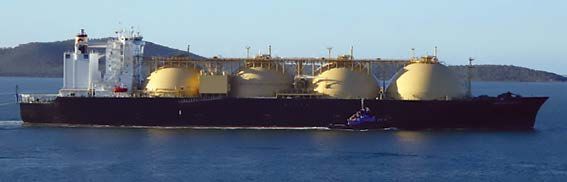
Owned by LNG Fukurokuju Shipping Corporation and operated by MOL LNG Transport Company, the 961.3-foot-long, Bahamas-flagged LNG carrier LNG Fukurokuju was constructed in 2016 by the Kawasaki Shipbuilding Corporation in Sakaide, Japan. Propulsion was provided by a single 35,939- hp steam turbine engine driving a fixed-pitch propeller.
EVENT SEQUENCE
On August 7, 2022, at 1445, the CC Portland got underway from the Cheniere Corpus Christi LNG Terminal on the La Quinta Channel to assist the inbound LNG Fukurokuju with navigating through the Corpus Christi Ship Channel, into the La Quinta Channel, and to the terminal. The CC Portland had a draft of 19 feet. The captain was at the helm when the tugboat departed; also on board were four other crewmembers, including the mate (in company training to qualify as a tractor tug captain), an engineer, and two deckhands.
The CC Portland was one of four tractor tugs dispatched to assist the LNG Fukurokuju, which had two pilots from the Aransas-Corpus Christi Pilots Association on board for its inbound transit. (The “Rules and Regulations Governing Pilots and Pilotage on the Corpus Christi Ship Channel” require two pilots to be on board all vessels greater than 900 feet in length overall.) Three other tugboats, the CC Gregory, CC Aransas, and CC LaQuinta (all operated by Edison Chouest), met the LNG Fukurokuju (which was in ballast condition with cold tanks) ahead of the CC Portland as the LNG carrier transited inbound from the Gulf of Mexico into the Corpus Christi Ship Channel.
The CC Gregory met the LNG Fukurokuju offshore near the entrance to the channel, where the crew secured a tow line through the center chock at the stern of the LNG Fukurokuju (center lead aft position). Next, the CC Aransas and CC LaQuinta met the LNG Fukurokuju near Harbor Island. According to the Aransas-Corpus Christi pilots on board the LNG Fukurokuju, their goal for the transit (as was typically done with similar transits) was to have a tugboat secured in the center lead forward position before the LNG carrier reached the turn from the Corpus Christi Ship Channel into the La Quinta Channel, where the waterway narrowed from 500 feet to 300 feet.
At 1540, the CC Portland arrived on location near buoys 25 and 26 in the Corpus Christi Ship Channel (about 2.5 miles from the turn into the La Quinta Channel) to await the inbound LNG Fukurokuju, which was about 6 miles away and transiting the channel at 8.4 knots. For this assist, the CC Portland crew was to secure their tow line through the center chock on the bow of the LNG Fukurokuju (center lead forward position). To prepare for the assist, the captain transferred operational control of the CC Portland to the mate, who sat at the main operating station (conning chair); the captain positioned himself next to the mate. The captain was acting as a training master and thus was responsible for overseeing the mate as he assisted the LNG carrier in the center lead forward position (which was required for the company’s tractor tug training program). At 1555, the mate positioned the tugboat near the middle of the ship channel.
At 1618, the LNG Fukurokuju approached buoys 25 and 26 at a speed of 8.2 knots. About a minute later, the CC Portland mate positioned the tugboat with its bow 600 feet forward of (and facing) the LNG Fukurokuju’s bow, maneuvering the tugboat astern and moving it into position along the starboard side of the LNG Fukurokuju’s bulbous bow.
About 1621, the CC Portland matched the speed of the LNG Fukurokuju at 8.5 knots astern. During this time, the deck crew on the bow of the LNG carrier threw their heaving line down to the deckhands on the bow of the tugboat. The CC Portland deckhands connected the tugboat’s tow line from the towing winch on the tugboat’s bow to the heaving line, using an eye on the end of the tow line. With the tow line connected to the heaving line, the crew on the bow of the LNG Fukurokuju began to pull in the heaving line through the centerline Panama chock on the LNG carrier. The CC Portland mate notified one of the LNG Fukurokuju pilots via VHF that the tow line was going up to the LNG carrier’s bow. (A Panama chock is a type of closed chock used for temporary mooring and towing lines. Mounted to the deck or bulwark, the chock must constructed according to the USO 13728 standard. The name derives from its use connecting ships to the locomotives that pulled them through the Panama Canal Locks.)
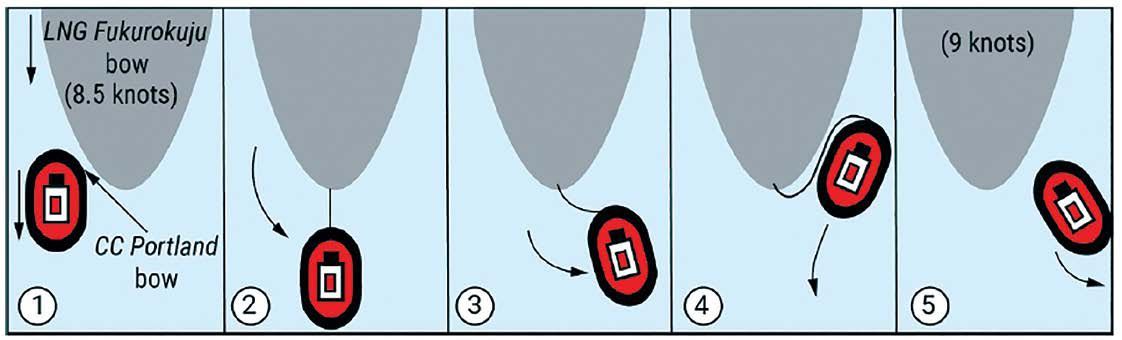
At 1623, the mate began increasing the tugboat’s speed astern, pulling ahead of the LNG carrier’s bow to reposition the tugboat in line with the centerline Panama chock. While pulling ahead of the LNG Fukurokuju, the CC Portland reached 10.2 knots, and the mate stated that the tugboat “zigzagged” and “did a couple of fishtails,” moving the tugboat out of position to the port side of the LNG carrier. Based on the portable pilot unit used by one of the LNG carrier pilots, about 45 seconds later, the CC Portland’s speed was reduced to below 8 knots, while the LNG Fukurokuju transited between 8.7 and 9.0 knots. According to the mate, the movement of the tugboat while repositioning ahead of the LNG carrier “created the speed loss.”
The tugboat’s loss of speed created a “belly” (loss of tension on the tow line between the tugboat and LNG carrier). About 1624, the LNG Fukurokuju’s voyage data recorder on the bridge captured an unidentified radio communication stating, “we got a line back there pretty low,” as the slack caused the tow line—the eye of which had not yet reached the chock of the LNG carrier—to dip into the water.
The mate gradually increased the angle of the starboard Z-drive by adding “ten degrees, [then] fifteen degrees max,” re-directing the thrust laterally to position the tugboat in line with the LNG carrier. However, the mate was unable to move the tugboat to the centerline of the LNG carrier. The mate continued to increase the angle of the starboard Z-drive, but the stern of the tugboat began to swing to starboard as it moved down the port box of the LNG carrier.
The LNG Fukurokuju began to overtake the CC Portland, and the attached heaving line parted, sending the tow line into the water. The captain stated, “…when everything was happening, it was too dangerous for me to [take over.]” Instead, with the captain “coaching” him, the mate again attempted to correct the tugboat’s position by increasing speed astern; however, he stated that when maneuvering the tugboat back in line with the LNG carrier, there was no response from the port Z-drive and the tugboat “wouldn’t go to port.”
The stern of the tugboat began to “sheer off to starboard,” and the tugboat began to move outside of the Corpus Christi Ship Channel. The mate stated that, as the tugboat’s stern continued to move to starboard, he saw the vessel was going to ground. The mate slowed the CC Portland, but at 1625, the tugboat grounded by the stern on its starboard outside of the channel near buoy 25 in about 10 feet of water. The tugboat captain reported something pop as the tugboat grounded.
The captain of the CC Portland, unsure if the tow line was made fast to the LNG Fukurokuju, activated the emergency release on the tow winch and notified the LNG Fukurokuju bridge via radio stating, “we are stuck aground freewheeling.” About a minute later, either the captain or mate of the tugboat again notified the LNG Fukurokuju bridge, “we are aground, we’re stuck.”
Noticing oil in the water, the CC Portland crew shut down the main engines and deployed spill kits to prevent further pollution. The crew of CC Portland notified the USCG of the grounding and reported that the vessel was leaking oil from the starboard Z-drive and that there was a hole in the starboard-side fuel tank.
The crew on the bow of the LNG Fukurokuju radioed to the bridge that the tugboat was aground on LNG Fukurokuju’s port side. One of the pilots on the LNG Fukurokuju released the escorting tugboat CC Aransas to assist the CC Portland. The CC Aransas met the grounded CC Portland at 1630. The LNG Fukurokuju continued without incident to the Cheniere Corpus Christs LNG Terminal after repositioning the CC LaQuinta in the center lead forward position vacated by the CC Portland.
The CC Portland crew remained on board the vessel into the evening so that damage to the vessel could be assessed. The Coast Guard and on-scene authorities determined that 4-5 gallons of fuel oil had been and there was no active sheening. The Coast Guard estimated there was a potential for 300-400 gallons of oil (gear) to leak from the Z-drive unit and a potential for 7,105 gallons of fuel oil to leak from the starboard fuel tank.
The CC Portland was unable to transit using its own propulsion and had to be towed from the grounding site. At 2359, the CC LaQuinta initiated a tow of the CC Portland, and at 0043 on August 8, the CC Portland moored at a nearby facility in Harbor Island, Texas for additional damage assessment.
DAMAGE
On August 8, divers examined the CC Portland. They discovered that the starboard Z-drive had been sheared off at the bolts connecting the drive to the flange. The port Z-drive was intact, but it had been fouled by the tugboat’s tow line. The divers found extensive damage to three starboard keel coolers. Additionally, they reported that one keel cooler support bracket had been ripped from the hull, leaving a hole measuring 4 inches by 3 inches in the No. 2 day fuel tank.
Later that day, the dive team returned to the grounding site and located and market the missing starboard Z-drive, which was on the bottom of the waterway outside of the channel on the south (green) and presented no hazard to traffic. Two days later, divers recovered the Z-drive.
After temporary repairs were made, the CC Portland transited under its own power from Corpus Christi to Port Fourchon, Louisiana, to be drydocked for permanent repairs, including replacement of the starboard Z-drive unit with a new unit. The the total cost to repair the damage was about $1 million.
The LNG Fukurokuju did not report any damage.
PERSONNEL
The CC Portland captain held a valid Coast Guard-issued merchant mariner credential as a Master of Vessels Less than 500 Gross Tons Limited to Near Coastal Voyages and an Officer in Charge of a Navigation Watch on Towing Vessels Less than 300 Gross Registered Tons Limited to Near Coastal Voyages. He had been employed by Edison Chouest Offshore for 14 years and had been working as tractor tug captain since 2018.
The CC Portland mate held a valid Coast Guard-issued merchant mariner credential as a Master of Self-Propelled Vessels of Less than 100 Gross Registered Tons Upon Near Coastal Waters. He was hired by Edison Chouset Offshore about 6 months before the casualty. Previously, the mate had worked for 3 years for a river cruise line as mate and captain, and before that, he worked for 27 years as a captain for a search and recovery and salvage vessel operator.
During his time with the cruise line, the mate gained experience operating small cruise vessels between 235 feet and 328 feet in length equipped with propulsion systems similar to the Z-drive units on the CC Portland. The mate noted the difference in sensitivity and engine responsiveness between the Z-drives on small cruise ships and the CC Portland, stating that the CC Portland Z-drives were “far more responsive.”
TRACTOR TUG CAPTAIN TRAINING PROGRAM
At the time of the grounding, the CC Portland mate was working to complete the company’s tractor tug training program to meet the company qualifications for a tugboat captain. The program was outlined in a company document, “Tractor Tug Training Program,” which also served as the trainee’s log of completed training items.
Each training item required a captain (training master) to observe as the trainee performed a specific maneuver/evolution, providing intervention as necessary for operational safety, and sign off on the item if “the trainee has completed the evolution with 100 percent proficiency, without question.” If the training master was not satisfied with the trainee’s performance, the trainee would be re quired top repeat the maneuver. The training was organized so that successive sections built upon demonstrated skills that were signed off in previous sections. Trainees were required to complete all training sections sequentially.
The mate began the training program to qualify as a tugboat captain about 6 months before the casualty. According to the mate, the August 7 casualty voyage was “the last of the training.” However, according to the mate’s training sign-off sheet, he had only completed two of the required five signoffs for ship assist maneuvers in the center lead forward position. Additionally, there were numerous instances in the log in which later elements had been marked completed before previous elements or the mate had counted single maneuvers for different sections.
Investigators asked company training masters to verify each time their initials appeared on the mate’s sign-off sheet. All six interviewed training masters raised concerns that many of the initials on the mate’s sign-sheet either did not match their own handwriting or that the initials were for training elements, positions, or maneuvers that they never completed with the mate. Interviewed tugboat captains and training master with the company also expressed concern with the mate’s ability to operate a tugboat in the center lead position.
TUGBOAT OPERATIONS IN THE CENTER LEAD FORWARD POSITION
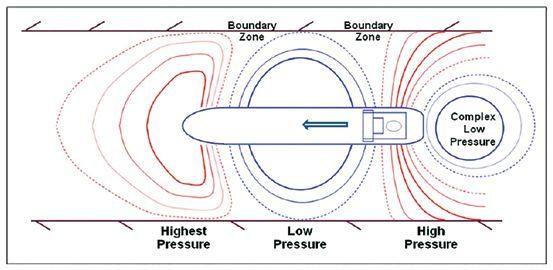
When a ship is moving through the water in the forward direction, a high-pressure area forms around the bow. When a tugboat is in the center lead forward position, it is subjected to the hydrodynamic forces created by the high-pressure area of the ship it is assisting. The speed of the vessel also increases these hydrodynamic forces exponentially. The pressure increases with decreasing distance to the bow, and therefore hydrodynamic forces are greatest when a tugboat is very close to the ship’s bow while making up the hawser. According to the Pilot’s Pocket Guide and Checklist, “The position in front of the ship’s [bulbous] bow is one of the most dangerous for the tug.”
According to the textbook Bow Tug Operations with Azimuth Stern Drive Tugs: Risks and Effectiveness, “a good guideline is that ship’s speed should not be higher than 60 percent of the tug’s maximum speed ahead.”
Investigators interviewed six company tugboat captains— all with experience operating tugboats out of the Cheniere Corpus Christi LNG Terminal—who noted the challenges associated with the center lead forward position. These captains stated that this position is “the most technically difficult” and, despite years of experience, they “still get nervous doing it.” The captains also noted the speed at which they felt comfortable performing this maneuver—for five of the captains, this speed ranged between 5 and 7 knots. One captain stated that when performing the center lead forward maneuver at 7.5–8 knots, the tugboat loses effectiveness because it is often operating at 75-85% of its maximum power. The captain added that “you never want to max out because you don’t have any power to get out, and you’re using the rest, 15-20% just to do what needs to be done on the job.”
Investigators assessed the speeds of eight LNG vessels transiting inbound through the Corpus Christi Ship Channel using historical automatic identification system data from June 2022. Based on interviews with tugboat operators and Aransas- Corpus Christi pilots, investigators identified an approximate 2-mile stretch in the Corpus Christi Ship Channel where bow tugboats are typically secured in the center lead forward position to prepare for the turn into La Quinta Channel. The average speed of the eight assessed LNG vessels was 8.5 knots (ranging from 7.0 to 11.5 knots) nearest buoys 25 and 26. The average speed was 6.3 knots (ranging between 5.5 and 7.2 knots) when approaching the turn into the LaQuinta Channel. There was no company or pilot association policy outlining a prescribed safe speed for center lead forward bow assist tugboat operations in the Corpus Christi Ship Channel.
ANALYSIS
To make up the CC Portland to the LNG Fukurokuju at the center lead forward position, the mate maneuvered the tugboat into position along the starboard side of the bow of the LNG Fukurokuju, which was transiting 8.5 knots. Once the LNG Fukurokuju crew began hauling up the tug’s tow line, the mate increased the tug’s speed astern, reaching 10.2 knots while repositioning the tug in line with and forward of the LNG Fukurokuju’s bow.
Automatic identification system data from June 2022 showed that other LNG carriers had transited an average of 8.5 knots nearest buoys 25 and 26, where the CC Portland attempted to make up to the LNG Fukurokuju. Therefore, the speed of the LNG Fukurokuju was typical for the area. However, hydrodynamic forces created by a ship increase exponentially with speed and with decreasing distance to the bow. Consequently, the forces acting on the CC Portland were even greater as it approached the bow of the LNG Fukurokuju, given the speeds of both vessels and the tugboat’s proximity to the LNG carrier’s bow when the mate attempted to re-position the tugboat off the bow of the LNG Fukurokuju, and these forces hampered the mate’s ability to control the tugboat.
Higher speed also reduces the amount of reserve propulsion power available to the operator. If the tugboat moves out of position, the operator has less power to regain position as compared to the same maneuver at a lower ship transit speed. When the CC Portland was positioned underneath the LNG Fukurokuju’s bow, the tugboat matched the LNG carrier’s 8.5-knot speed—meaning the tugboat was working at 65% of its maximum speed (13 knots). When the mate increased the tugboat’s speed to over 10 knots to pull ahead of the LNG carrier, the CC Portland was operating at nearly 80% of its maximum speed—far greater than the 60% recommended in the Bow Tug Operations with Azimuth Stern Drive Tugs: Risks and Effectiveness textbook. As speed increases, the margin of error decreases to the point where regaining position may be impossible.

There was no policy or guidance (for company tugboats or other vessels transiting the area) outlining a prescribed safe speed for tugboats completing ship bow-assist maneuvers in the Corpus Christi Ship Channel. Therefore, on the day of the casualty, there was no policy limiting the tugboat’s speed while the mate was attempting to match the LNG carrier’s speed of 8.5 knots and reposition the tugboat. After the casualty, other tugboat captains (who worked for the same company) told investigators that they felt comfortable performing bow-assist maneuvers at much lower speeds (ranging from 5 to 7 knots). Additionally, the NTSB previously investigated a similar collision in 2022 between the tugboat George M and containership MSC Aquarius in which the tugboat’s company established a speed limit of 7 knots for performing bow-assist maneuvers. Had the CC Portland’s operator established a similar policy, the captain and mate would have had to wait for the LNG carrier to reduce its speed in order to execute the maneuver on the day of the casualty, thus reducing the effect of the hydrodynamic forces acting on the tugboat and increasing the amount of reserve propulsion power available.
As the mate attempted to reposition the CC Portland, his inputs directed more thrust laterally, and the tugboat therefore lost speed astern. As the CC Portland lost speed, the tugboat began to move down the port bow of the LNG Fukurokuju. This movement pulled the tow line (attached at the bow), to the stern of the tugboat, causing the heaving line to snap and sending the tow line into the water.
As the mate increased propulsion astern to regain position, the port Z-drive was fouled by the submerged tow line, thus significantly impacting the tugboat’s maneuverability. At the time, the mate and training master were unaware that the port Z-drive was fouled as the mate continued to attempt to maneuver the tugboat back to the LNG carrier’s centerline. With only the starboard Z-drive operational, the mate was unable to regain position, and as a result, the tug departed the ship channel and ran aground.
At the time of the casualty, the CC Portland mate had not yet completed the company’s tractor tug training program, which included bow-assist maneuvers (two of the required five assist maneuvers in the center lead forward position were documented). A review of the mate’s training sign-off sheet showed that he had not completed the training in accordance with company guidelines—elements were completed out of order, and, in many cases, the mate counted single maneuvers for different sections. Further, nearly all training masters that had reportedly signed off on the mate’s training raised concerns that many of the initials on the mate’s sign-off sheet either did not match their own handwriting or were for training elements, positions, or maneuvers that they never completed with the mate. Therefore, the mate inaccurately represented how much training he had completed. Because he did so, his training masters—including the CC Portland captain on the day of the casualty— were likely under the impression that the mate was further along in the training program and thus more advanced in his skill set than he actually was.
The CC Portland captain was responsible for overseeing operational safety and decision-making on board the vessel. As such, the captain was expected to monitor the vessel’s movement and the mate’s performance while maintaining an overall awareness of the situation. At the time of the casualty, the captain was “coaching” the mate (who was in the conning chair) through the maneuver and did not take direct action until after the CC Portland had grounded. Had the captain attempted to take over the conning chair, the time lost during the transfer could have been time the mate needed to successfully reposition the tugboat. Therefore, the captain likely did not have sufficient time between the loss of control and the grounding to safely switch positions with the mate and take control of the tugboat.
PROBABLE CAUSE
The National Transportation Safety Board determines that the probable cause of the grounding of the CC Portland was the mate’s attempt to make up bow-to-bow with a liquefied natural gas carrier while the tugboat and liquefied natural gas carrier transited at a speed that was excessive for the advanced harbor-assist maneuver. Contributing to the casualty was the lack of a company policy regarding maximum allowable speed for bow assist maneuvers.
LESSONS LEARNED
The National Transportation Safety Board has previously noted the effect of speed on bow-to-bow harbor-assist operations in other investigations. The risk of a casualty during these operations with azimuthing stern drive (ASD) tugboats increases with increasing speed. Hydrodynamic forces around an assisted vessel’s bow increase exponentially with speed, while the amount of reserve propulsion power available to the tugboat operator decreases. Therefore, owners and operators of ASD tugboats that perform bow-to-bow harbor-assist operations should set speed limits for these maneuvers. These limits may vary for different classes of tugboats based on design. Tugboat operators should communicate these pre-determined speed limits to pilots and ship masters in command of the vessels that they are assisting before engaging in these maneuvers.
Reprinted from Marine Construction Magazine Issue V, 2023.