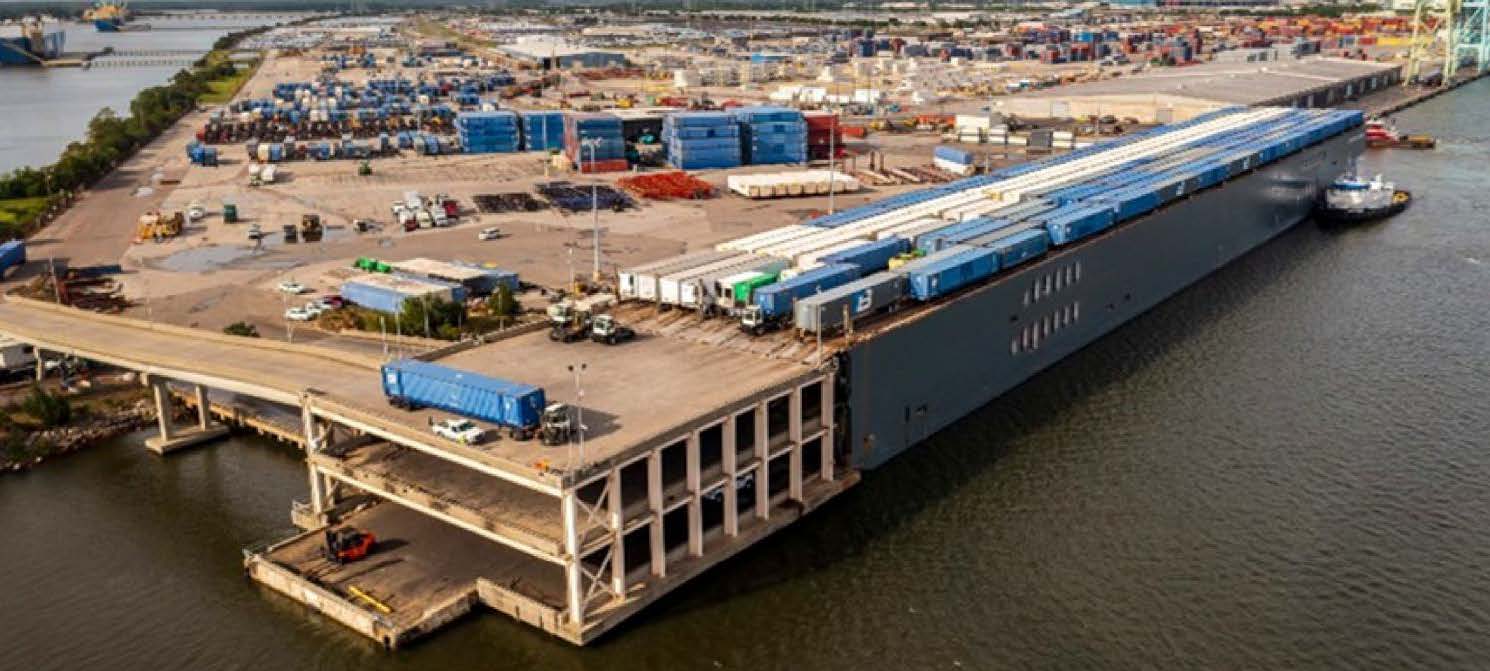
On June 8, 2023, about 2130 local time, the freight barge San Juan- JAX Bridge contacted the Army Terminal Pier in Cataño, Puerto Rico, while being moored by the ocean tug Signet Thunder and three assist tugs (see figure 1 and figure 2). There were no injuries, and no pollution was reported. Damage to the barge was repaired at a cost of $277,571.
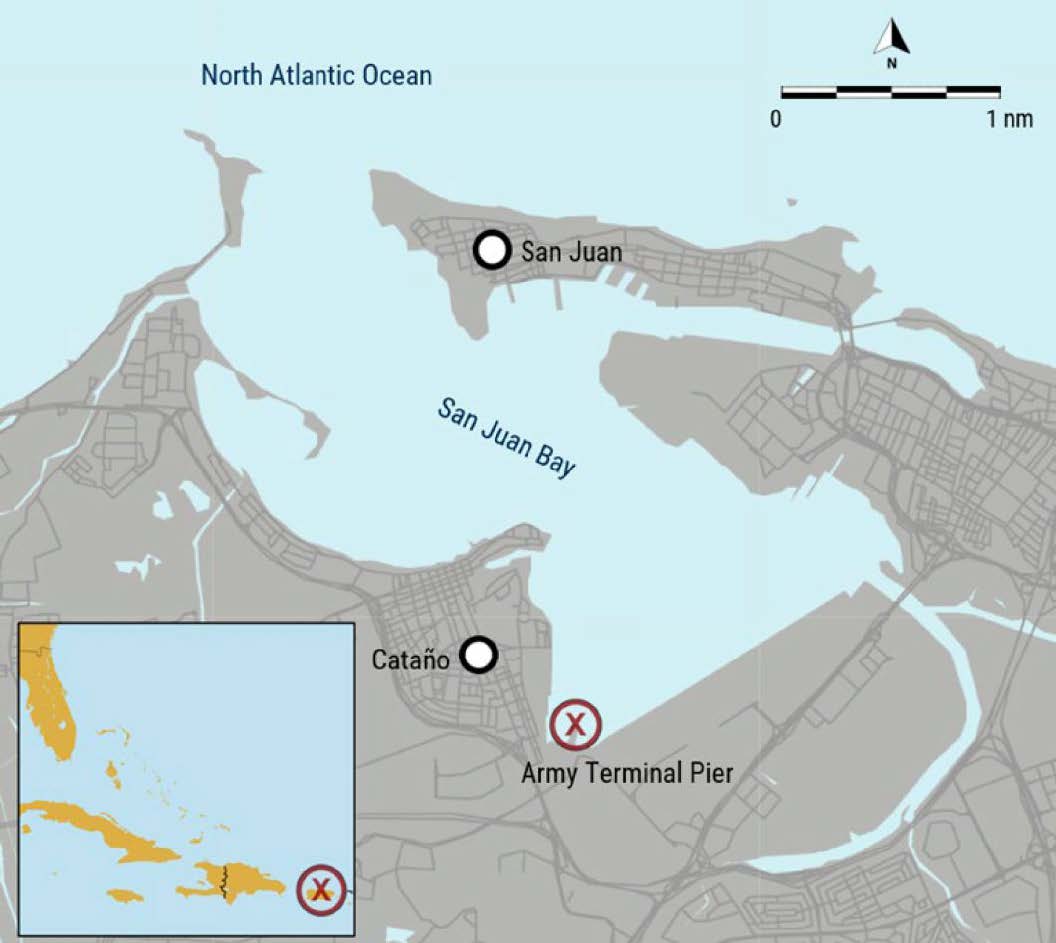
Factual information
The Signet Thunder was a 120-foot-long ocean tug built in 2001 and operated by Signet Maritime Corporation. The San Juan-JAX Bridge was a 699-foot-long freight barge built in 1984 and operated by Trailer Bridge, Inc. The vessels routinely transported roll-on/roll-off cargo between Jacksonville, Florida, and San Juan, Puerto Rico.
On June 3, 2023, the Signet Thunder left Jacksonville towing the San Juan-JAX Bridge, en route to the Army Terminal Pier at Cataño in San Juan Harbor, San Juan, Puerto Rico. On June 8, while underway, the Signet Thunder suffered a port main engine casualty. The tug’s crew repaired the engine and placed it back in service; however, the US Coast Guard, after being notified about the engine casualty, required an additional assist tug on arrival until the repairs could be inspected. (In addition to Signet Thunder, it would normally take two other harbor tugs to maneuver the barge with its large sail area into the narrow slip.)
After the Signet Thunder and San Juan-JAX Bridge arrived in San Juan Harbor on the evening of June 8, a docking pilot boarded the barge from one of the assist tugs and prepared to dock the barge, bow out, port side to the Army Terminal Pier. He positioned the tugboat Brooklyn McAllister on the barge’s starboard quarter and the tugboat Dorothy McAllister on the port bow. The extra assist tug required by the Coast Guard, the Don Alfredo, stood by near the barge. The Signet Thunder made up, bow to stern, on the barge’s starboard bow. The tugs spun the barge around, stern to the terminal, and attempted to line up parallel to the Army Terminal Pier. They then started to back the barge into the slip and push it alongside.
Across from where the San Juan- JAX Bridge barge would moor at the Army Terminal Pier, the chemical tank vessel Axios, with a beam of 105 feet, was docked at the Cataño Oil Dock–West. The distance between the Axios and the Army Terminal Pier was 235 feet. Once the barge, with a beam of 104 feet, was moored, there would be 131 feet separating the two vessels in the slip. During the docking, when tugs (beams of about 34 feet) were assisting, there was even less room to maneuver (see figure 3).
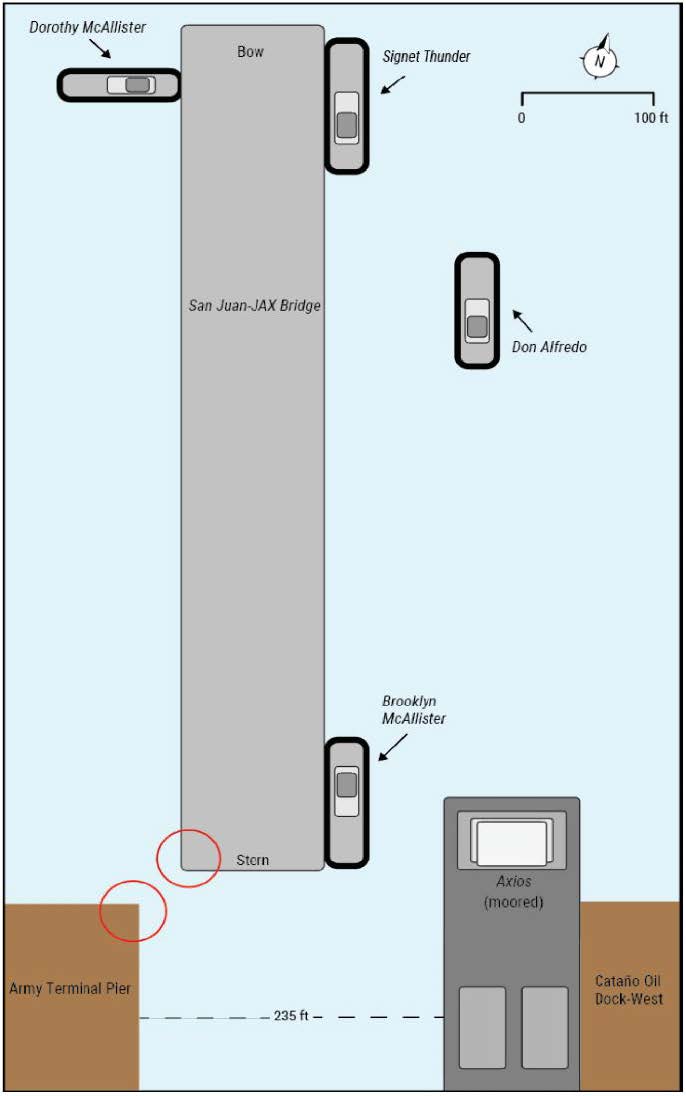
The Brooklyn McAllister was positioned at the barge’s starboard quarter. Due to the height of the barge, the Brooklyn McAllister captain was not able to see the Army Terminal Pier from where his tug was positioned. According to the docking pilot, he first instructed the Brooklyn McAllister’s captain to keep the barge’s stern clear of the Axios. However, he then gave instructions intended to move the barge’s stern away from the Army Terminal Pier so that the barge would clear the corner of the dock while entering the slip, given a light breeze on the starboard beam. The Brooklyn McAllister captain later stated that he had heard the docking pilot’s instructions as “ahead and to starboard.” The docking pilot stated that he requested and received confirmation that the captain was carrying out his instructions. However, the barge moved to port, and the barge’s port quarter was pushed into the corner of the pier with enough force to damage the barge.
After the impact, the docking pilot instructed the tugs to maneuver the barge out and away from the slip and gave orders for another approach attempt; the second approach resulted in the tugs successfully docking the barge at the pier.
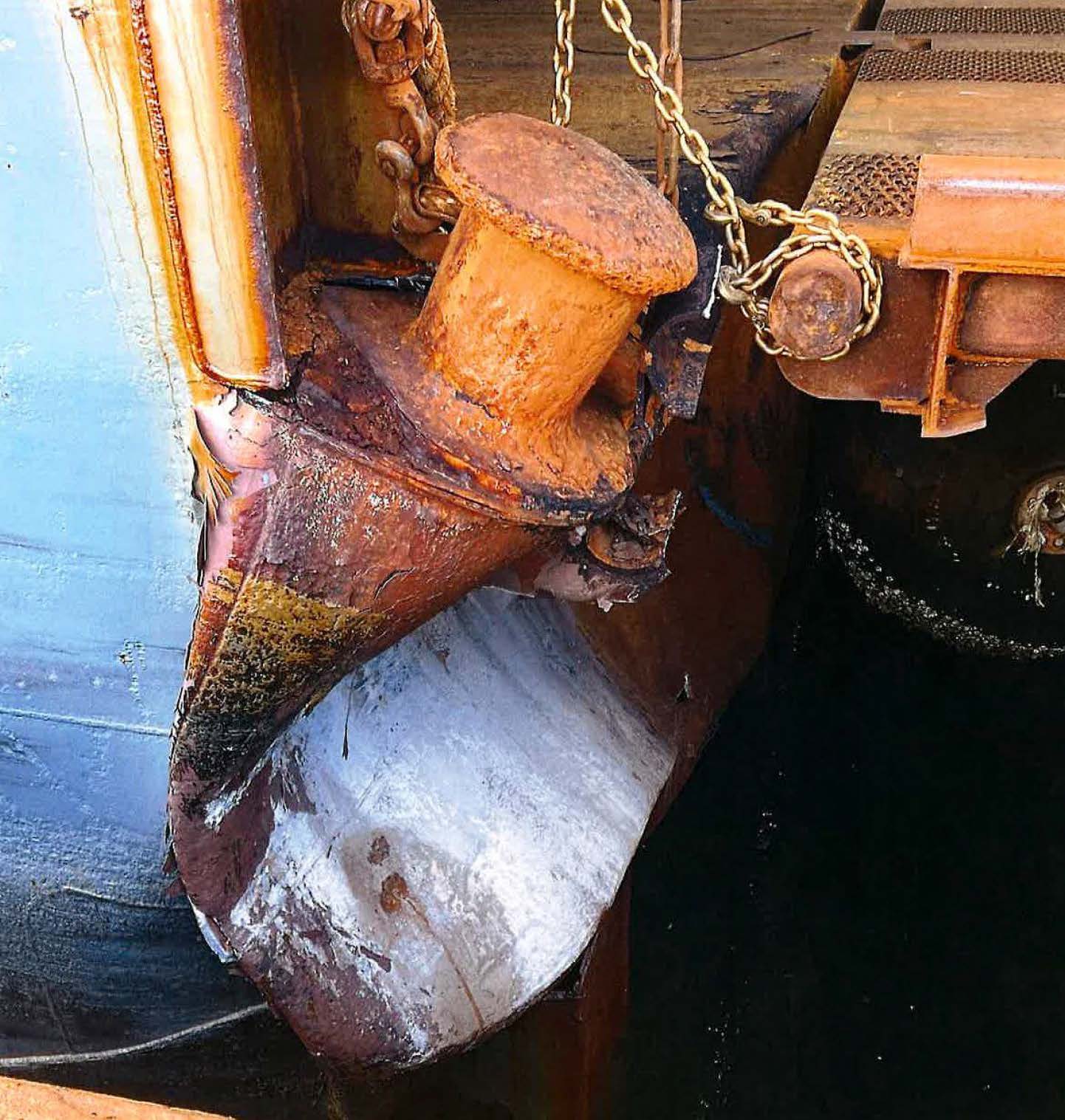
The San Juan-JAX Bridge suffered fractured frames and a 3-meter-by-4-meter buckled area of the transom and main deck (see figure 4). The transom and bottom plating were also holed. Repairs were made to the barge at Grand Bahama Shipyard, and the vessel returned to service that month, in June 2023.
Analysis
After the ocean tug Signet Thunder arrived in San Juan Harbor towing the San Juan-JAX Bridge barge, a docking pilot boarded the barge to dock it at the pier, in darkness, with little clearance between the pier and a nearby moored tanker. The Signet Thunder and three tugs assisted with the docking. The assist tug Brooklyn McAllister was made up on the barge’s starboard quarter, and its captain was unable to see the Army Terminal Pier from where the tug was positioned due to the height of the barge. The docking pilot gave instructions intending the captain to move the barge’s stern away from the northeast corner of the pier. However, the captain of the Brooklyn McAllister maneuvered his vessel in a way that pushed the port quarter of the barge toward the pier, contrary to the docking pilot’s intention. The miscommunication resulted in the barge contacting the pier. Probable Cause The National Transportation Safety Board determines that the probable cause of the contact of the barge San Juan-JAX Bridge with the Army Terminal Pier was miscommunication between the docking pilot and an assist tug captain while docking the barge.