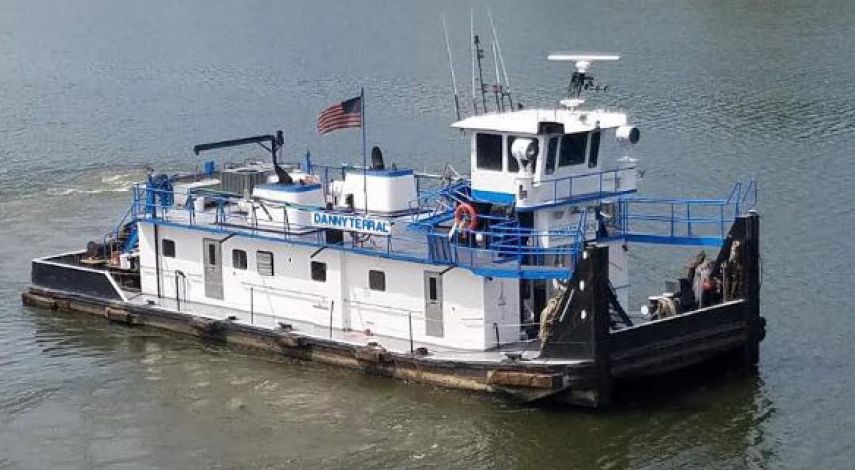
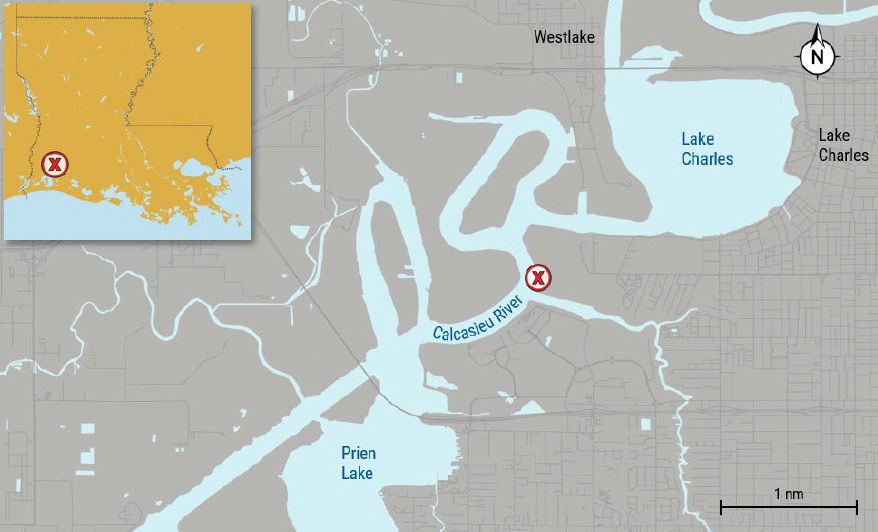
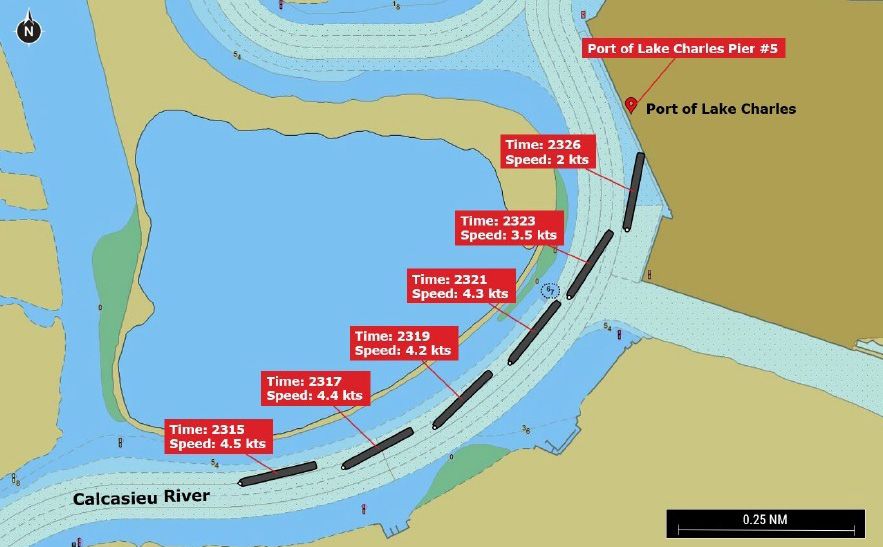
On July 8, 2023, at 2326, the towing vessel Danny Terral was pushing six loaded barges on the Calcasieu River when the starboard lead barge contacted a pier while docking at the Port of Lake Charles (see Figure 1 and Figure 2).1 There were no injuries, and no pollution was reported. Damage to the pier was estimated to be about $1 million. The tow remained intact, and there was no reported damage to the barges or towing vessel.
Factual Information
On July 6, at 1355, the 75-foot-long steel towing vessel Danny Terral departed the Old River Fleet on the Lower Old River near Lettsworth, Louisiana, en route to Lake Charles, Louisiana, with five crewmembers on board, including a captain, mate, steersman (in training), and two deckhands. For the transit, the Danny Terral was pushing six barges loaded with rock arranged together in two strings of three barges, for a total length (vessel and tow) of 675 feet and maximum width of 70 feet. Before departure, the captain and mate had completed a voyage plan and navigation assessment document, which addressed potential issues related to weather, navigational hazards, river conditions including “velocity and direction of currents,” and traffic along the route. The captain and mate noted no issues on the voyage plan.
On July 8, at 2120, the Danny Terral entered the Calcasieu Ship Channel and headed northbound towards Lake Charles. The captain and steersman were on watch in the wheelhouse; a deckhand was also on watch. Just before 2315, the mate arrived in the wheelhouse for his 2330 scheduled watch. The mate and the captain completed a watch changeover and discussed the plan to moor at the Port of Lake Charles. This was the mate’s first time docking at the intended berth—which he later described to investigators as “unique.” His only previous docking at the Port of Lake Charles was completed under the supervision of a training captain at a different berth location.
At 2315, the mate and deckhand assumed the watch from the captain, steersman, and other deckhand – 15 minutes before the scheduled 2330 watch change. The captain departed the wheelhouse, the offgoing deckhand was relieved of the watch, and the steersman remained in the wheelhouse. The tow was less than one mile from the Port of Lake Charles and transiting at 4.5 knots. Upon taking the helm, the mate checked the tow’s speed and heading and turned on the spotlights to help see the pier in the darkness, which had no lights. He told investigators that, upon approach to the Port of Lake Charles pier, there was no traffic in the area and there were no other vessels moored at the pier.
The mate began to slow the tow to prepare for the docking at Pier No. 5. He stated that he wanted to slow the tow to “roughly two [knots]” on approach to the pier to maintain directional control. To slow the tow, the mate pulled the engines back and then into clutch before moving the throttles to full astern while adding “full starboard rudder, flanking rudder.” The mate told investigators that, for the docking, he was attempting to turn the head of the tow to port while slowing the tow’s forward momentum. However, as the tow rounded the bend, the head of the tow “stopped swinging [to port]” but “still had forward momentum.” The mate also told investigators that, during the approach, the outgoing current set the tow towards the pier. The tow continued towards the pier and, about 2326, the lead starboard barge contacted the pier at two knots (see Figure 3).
The deckhand, who was walking out to the head of the tow while carrying mooring lines, was about 150 feet forward of the Danny Terral on a barge when the contact occurred. According to the mate, the deckhand on watch would typically call out distances as the tow approached a dock. The deckhand stated that he would give the wheelhouse operator distances when requested over VHF radio. However, the deckhand stated that since he had not yet reached the head of the tow, he didn’t call out distances.
Following the contact, the mate maneuvered the tow astern away from the pier, and the captain returned to the wheelhouse and landed the tow on the pier.
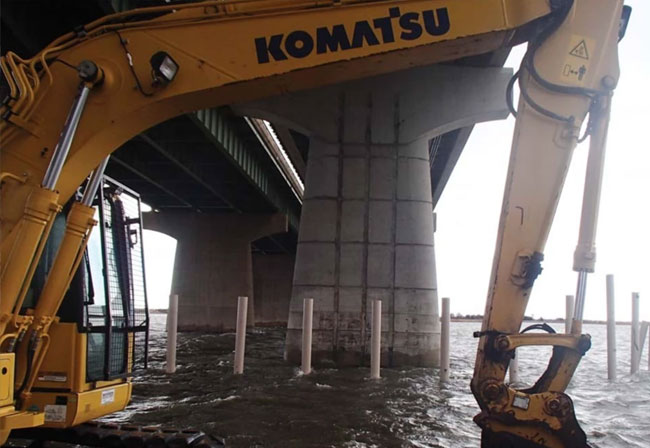
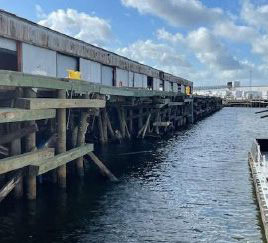
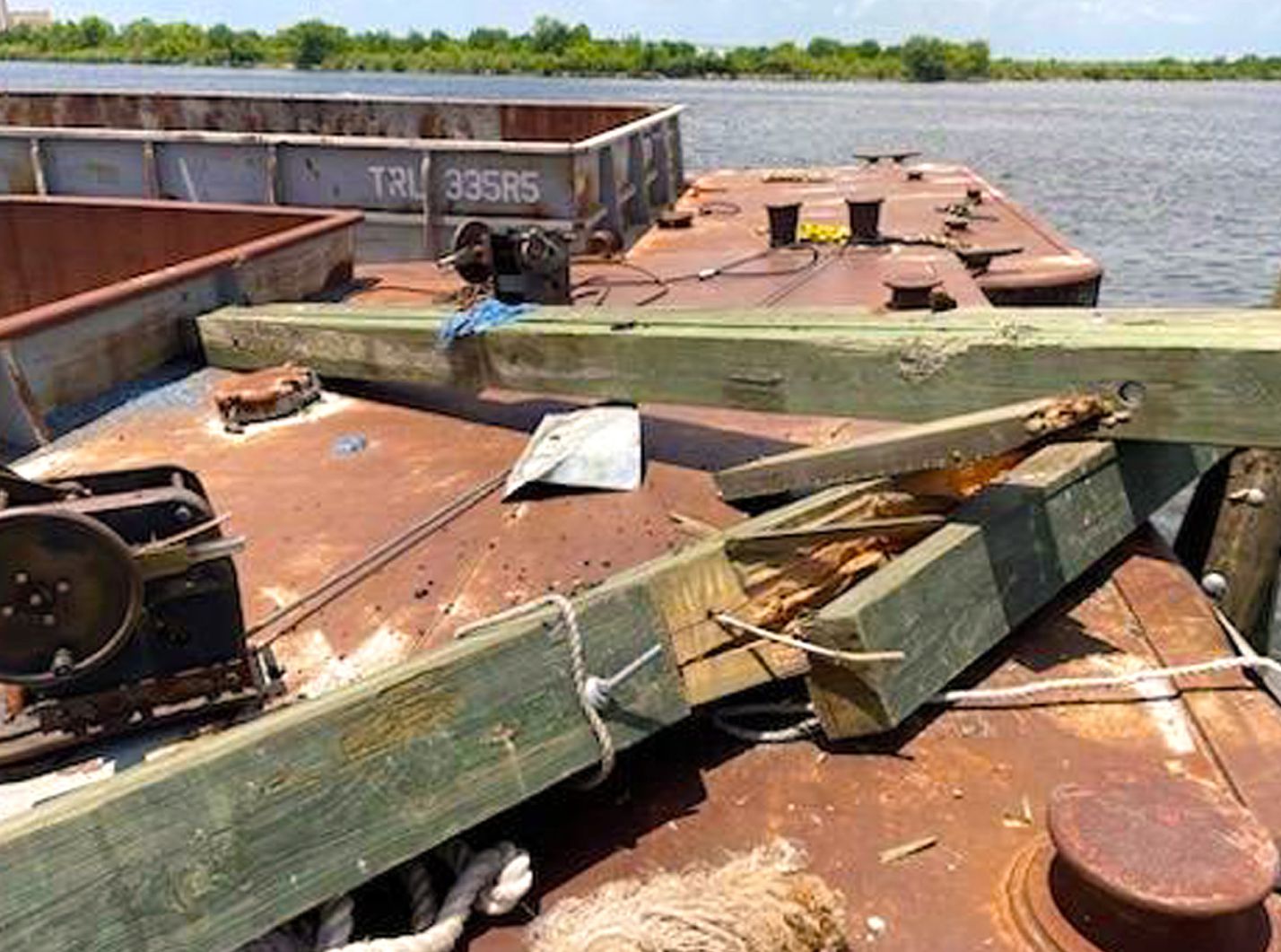
The tow remained intact following the contact. The deckhand observed damage to the pier spanning 30-40 feet and noted timber on the starboard lead barge He did not see damage to the barges or the vessel. The Coast Guard inspected the pier the following day and noted damage to the pier support pylons and undergirding, spanning about 40 feet in length (see Figure 4). The cost to repair the pier was estimated to be about $1 million.
The mate had about 10 years of combined experience on board towing vessels. In March 2022, he began training as a mate/pilot while completing the requirements for his credential. In March 2023, he earned a Coast Guard credential as a master of towing vessels of less than 200 gross tons and began working fulltime as a mate.
Following the casualty, the mate tested negative for drugs and alcohol. He told National Transportation Safety Board investigators that he was not on his phone at the time of the casualty, which was corroborated by the steersman, who was in the wheelhouse at the time of the contact. The mate also completed a work/rest report for the 5 days preceding the contact, which indicated that he received 11 hours of sleep each day and that he maintained a consistent work and sleep cycle.
Analysis
The mate had been credentialed and qualified with the company for about four months at the time of the contact, but he had never docked at this specific berth location at the Port of Lake Charles. After the casualty, the mate described this berth location to investigators as “unique” and not a typical approach that he had previously completed; his only previous docking at the Port of Lake Charles was completed under the supervision of a training captain at a different berth location.
The nighttime conditions required the mate to manually train the spotlight on the unlit pier, in addition to operating the steering and propulsion controls and monitoring the tow’s speed and position. The deckhand, who would typically be positioned at the head of the tow to call out distances to the operator in the wheelhouse as the tow approached the pier, had not yet gotten into position for the docking. As a result, he did not communicate with the mate regarding the tow’s distance to the pier. The mate’s inexperience with the docking location, coupled with the unlit pier and lack of distance information from the deckhand, resulted in him misjudging the approach to the pier.
Investigators were not able to interview the captain, so it is unclear if the mate and the captain discussed the outgoing current, berth location, or the mate’s experience at the Port of Lake Charles during the watch change immediately before the contact. Further, there was no indication that the required navigation assessment form, which included an item for “velocity and direction of currents,” was updated for the docking. Either a discussion on the maneuver or a review of the navigation assessment form would have given the captain and mate the opportunity to assess the risks associated with the docking. However, the captain left the wheelhouse immediately after the watch change. If the captain had any reservations or concerns about the docking, he should have remained on the bridge.
Probable Cause
The National Transportation Safety Board determines that the probable cause of the contact of the Danny Terral with the Port of Lakes Charles pier was the mate misjudging the approach to an unlit, unfamiliar pier in the dark.