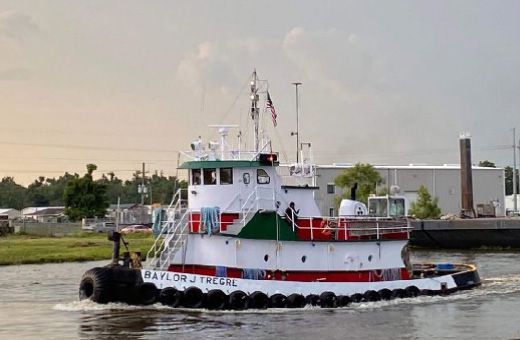
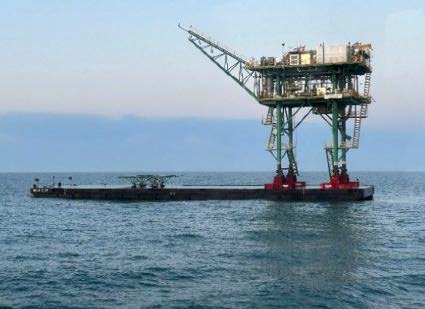
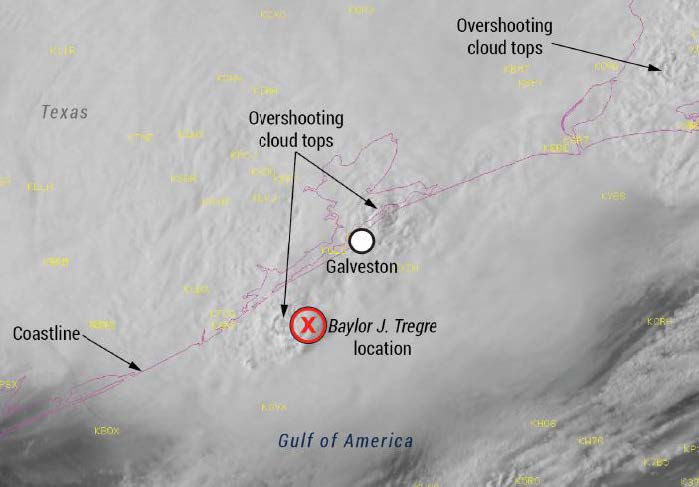
On May 13, 2024, about 1657 local time, the towing vessel Baylor J. Tregre was towing the ocean barge MARMAC 27 in the Gulf of America, about 23 miles south of Galveston, Texas, when the towing vessel capsized and sank (see figure 1 and figure 2). All four crewmembers abandoned the vessel and were rescued by the U.S. Coast Guard. One crewmember sustained minor injuries. There was no pollution reported. Damage to the towing vessel was estimated at $2 million.
Background
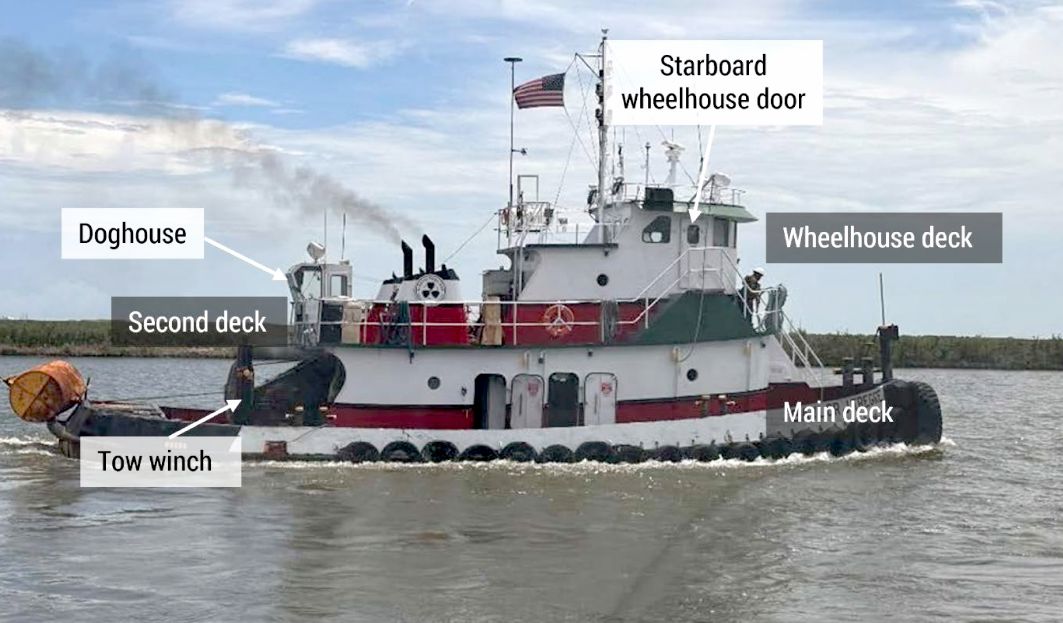
The 67-foot-long towing vessel (tugboat) Baylor J. Tregre, constructed of welded steel, was built by R&S Fabricators, Inc. in Lockport, Louisiana, in 1997 as the Trent Joseph for Coastal Towing LLC. In 2023, Trinity Tugs LLC acquired the vessel, renaming it Baylor J. Tregre. The vessel’s propulsion was provided by dual propellers with kort nozzles (each driven by a 750-hp diesel engine). The Baylor J. Tregre had an aft double drum towing winch with 1,800 feet of 1.25-inch tow wire. The Baylor J. Tregre had a valid U.S. Coast Guard-issued certificate of inspection documenting compliance with Title 46 Code of Federal Regulations Subchapter M.
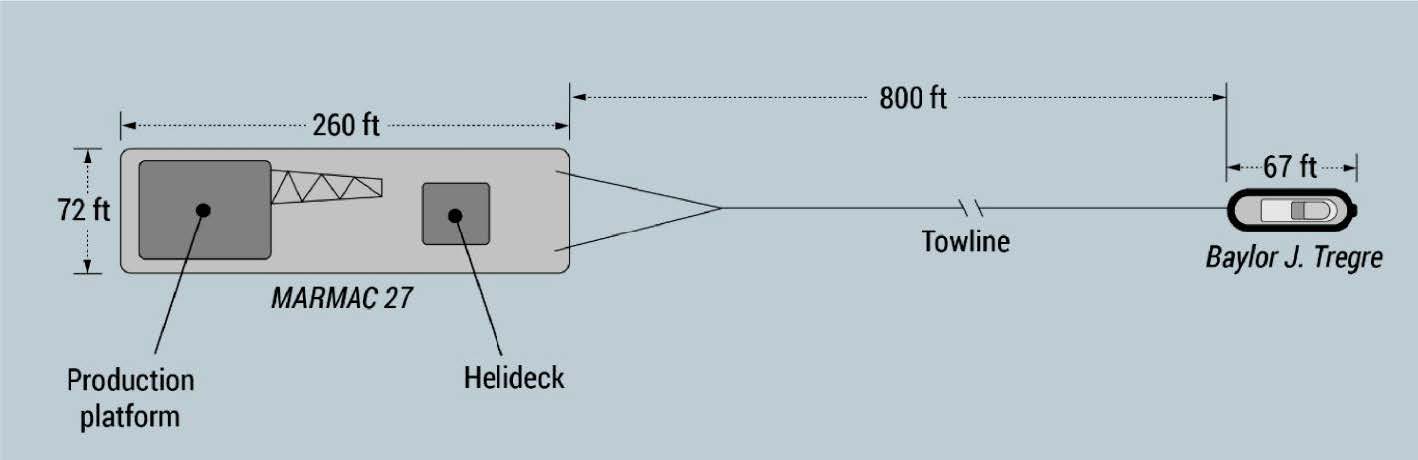
The 260-foot-long, 72-foot-wide, 16-foot-depth oceangoing deck barge MARMAC 27 was leased by Manson Construction Co. The barge had a load line certificate issued by the American Bureau of Shipping (ABS).
Event Sequence
On May 11, 2024, Trinity Tugs entered into an agreement with Manson Construction Co. for the Baylor J. Tregre to tow the barge MARMAC 27, which was loaded with a production platform and helideck, from Houma, Louisiana, to Brazos Area Block 538A, an oil and gas lease block in the Gulf of America.
The same day, about 0340, the Baylor J. Tregre departed Houma, en route to Block 538A, with the MARMAC 27 in tow astern. The tow arrangement consisted of two bridles fitted to port and starboard bitts on MARMAC 27. The bridle lines connected to a shackle, which had a shock line attached to it. On the other end of the shock line was the main tow wire (towline), which was about 800 feet long (see figure 4). The wire was connected to the tow winch on the stern of the main deck; the towline ran through centerline roller chocks fitted in the stern bulwark just above the main deck centerline. The MARMAC 27 drafts at departure were 9 feet forward and 10 feet aft.
The Baylor J. Tregre had four crewmembers aboard, including a captain, a mate, and two deckhands (deckhands 1 and 2). The captain and deckhand 1 worked a watch schedule of 0600–1200 and 1800–2400, and the mate and deckhand 2 worked the opposite watch schedule of 0000–0600 and 1200–1800.
Once offshore, the Baylor J. Tregre proceeded on a westerly course along the coastline of Louisiana (the tow could not use the Gulf Intracoastal Waterway because the platform on the barge was too tall to transit through some bridge and powerline crossings). About 0630, on May 13, the captain, who was at the helm for his scheduled watch, executed a southwesterly course change. The crew received daily weather reports from Trinity Tugs shoreside staff and monitored VHF radio for marine weather broadcasts. The mate was on watch when the operating company called (via cell phone) with the daily weather report on May 13. According to the mate, the forecast for that day included a chance of thunderstorms throughout the day into the evening; he stated that the daily weather report forecast matched the weather report he had heard over VHF radio just before the phone call. (The mate did not recall hearing any updated weather forecasts over VHF radio afterward.)
The crew also reported daily to shoreside staff (typically verbally by phone) the vessel’s position, estimated distance and time to destination, and weather conditions. At 1530, when the tow was about 60 miles from its destination, the crew reported the weather was 3- to 4-foot seas with winds from the south at 10–15 mph (about 9–13 knots). According to information transmitted from the automatic identification system (AIS), the tow was transiting between 4–5 knots. Shoreside staff directed the mate to reduce the vessel’s speed to adjust the tow’s arrival time.
Sometime after the phone call between the mate and office of Trinity Tugs, the mate noticed a squall forming to the north of the tow’s position. The mate adjusted the heading of the tow, turning closer inshore.
The mate increased the range on the radar and saw a “narrow finger band” moving from west to east coming from the shore. After 15–20 minutes, the storm appeared larger, and the skies were beginning to darken. The mate again increased the range on the radar and saw that the storm picture had changed from a narrow finger band to a circle, about 4 to 5 miles wide, north of their position. The tow continued on a heading of west-southwest, transiting between 4–5 knots.
The mate stated that, shortly afterward, the wind began to blow out of the north and “intensified at a very quick rate,” and he noticed that the vessel started losing speed. According to AIS data, the vessel’s speed dropped from 4.0 knots at 1647:04 to 1.8 knots at 1650:09. The mate saw the anemometer display in the wheelhouse indicate a wind velocity of 45 knots (he could not remember if the anemometer was capable of displaying winds higher than 45 knots). He noted “the seas were blown flat.”
The mate attempted to steer the Baylor J. Tregre into the wind. He stated that, before initiating the turn, the MARMAC 27 was following “right behind,” but “within a few more minutes after that, everything just went black.” The mate lost sight of the barge, and he felt “like maybe some sort of cyclone had formed” on top of or next to the vessel. He thought it was hailing because “it sounded like ice on the boat.”
Meanwhile, deckhand 2 was on duty down below aft in the vessel conducting clean-ups when he felt the vessel suddenly jerk him forward. He went to the wheelhouse; he told investigators that when he got there, the vessel was heeling 45° to port.
The mate then called the captain to the wheelhouse. The captain, whose stateroom was located directly aft of the wheelhouse, arrived immediately. According to the captain, when he arrived, “the main deck stern bulwarks were underwater.” About 1654:20, the vessel’s speed had dropped to 0.6 knots, according to AIS. The captain and mate estimated winds were about 85–100 mph (about 74–87 knots) at the time. The mate told investigators, “… I think it was maybe a waterspout or something, it took the barge and kind of brought it around to the side of us and the towline and the barge pulled us over.” The mate then sounded the general alarm to summon deckhand 1 to the wheelhouse.
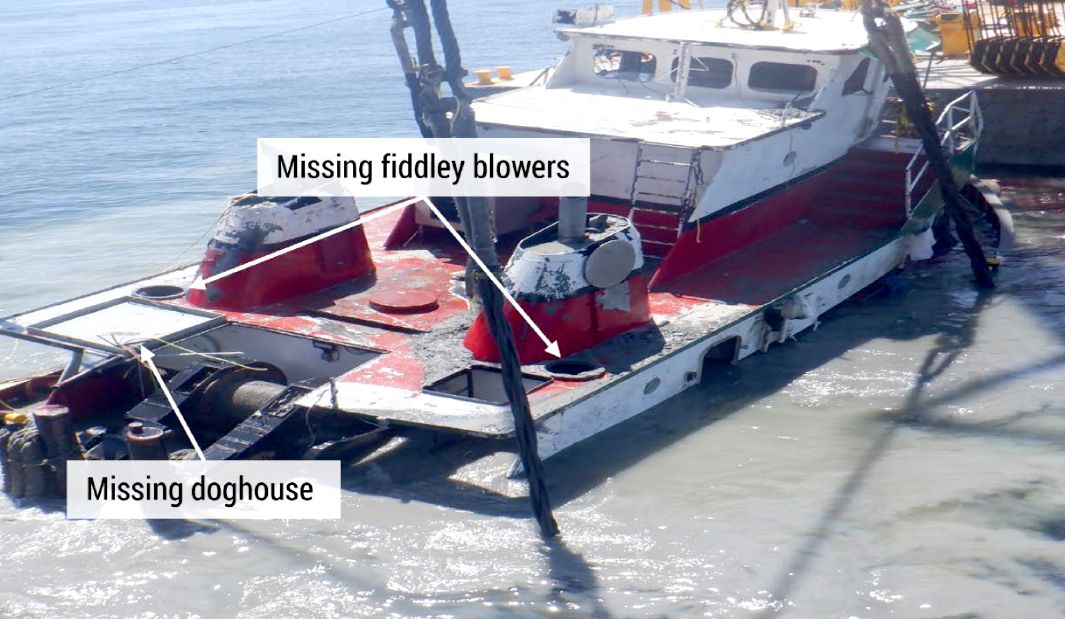
The captain then took the wheel and instructed the mate to leave the wheelhouse and “turn the barge loose.” The mate stated he could not use the port wheelhouse door because “it was almost in the water”and recalled, “We were leaning so hard that it took both deckhands to help [him] out of the starboard side door of the wheelhouse.” The mate proceeded aft down the starboard side of the wheelhouse in an attempt to make it to the “doghouse”—a small, enclosed structure, located aft on the port side of deck 2 (the deck below the wheelhouse), that housed the controls to pay out and/or release the towline (see figure 5). However, as he proceeded aft, he saw the doghouse was halfway underwater and the windows were “blown out.” The mate stated that he could not use the tow winch to pull in the tow because the winch was controlled from the doghouse, and the tow winch drive engine, located in the upper engine room, would need to be started. He returned to the wheelhouse and told the captain there was nothing he could do.
The captain and mate continued attempting to change the Baylor J. Tregre’s heading and right the vessel, but the port quarter was underwater, and the mate estimated that the starboard rudder and propeller were out of the water. When the mate located the barge, it was off the port beam, and the towline was “tight as a banjo string.”The captain lost steering and attempted to use the vessel’s propellers to steer the vessel in front of the barge but was unsuccessful. The mate and the captain referenced their electronic chart system; the mate told the captain,“This thing is dragging us sideways and backwards at 3.5 knots.”
At 1657, the mate, with permission from the captain, made a distress call on VHF channel 16. Coast Guard Sector Houston-Galveston received the call. Shortly afterward, the vessel lost electrical power, and the main engines stopped running. The last AIS transmission from the Baylor J. Tregre was at 1712.
After the vessel lost power, the mate exited the wheelhouse by climbing up through the starboard door. He then helped the two deckhands and captain climb out of the wheelhouse. As the mate wa securing the starboard wheelhouse door, deckhand 2 entered the water. Crewmembers threw a life ring to deckhand 2, but with the wind and waves, the life rings retrieval line got hung up. By the time the retrieval line was free, the crew had lost sight of deckhand 2.
The three remaining crewmembers stayed on board the starboard side of the vessel.
The sea state worsened, with 6- to7-foot seas, and the vessel continued to sink by the stern with a heavy port list. The crew, all wearing lifejackets, moved to the bow. A wave then blew the wheelhouse windows out, and the vessel started sinking more rapidly.
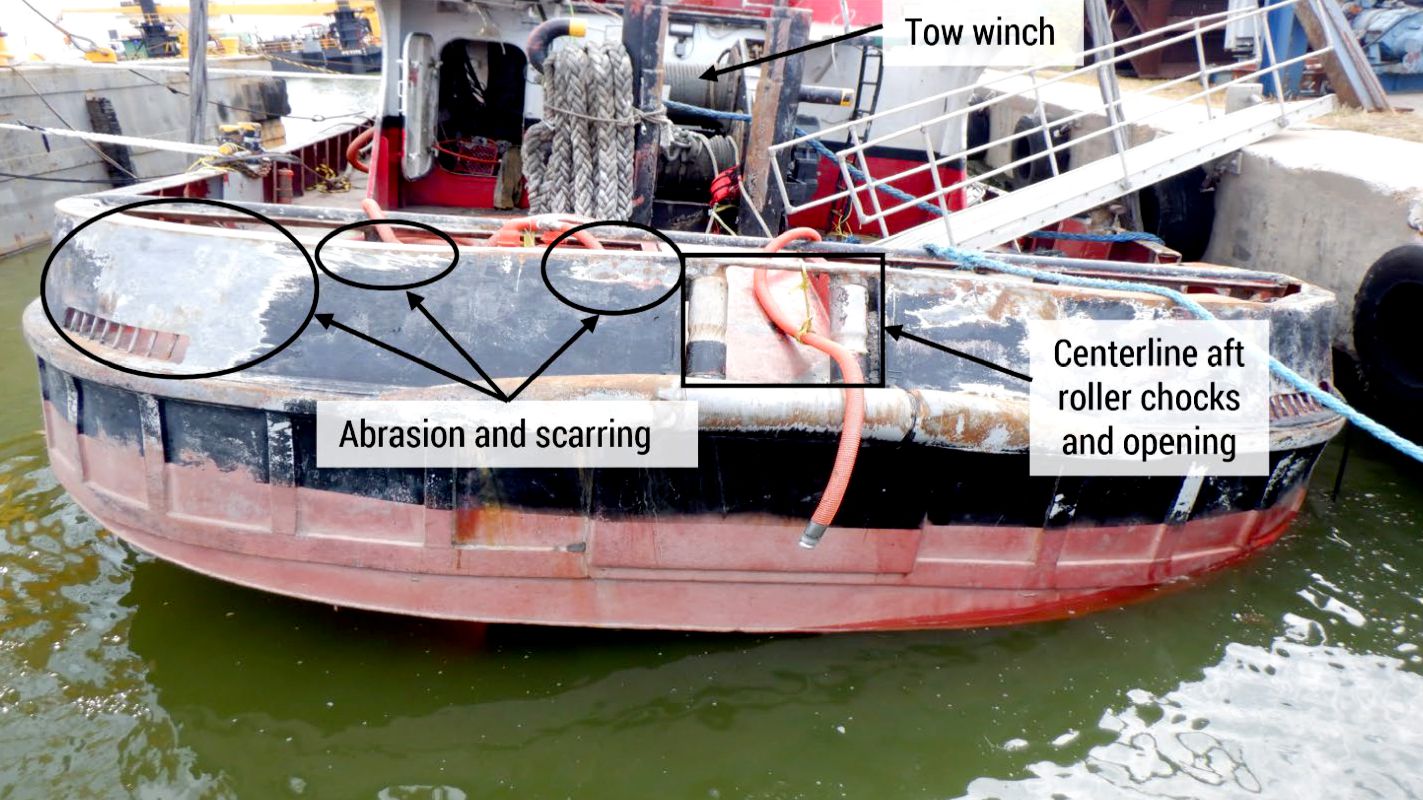
The remaining crew entered the water as the vessel sank, and the Baylor J. Tregre’s only liferaft self-deployed (automatically launched as designed once submerged). Deckhand 1 and the captain swam toward and entered the liferaft. The mate located and retrieved the vessel’s emergency position indicating radio beacon (EPIRB), which had floated free from the vessel. The seas pushed the mate away from the liferaft, so he attempted to swim to the barge but missed it by about 100 yards and decided to drift. The captain and deckhand 1 cut the sea painter, and the liferaft began to drift. The captain and deckhand 1 recovered deckhand 2 from the water, and shortly afterward, the mate spotted the drifting liferaft, swam to it, and was recovered by the crew.
At 1717, Coast Guard District 8 New Orleans received an EPIRB alert from the Baylor J. Tregre. Station Freeport (Texas) launched a response boat, and Air Station Houston launched an MH-65 helicopter. At 1804, the rescue helicopter crew spotted the liferaft and directed the response boat to the liferaft’s position. At 1808, the response boat crew recovered the four Baylor J. Tregre crewmembers. Deckhand 2 reported injuries and was airlifted by the rescue helicopter from the response boat and transported to a local hospital.
An assist tug arrived about 2130 that same evening, and its crew reported that the Baylor J. Tregre was not visible, but its towline was still tethered to the MARMAC 27, which was holding relative position. The next day, on May 14, a marine warranty surveyor boarded the MARMAC 27 for inspection. The surveyor found no damage to the cargo and reported that draft mark readings were “per the transit stability condition that was approved for the tow.”
On May 15, the tow wire connecting the B was cut, and the location was marked with a buoy. The M was towed to Freeport. Salvage Operations were conducted from May 18 to June 15. The salvor found the B in an inverted position on the ocean floor. The vessel was successfully raised and transported to a salvage dock in Galveston, Texas.
Probable Cause
The NTSB determines that the probable cause of the capsizing and sinking of the towing vessel Baylor J. Tregre was the mate’s inability to maneuver the tow into the wind due to the overwhelming towline force generated by the towed barge during the sudden onset of severe weather, resulting in unrecoverable heeling.