By Warren Miller
Reclamation projects have become increasingly popular as a tool to mitigate the effects of sea level rise in urban areas. Perhaps no city has taken an approach as bold as has Copen-hagen (København), the capitol of Denmark, a country surrounded on three sides by water.
The Copenhagen municipal government proposed in 2018 to build a series of islands and peninsulas on the outer perimeter of its extensive port to shield the city from the increasing effects of sea level rise and wave action.
Almost immediately after its presentation, the principle agreement got a broad support in both the Danish Parliament and the citizen assemblies in Copenhagen. Three years later, in June 2021, the Danish Parliament agreed on the final law to establish Lynetteholm.
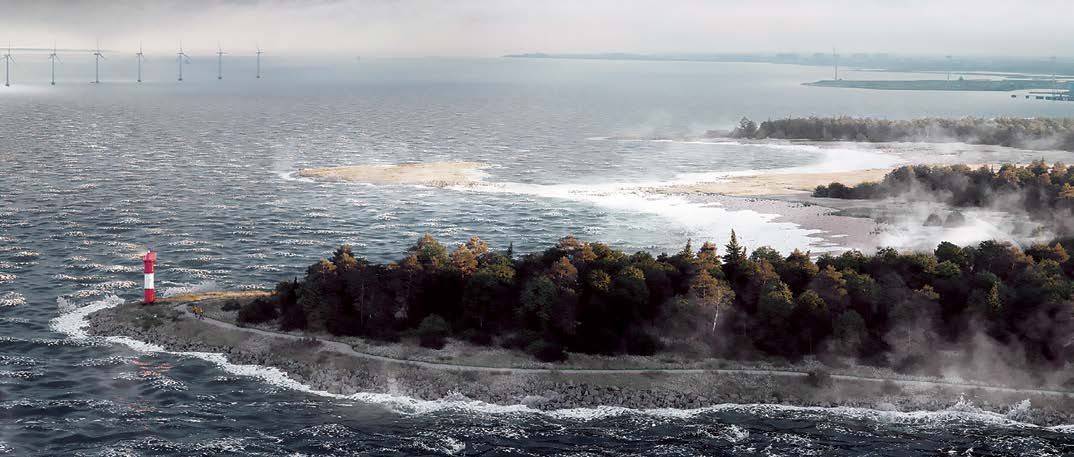
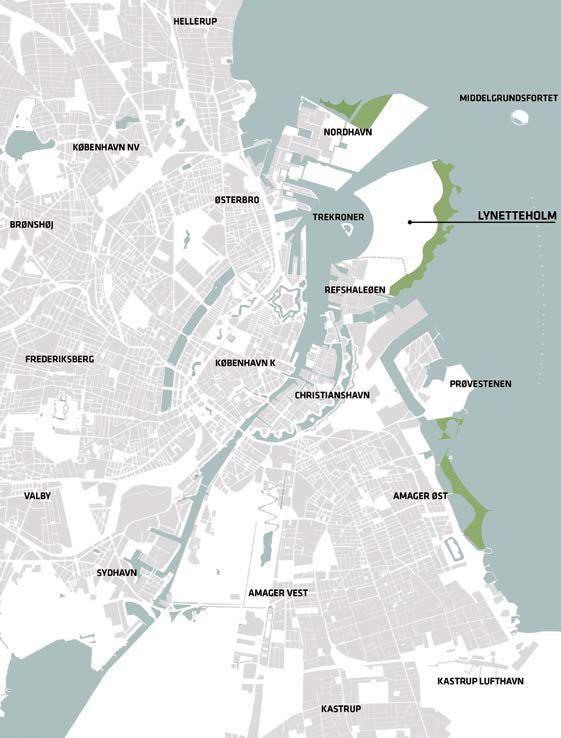
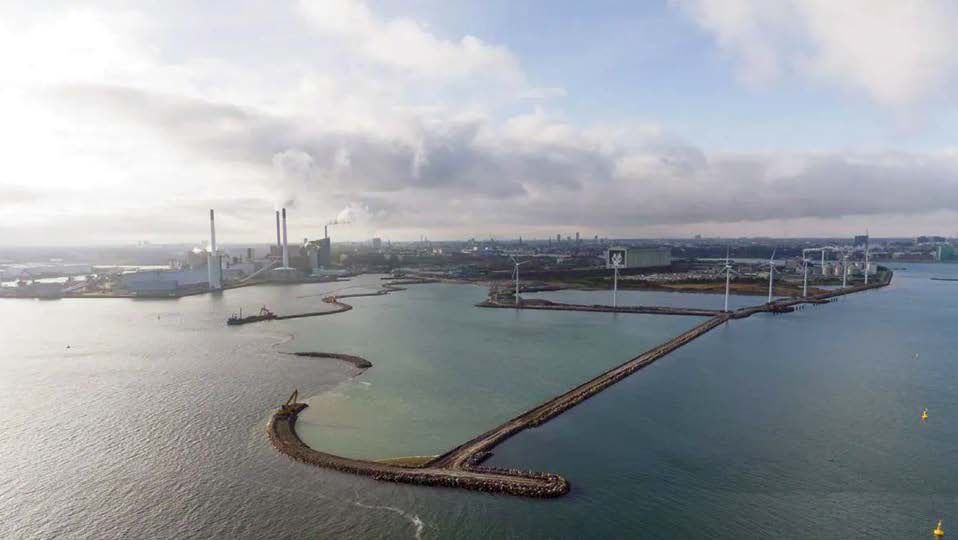
Lynetteholm—when completed—will be a 271- acre, man-made peninsula extending out into the Øresund, the narrow channel that connects the Baltic Sea with the wider passages (the Skagerrak and Kattegat) that lead to the North Sea and Atlantic Ocean.
The project was presented as a solution on four problems: housing shortage, climate control, traffic congestion and disposal of surplus soil. “Since Denmark is located between two large sea areas – the North Sea and the Baltic Sea – the risk from coastal flooding is high,” according to writer Ted Bartholomeuz in 2022. “This risk is only set to increase. Denmark’s Ministry of Environment has estimated that climate change could cause sea levels to rise by up to 1.2 meters within this century.”
Despite the widespread support, the project has drawn opposition from a number of environmental groups. The environmental group Klimabevægelsen i Danmark (Climate Movement in Denmark) lodged a petition with the European Parliament claiming the Danish government broke EU law by failing to carry out an adequate assessment of Lynetteholm’s environmental impact. The European Commission dismissed the complaint in September 2021.
The project also was met with public protests. At a ceremony marking the start of construction in January 2022, Copenhagen’s mayor, the city’s transport minister and the CEO of project lead developer By & Havn were surrounded by protesters as they symbolically shoveled Lynetteholm’s first piles of dirt. Lynetteholm’s development has continued as planned, however.
“Lynetteholm’s is part of the long-standing tradition of urban development and land reclamation that has characterized Copenhagen since it was first founded,” writes the Danish architectural firm that designed it, Arkitema, on its website. “Rather than considering the need for climate-proofing and flood protection a standalone project, Lynetteholm combines climate-proofing with urban development, and presents a unique opportunity to help protect the city against climate change and storm surges by taking a nature-based approach which also adds new urban qualities.”
And while Lynetteholm may be the largest and boldest reclamation project in Europe, it’s not an isolated event.
According to the non-profit American Geophysical Union, reclamation projects have created 253,000 hectares (976.8 square miles) of additional land to the earth’s coastal surface in the 21st century, equivalent to an area the size of Luxembourg. Seventy percent of recent reclamation has occurred in areas identified as high risk to extreme sea level rise by 2100.
Lynetteholm’s size allows for what its designers call a more natural approach to absorb wave action. The shoreline is a “process landscape,” an environment that will take shape over time. And it will be wide and flat, says one of the project’s designers.
“Instead of going vertically high, we go wide,” Ole Schrøder, a partner at Tredje Natur, a landscape architecture firm involved in the project, told CNN in 2023. “We can better ac-cumulate the waves with a beach landscape that absorbs them with a natural approach.”
Real estate developer By & Havn believes the capelike design is essential for the protection of the port city, highlighting Copenhagen’s history of dangerous storms and severe flooding.
“We are building Lynetteholm on a long tradition of infilling and land reclamation,” the company writes on its website. “Copenhagen’s geography has been in constant development since Christian IV established the first major expansions of the city, such as Christianshavn [founded in 1619]. By constructing Lynetteholm in the water, we are creating space for excess soil from Copenhagen’s construction site to be used to protect the city against storm surges, while at the same time establishing a coastal landscape, a form of beach park with forest and beach areas, which must be included in an overall storm surge plan for Copenhagen.”
Aarsleff continues construction work at Lynetteholm
Last October, Per Aarsleff A/S entered into a contract with By&Havn A/S for the construction of the second phase of Lynetteholm which is Copenhagen’s new peninsula and flood protection.
Phase Two is divided into three contracts, and Aarsleff has been awarded all three con-tracts which comprise the execution of Lynetteholm’s eastern, western and northern perimeter, together constituting the last phase of Lynetteholm’s entire outside edge.
“Lynetteholm is an exciting and challenging project,” says Jesper Kristian Jacobsen, CEO of Aarsleff. “By & Havn’s ambitious approach to the request concerning reduction of the CO2 emission in the building process inspires us to finding new and more sustainable solutions within the building and construction business. And here, Aarsleff can and wants to con-tribute. We are therefore looking forward to continuing our good cooperation with By & Havn.”
Per Aarsleff A/S and its sister company VG Entreprenør A/S are to incorporate 3,153,000 tons of quarry stones in the seven-kilometer-long embankments which provide the entire perimeter of Phase Two. The embankments will be up to 60 meters wide and up to 16 meters high. The top three meters will rise above normal daily water levels. Similar to phase 1, By & Havn has focused on the CO2 emission of the project, and in phase 2 the requirements are intensified.
“We, as the contractor, must do our utmost to reduce the CO2 emission during the entire construction project, including keeping CO2 accounts for documentation of our efforts, Jacobsen added.
In the spring of 2023, Aarsleff completed the first part of Lynetteholm’s perimeter in Phase 1 of the project. Construction work of Phase Two began last October and must be completed in March 2026.
The total contract value of Aarsleff’s contracts for Lynetteholm’s phase 2 is DKK (Danish krone) 2.15 billion, or U.S. $315,378,125.
Source: Per Aarsleff A/S website
Reprinted from Marine Construction Magazine, Issue I, 2024.