The following is a reprint that we previously published— a guide to inspecting concrete, excerpted from materials published by the U.S. Department of Defense’s United Facilities Criteria (UFC).
Scoping the Problem
Concrete damage appears in the following forms:
- Corroded rebar;
- Alkali-silica reaction;
- Freeze/thaw deterioration;
- Abrasion wear;
- Chemical deterioration from saltwater;
- Overloading deterioration;
- Shrinkage.
As with timber structures, concrete damage is found by walking the pier deck, inspecting below the pier deck in a small boat or barge, and underwater inspections. The primary method of inspecting concrete is visual observation and sounding with a hammer. Only after problems are detected should other inspection methods be used. These other methods may include chipping away loose concrete to reveal the steel, coring, or Schmidt hammer
Surface Inspections. The “Concrete Structures and Attachments (Above Water) Checklist” can be used to do a thorough inspection of all concrete structures and their attachments above water. Include annual load testing of the pier decking if heavy equipment or vehicles are to be driven onto the pier.
Areas where the inspector should be particularly watchful for signs of deterioration, include:
- Inside corners and areas where radical changes occur in size of deck sections, curbs, and bollards;
- Construction joints;
- Poorly designed scuppers, drips, and curb slots, and other areas where inadequate drainage exists;
- Joints between the deck and pile cap, expansion joints where insufficient gap is allowed, and rigid joints between precast piles and cast-in-place pile caps.
The inspector should be alert for any change in appearance of the concrete surface and any change in the sound from the hammer:
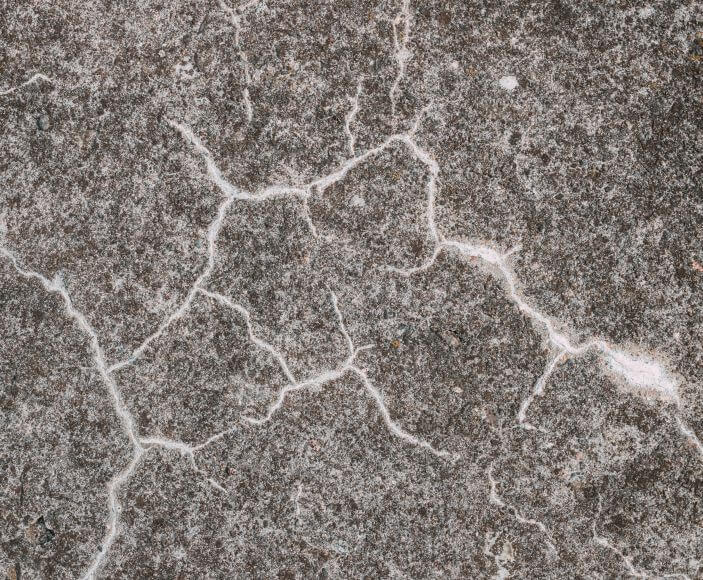
- Erosion of the surface material or by cracking on the surface are signs of chemical attack;
- Erosion of surface material is a sign of freeze-thaw deterioration.
Use a hammer or gad (sharp pointed tool) to chip or probe the surface to detect the depth of deterioration.
Corrosion of the reinforcement can be detected from rust stains on the surface. More advanced stages of corrosion is indicated by cracks that run parallel to the steel reinforcing bars. At times, corrosion is hidden from view, but will be indicated by a hollow sound from the hammer. This can occur on heavily reinforced slabs, such as pier decks, where the reinforcement has corroded enough to delaminate a layer of concrete at the level of the reinforcing mat.
Sampling Equipment, Measurements and Ratings for Concrete Structures
| Special Sampling Equipment | Measurement, Ratings or Samplings |
|---|---|
| Half-cell potential measurements | Location and size of damaged area |
| Schmidt hammer | |
| Hammer | |
| Chipping tool | Depth of chips, cracks, spalls, etc. Powder samples for chloride contamination |
| Concrete rotary drill | Drilled concrete cores for laboratory analysis |
| Pachometer | Rebar locator |
Give special attention to cracks found on the surface of a concrete structure. Make sketches that show the length and direction of the cracks. Overall cracking patterns and changes in crack length, width and direction with time are meaningful data to a structural engineer. Photographs are helpful, but only as a supplement to the sketches.
If there is evidence of significant deterioration, more detailed non-destructive testing (NDT) techniques may be used in a scheduled Level III inspection. The plan and sampling techniques should be tailored to the specific areas of concern.
Underwater Inspection. The “Concrete Structures and Attachments (Below Water) Checklist” can be used to ensure that a thorough inspection of all concrete structures and their attachments below water is done. An engineer should explain to the diver exactly what should be looked for: number and size of piles, type and depth of bulkheads. The engineer will evaluate the diver’s observations and determine the degree of corrosion.
Concrete Structures and
Attachments (Above Water)
CHECKLIST
| Deck Area |
|---|
| Check horizontal and vertical alignment |
| Check for missing, broken, or loose connections, obstructions and other hazardous conditions of curbs, handrails and catwalks. |
| Check bollards, bits, cleats and capstans for wear, breaks, rough or sharp surfaces or edges, and missing or loose bolts. |
| Check deck drains and scuppers for loose, missing or broken screws, water ponding and other deficiencies. |
| Check manhole covers and grating fro rust, corrosion, bent or worn hinge pins, and other damage. |
| Inspect concrete deck surface, curbs, utility trenches and gallery areas for cracks, spalling, loose joint sealers, and other damage. Closely inspect for corrosion of reinforcing steel and visual signs of rust. |
| Check ladders for corrosion, and broken, bent or missing rungs. |
| Check grounding connections for security |
| Exposed Area Under Pile or Along Wharf or Dolphin Assembly |
|---|
| Check pile caps and bearing, batter and fender piles for damaged or broken members, cracks and spalling of concrete, rust stains, and exposed reinforcing steel. |
| Check for efflorescence, and general disintegration of the underside of pier decking and pile caps (Figure 5-13). |
| Check bottom scouring or undermining. |
| Check for evidence of shrinkage, swelling, and chemical deterioration; freeze/thaw deterioration; abrasion wear; and overload damage of piles as shown in Figure 5-14 |
| Sound the piling or structure with a hammer to detect any loose layers of concrete or hollow spots. A sharp ringing noise indicates sound concrete. A soft surface will be detected, not only by a sound change, but also by the change in the rebound, or feel, of the hammer. A thud or hollow sound indicates a delaminated layer of concrete, most likely for corrosion of steel reinforcement. |
Level III Test Procedures for Concrete Inspection. If signs of deterioration or damage are found by Level I or II inspections then a Level III inspection, involving either nondestructive or destructive tests, may be required. Level III concrete inspections use mechanical and electrical test methods.
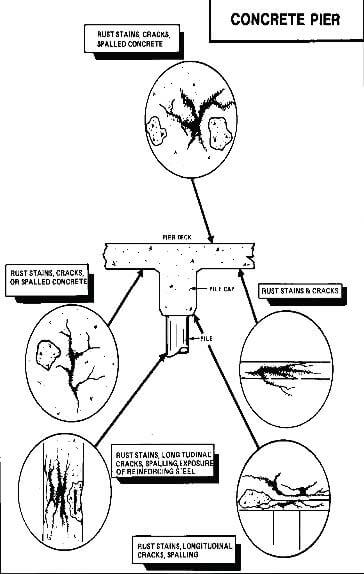
CONCRETE PIER
Inspection Areas for Visual Indications of Concrete and Reinforcement Deterioration
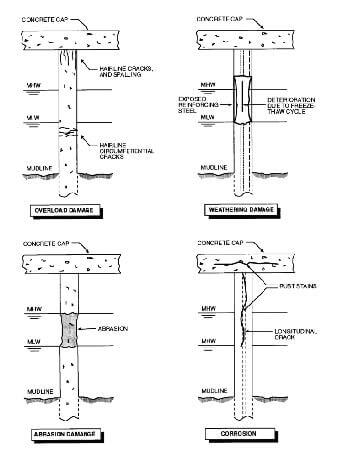
CONCRETE PILES
Typical Damage to Concrete Piles from Non-Biological Sources
Mechanical and electrical test methods include:
- The Schmidt test hammer may be used in order to compare the relative surface quality of concrete at different locations on the same structure. The instrument measures the hardness of concrete surfaces by the extent of rebound of a spring-loaded steel plunger in a tubular frame. The relative surface quality of the concrete, which is also an indication of its compressive strength, can be obtained. Surface texture may reduce values obtained.
- Core samples are destructive in nature and should only be used if other techniques cannot satisfactorily define the damage. Core samples may be taken from selected areas in order to determine the cause and depth of deterioration, chloride, ion contamination for petrographic analyses, and the actual compressive strength. Take special care when setting up to drill a core, in order to avoid hitting steel reinforcement, especially prestressed steel. Steel reinforcement near the surface can be located by using a pachometer (rebar locator). The length of the core sample should be twice the diameter. After the core has been taken, patch the hole with non-shrink cementitious mortar.
- The ASTM C876 test method Corrosion Potentials of Uncoated Reinforcing Steel in Concrete can be used to determine the extent of active corrosion and the degree of susceptibility of corrosion in other areas in the structure. Corrosion can be detected before visible signs appear. The method detects corrosion by measuring the electrical potential of the steel. An electrical connection is made from one side of a voltmeter to an embedded steel-reinforcing bar that has been exposed. The other side of the voltmeter is connected to a copper sulfate half-cell, which is then put in contact with the concrete surface at various locations. The magnitude and sign of the resulting voltage is an indication of corrosion activity.
- Ultrasonic methods are available to inspect concrete for voids that cannot be seen, such as honeycomb pockets, and for internal deterioration by cracking. Pulse velocities and fundamental frequencies are imposed in the concrete structure to search for imperfections. Sonic methods conducted at specific time intervals can monitor progressive deterioration. Interpretation of data is a highly specialized skill.
Before starting any of the above tests, a test plan must be prepared and the areas to be tested must be cleaned thoroughly.