BY THE AMERICAN SOCIETY OF CIVIL ENGINEERS (ASCE)
America’s infrastructure is the foundation on which our national economy, global competitiveness, and quality of life depend.
While often taken for granted when it is working properly, every American household or business immediately feels the impact of just one inefficiency or failure in our built environment. Our infrastructure includes an interconnected system of highways, streets, public buildings, mass transit, ports, airports, inland waterways, water systems, waste facilities, the electric grid, broadband networks, dams, levees, and other public and private facilities. Maintaining these networks is essential to meet economic demands and protect public health and safety. For American families and businesses to thrive, we need a first-class infrastructure system that moves people and goods safely, sustainably, efficiently, and affordably by land, water, and air; energy transmission systems that deliver clean, dependable, low-cost power; and water systems that reliably and safely drive industrial processes, as well as the daily functions of our communities.
Since 1998, ASCE has issued a quadrennial assessment of the United States’ infrastructure networks, known as the Report Card for America’s Infrastructure. For more than two decades, the message behind the unflattering grades was consistent: federal, state, and local governments, in addition to the private sector, have not been prioritizing our interdependent infrastructure systems. In sum, the bill on our infrastructure systems was past due. We needed to reverse the nation’s growing infrastructure investment gap to remain competitive in the global marketplace, allow local businesses to thrive, and keep our families safely connected. That message grew louder with each evaluation, through our most recent Report Card release in early 2021.
However, in late 2021, the trend began to change. Congress passed the Infrastructure Investment and Jobs Act (IIJA), the most comprehensive federal investment in the nation’s infrastructure in U.S. history. The law included many of the solutions to raise the grades featured in ASCE’s 2021 Report Card, including robust resources for water infrastructure, transportation, and related areas.
A few years later, IIJA investments and policy changes are already improving the performance of our transportation, water, energy, and waste networks.
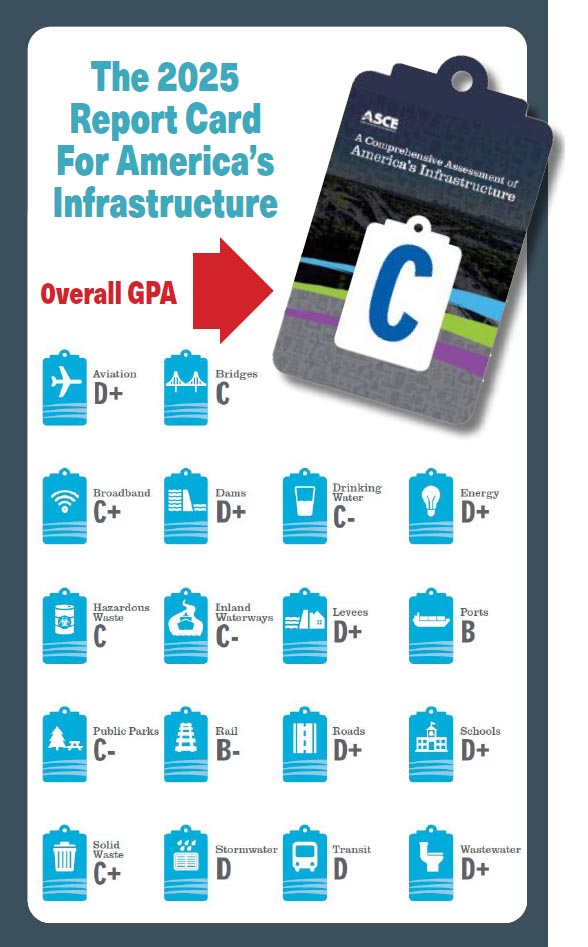
As a result, nearly half of the grades are increasing for the 18 categories we assess in this 2025 Report Card for America’s Infrastructure. This forward momentum is due in large part to the actions of the federal government in partnership with state and local governments and the private sector.
Unfortunately, while significant advancements are being made, we still face a substantial investment gap. The shortfall grows as existing infrastructure systems continue to age and demands on those systems increase. In addition, passage of the IIJA has shed light on key issues affecting our industry.
Projects should be modernized or replaced by prioritizing resilience to withstand extreme weather. Resilience-focused measures may add to upfront costs but save on sudden, less predictable, and large financial impacts from disasterrelated damages. Infrastructure projects take a long time to develop, and stakeholders may hesitate to pursue resilient designs without assurances that current funding levels will be sustained in the future. These are just a few of the challenges we continue to face.
The 2025 Report Card for America’s Infrastructure provides a snapshot of how our infrastructure systems are faring and offers solutions for improving the performance of each category. For the second consecutive report, Report Card grades show that U.S. infrastructure is trending in the right direction thanks to comprehensive support, innovative solutions, and bold leadership. Continued action will further improve these networks, unlocking the full potential of our nation’s economy and creating opportunities for all Americans. Key Findings
The 2025 Report Card for America’s Infrastructure demonstrates that recent federal investments have positively affected many of the infrastructure sectors Americans rely on every day. As a result, incremental improvements were made across some of the historically lowest-graded categories in the Report Card.
Almost half of the 18 assessed categories saw increased grades and contributed to an overall grade improvement from C- to C. This is promising momentum, but sustained infrastructure investments are necessary to equip stakeholders with certainty for long-term planning and execution of policies and projects that fully realize the benefits of robust resources.
The 2025 grades range from a B in ports to a D in stormwater and transit. For the first time since 1998, no Report Card categories were rated D−. Among the 18 categories assessed, eight saw grade increases. Many of those categories had been chronically stuck at D- or D for years. This improvement was possible due to the government and private sector prioritizing investments in systems that historically had received little attention. Two categories—energy and rail—were downgraded because of concerns related to capacity, future needs, and safety. Broadband was introduced as a graded category in 2025, coming in at a C+. Although evidence points to improvements throughout infrastructure’s system-of-systems, nine categories remained within the D range—a clear sign that more needs to be done to improve the health of America’s built environment.
Though distinct in function, the 18 infrastructure categories operate collectively to provide essential services for people and communities. Several key trends appeared in our review that indicate continued gaps exist despite recent infrastructure upgrades. The following trends are worth noting:
1. Aging infrastructure systems are increasingly vulnerable to natural disasters and extreme weather events, creating unexpected and often avoidable risks to public safety and the economy.
Climate-related challenges are widespread, affecting even regions previously resistant to these events: floods become more intense and occur more often, hurricanes create higher wind loads, and wildfires encroach more unpredictably. Investments in resilient infrastructure are consistently proven to be an effective use of limited public dollars, because they reduce costs in the long term, especially by minimizing rebuilding needs after a significant event. For instance, by adopting the most up-to-date codes and standards, communities will be better equipped to handle disasters and more responsibly deploy public resources.
2. Recent federal and state investments have had a positive impact, but the full force of increased funding will take years to realize. Sustained investment is key to providing certainty and ensuring planning goes to development, as well as making larger infrastructure projects attainable.
Before recent federal legislation, like 2021’s Infrastructure Investment and Jobs Act (IIJA), many of our infrastructure networks had been neglected for decades at the federal level. As time passed and investments failed to keep pace with demands, the backlog of maintenance projects grew. Meanwhile, demands on infrastructure systems have intensified apart from maintenance. Community expansion and usage trends, economic growth, unpredictable events, and new technologies have called for new plans and project design. These raised stakes require the federal government to continue prioritizing infrastructure investments. Therefore, federal decision-makers will need to preserve momentum from continued partnerships with state and local governments that match investments and facilitate planning.
Considering the extensive time it takes to study, design, and complete projects, sustained investment at current or higher funding levels will be necessary for infrastructure to continue to improve.
3. Unreliable or unavailable data on key performance indicators continues to impact certain infrastructure sectors.
Sectors like school facilities, broadband, energy, levees, stormwater, and public parks continue to lack extensive public data. Robust information on asset conditions, capacity, operations, safety, or resilience enables proactive public discussion on infrastructure. Many infrastructure categories lack a basic inventory of assets and therefore are unable to implement asset management practices. Data—publicly available, routine, and reliable—should be standard across all infrastructure sectors to target investments and allow decision-makers to wisely allocate limited funding to needs. Through enhanced data, both efficiency and effectiveness of assets can be better achieved.
ASCE applauds Congress, state and local policymakers, and the private sector for demonstrating leadership over the past several years and prioritizing our nation’s infrastructure. Those investments are starting to have an impact, but our work is not yet complete. As decisionmakers look to the future of America’s infrastructure, they should weigh the consequences of insufficient support in our most vital networks.
For decades, investment at all levels of government and the private sector has failed to keep up with the increasing demands and projects necessary to reach a state of good repair. By incentivizing innovation and maintaining—or in some cases adding—investment, America will sustain recent momentum on our infrastructure systems and ensure they are built for the needs of the 21st century.
The American Society of Civil Engineers, founded in 1852, is the country’s oldest national civil engineering organization. It represents more than 160,000 civil engineers in private practice, government, industry, and academia who are dedicated to advancing the science and the profession of civil engineering, and protecting public health, safety, and welfare.
The full version of this report can be found at: www.infrastructurereportcard.org.