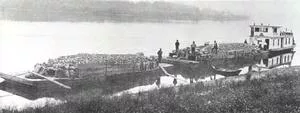
Before the arrival of the railroads and hard-surfaced roadways, the Illinois River was the main artery by which agricultural products were sent to markets and by which manufactured and processed goods were delivered to the people who lived along its banks.
By 1831, Beardstown became an important trade center, with Havana to follow by 1840. Steamers and packet lines grew rapidly to 59 boats on the Illinois by 1850.
Introduction of Barges
The use of barges to carry commodities began as early as the 1840s. From the 1840s to the 1860s, loaded keelboats tied to the sides of steamboats served as the first barges. From 1858 to 1867, the Illinois Packet Company used 16 steamboats and 16 barges to export local agricultural products to St. Louis and Chicago and import building materials and machinery.
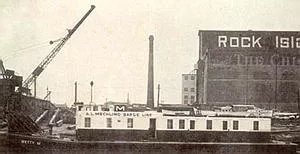
By 1865, shipping companies were tying flat-bottomed, shell-draft barges to the steamboats. Their advantages were ease of loading, flexibility, rapid pick-up and delivery, and the grain or coal did not have to be packed—it could be piled directly on the deck. It was also very economical at $.04 per bushel.
However, river trade after 1860 consisted mostly of low-class freight, such as sand and gravel, and local traffic from one Illinois river town to another. The railroad had garnered most of the grain shipping. From 1887 to 1903, the rate from St. Louis to New Orleans was $.05 to $.09 per bushel cheaper than rail.
As barge numbers increased, steamboat design was changed to allow them to push barges. The steamboat became taller and sleeker and had stronger engines steered by multiple rudders. Five to six large barges could hold as much product as one hundred rail cars. In 1869, Congress appropriated $84,000 for navigational improvements to the Illinois. However, by 1893 the idea of dams and locks was abandoned in favor of roads and rail. In 1900, the Chicago Sanitary and Shipping Canal moved more water into the Illinois River. Still, traffic decreased until reaching a low point of river traffic from 1920 to 1930 to just between 100,000 and 200,000 tons.
Modern Improvements
The decline in barge traffic was reversed when the Federal Control Act of 1918 created the Inland Waterways Corporation, which brought new terminals for barges on the Mississippi and new designs for barges and towboats. Diesel engines replaced steam. Barges could carry one to two thousand tons each. Nine-foot-deep channels were dredged to accommodate the increased size of vessels. The Illinois Waterways Project was finished in 1939.
Traffic gradually increased on the Illinois from 7 million tons in 1945 to 25.5 million tons in 1970.