When it comes to aligning our members and our industry on ever-evolving issues and topics of importance, words matter.
It’s why AEM and its member leaders developed three industry guidance documents to help nonroad equipment manufacturers use agreed-upon common language when representing the industry and discussing the topics of autonomy, cybersecurity and data.
The documents provide structured vocabulary for industry representatives as they engage in conversations and share information:
- inside and outside of the industry;
- with lawmakers and regulators;
- with customers and equipment end users; and
- with the general public.
The direct result of collaboration between AEM member company representatives of AEM’s Ag Technology Leadership Group and CE Technology Leadership Group, these documents serve as resources for educating customers, end users, lawmakers, regulators and the general public on:
- the implementation of autonomy in our industry;
- the levels of cybersecurity for machine data today; and
- how equipment data is accessed.
The documents are not intended to be all-inclusive or all-encompassing, but instead serve to offer a glimpse into the implementation of autonomy, cybersecurity, and data in the non-road industry.
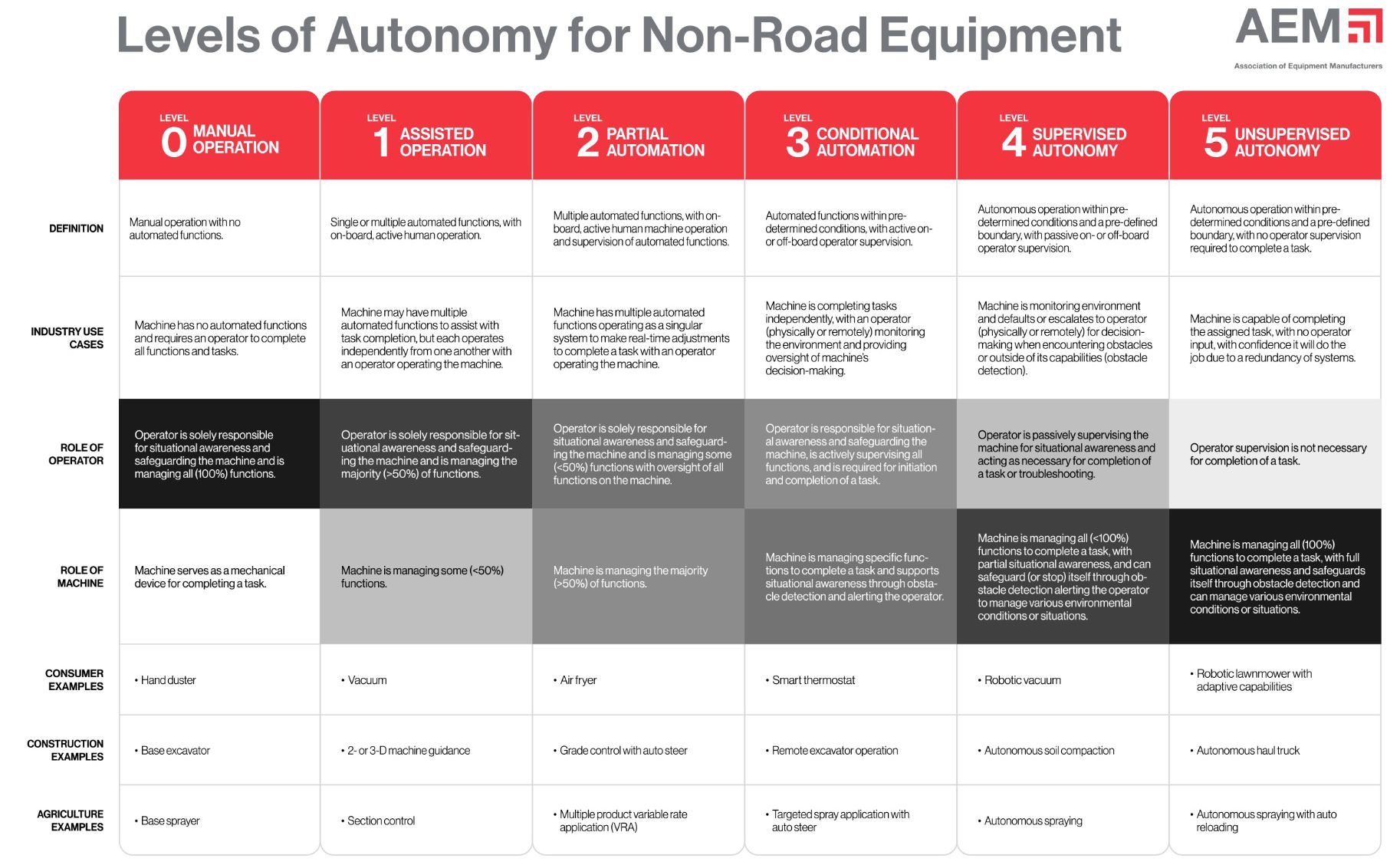
Levels of Autonomy for Non- Road Equipment
Non-road equipment is designed to execute specific functions relative to its intended applications and tasks in nonroad environments in agriculture and construction. Construction worksites, farm fields, dairies and feedlots, areas of animal husbandry, etc., are dynamic environments defined by fences or other boundaries with some level of restriction for access or entry. These do not apply to on-road operation of non-road equipment.
It is important to note that autonomous operation is based on pre-determined conditions for operation and pre-defined boundaries for work. This is one of many unique distinctions between the non-road and on-road industries.
For the purposes of this document, a machine can be a single machine or a combination of machines, products, and systems (components working in coordination, acting with selfawareness within a system). It should be noted that an operator can take control of a machine at all times, in any of the levels highlighted in this document.
The Levels of Autonomy for Non-Road Equipment include five categories:
- manual operation – Manual operations with no automated functions;
- assisted operation – Single or multiple functions, with onboard, active human operation;
- partial automation – Multiple automated functions, with onboard, active human machine operation and supervision of automated functions;
- conditional automation – Automated functioning within predetermined conditions, with active or on-board supervision;
- supervised autonomy – Autonomous operation within predetermined conditions and a pre-defined boundary, with passive on- or off-board operator supervision; and
- unsupervised autonomy – Autonomous operation within predetermined conditions and a pre-defined boundary, with no operator supervision required to complete a task.
Cybersecurity for Machine Data for Non-Road Equipment
Construction worksites, farm fields, dairies and feedlots, areas of animal husbandry and other worksites are dynamic environments defined by fences or other boundaries with some level of restriction for access or entry. equipment.
The AEM document covers examples of systems and data they collect in three categories: onmachine data; during the transfer of data (such as, to off-board servers or the cloud); and offmachine, including performance metrics and to third-part management systems,
As in all three documents, the primary focus is on following the data and who has responsibility for its security; the existing standards (ISO 24882, for example); and example scenarios and situations.
Data Layers for Non-Road Equipment
A fleet includes a system of individual IoT devices (machines) and external data inputs (weather monitoring, ground conditions, project progress trackers, etc.).
The layers are divided into three categories: on-board data (sensors and controller that gather asset=- level data); individual asset subsystem, involved with gathering and formatting asset-level data; transfer layer, dealing with transferring asset-level to larger systems; and off-board data, packaging data from multiple assets into a system.
The Association of Equipment Manufacturers (AEM) is the North American-based international trade group representing non-road equipment manufacturers and suppliers, with more than 1,100 member companies and over 200 product types across diverse industry sectors, including construction.
The documents mentioned can be downloaded at: AEM Guidance Documents: Common Language for Non-Road Equipment Manufacturers – AEM | Association of Equipment Manufacturers