The LGM 1130 introduced in 1974 was Liebherr’s first mobile harbor crane, and the crane has evolved significantly ever since.
Progress evolves with the times and new lessons gained from experience. Liebherr has developed its flagship mobile harbor crane over five decades of changing industry demands, standards, and trends. Upgrades over the years have ultimately served to accommodate larger and heavier cargoes, while maintaining high standards in performance and reliability. This has included updates to the crane’s tower and boom, to modifications in its undercarriage. In recent years, all-electric cranes optimized for energy efficiency and sustainability have come to the forefront. And the newest LHM series focuses on advanced electronics and sensor technology for future automation.
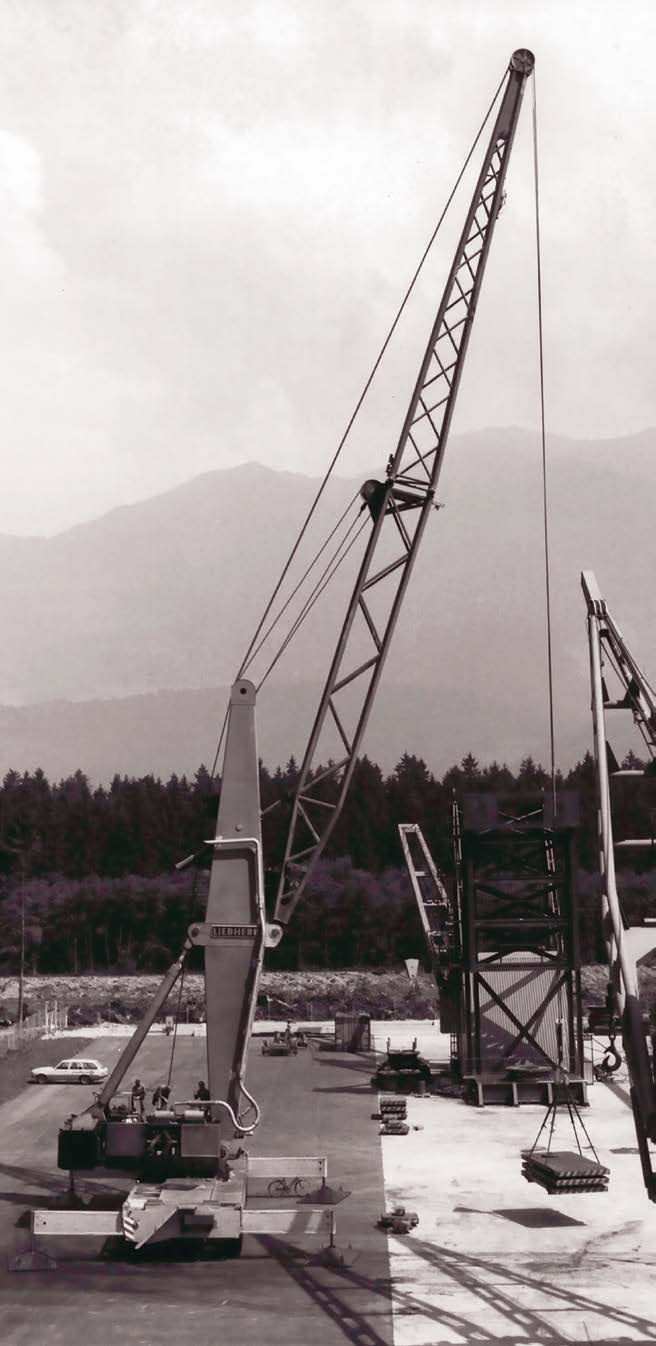
The legacy and evolution of the Liebherr mobile harbor crane couldn’t be more illustrative than with the LGM 1130 introduced in 1974. Mobile harbor cranes in those times were often used as backup for STS container cranes, positioned under the container crane itself. This was made possible through a folding- tower design that allowed the LGM to fold its boom, drive underneath the container crane, and erect itself again to then support the STS. The LGM was introduced during a period when containerization was becoming increasingly dominant, and global trade routes were expanding.
Mobile harbor cranes are renowned for their flexibility and versatility, and this trait was reinforced over time. Capable of handling various applications such as bulk handling, container handling, and heavy goods transport, these cranes needed to offer more efficiency compared to other port equipment. The rubber-tired undercarriage provides excellent load distribution, eliminating the need for extensive quay preparation and allowing for easy transition to new projects or ports.
With the introduction of the LHM 250 in 1996, new benchmarks for efficiency and innovation were set. This crane featured an X-shaped undercarriage and individually steerable wheelsets, allowing for improved maneuverability in increasingly narrow port environments. The LHM 250 was also the first Liebherr mobile harbor crane to incorporate telemetry, enabling remote monitoring and data transmission. This innovation was crucial as the industry demanded greater efficiency and larger cranes to handle the growing size and capacity of container ships.
“Over the years, Liebherr has continuously adapted to market demands, introducing groundbreaking models that have had an impact on port operations,” says Sebastian Simon, product manager at Liebherr Rostock. “Our commitment to innovation and quality has made us a trusted partner in the maritime industry.”
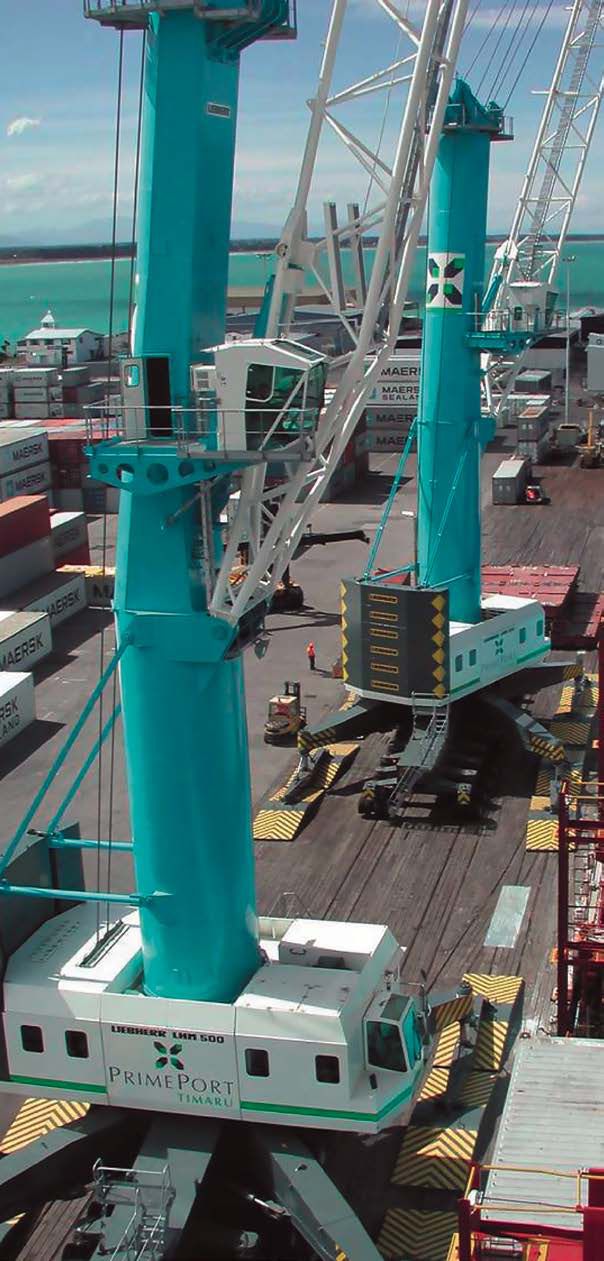
The LHM 500, launched in 2002, continued this legacy with its robust design and increased focus on environmental sustainability. The crane’s tubular tower and 4-chord boom were designed to enhance steelwork reliability, extending the crane’s lifecycle and reducing its environmental impact. In 2010, innovation saw a shift towards the integration of digital technologies and automation in port operations, with the LHM 550 incorporating advanced telemetry and other features.
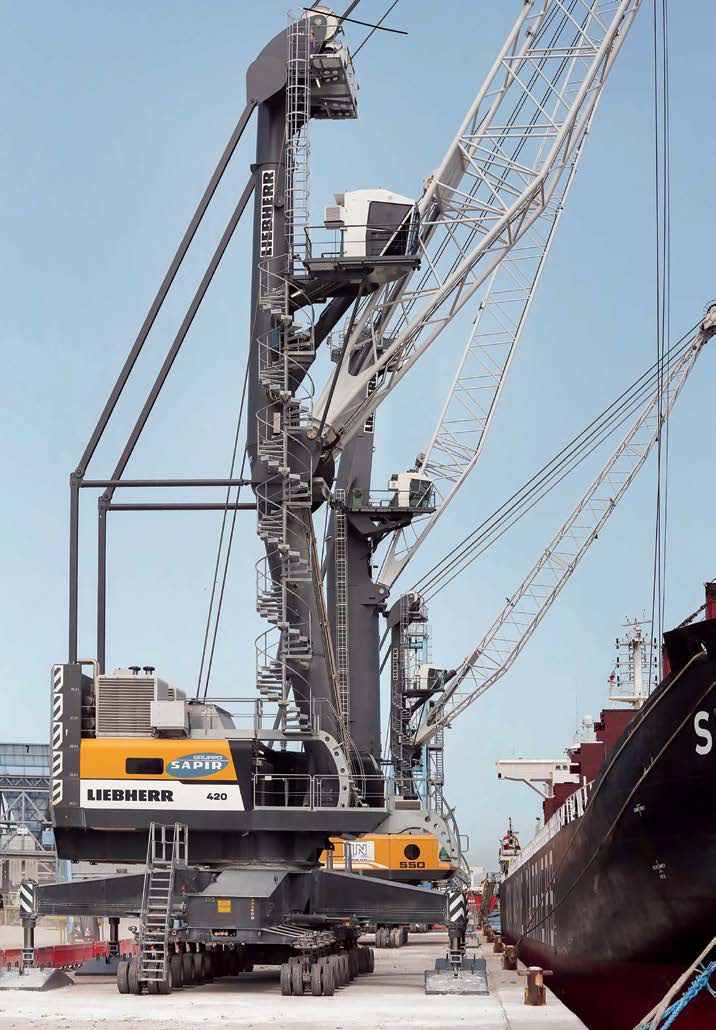
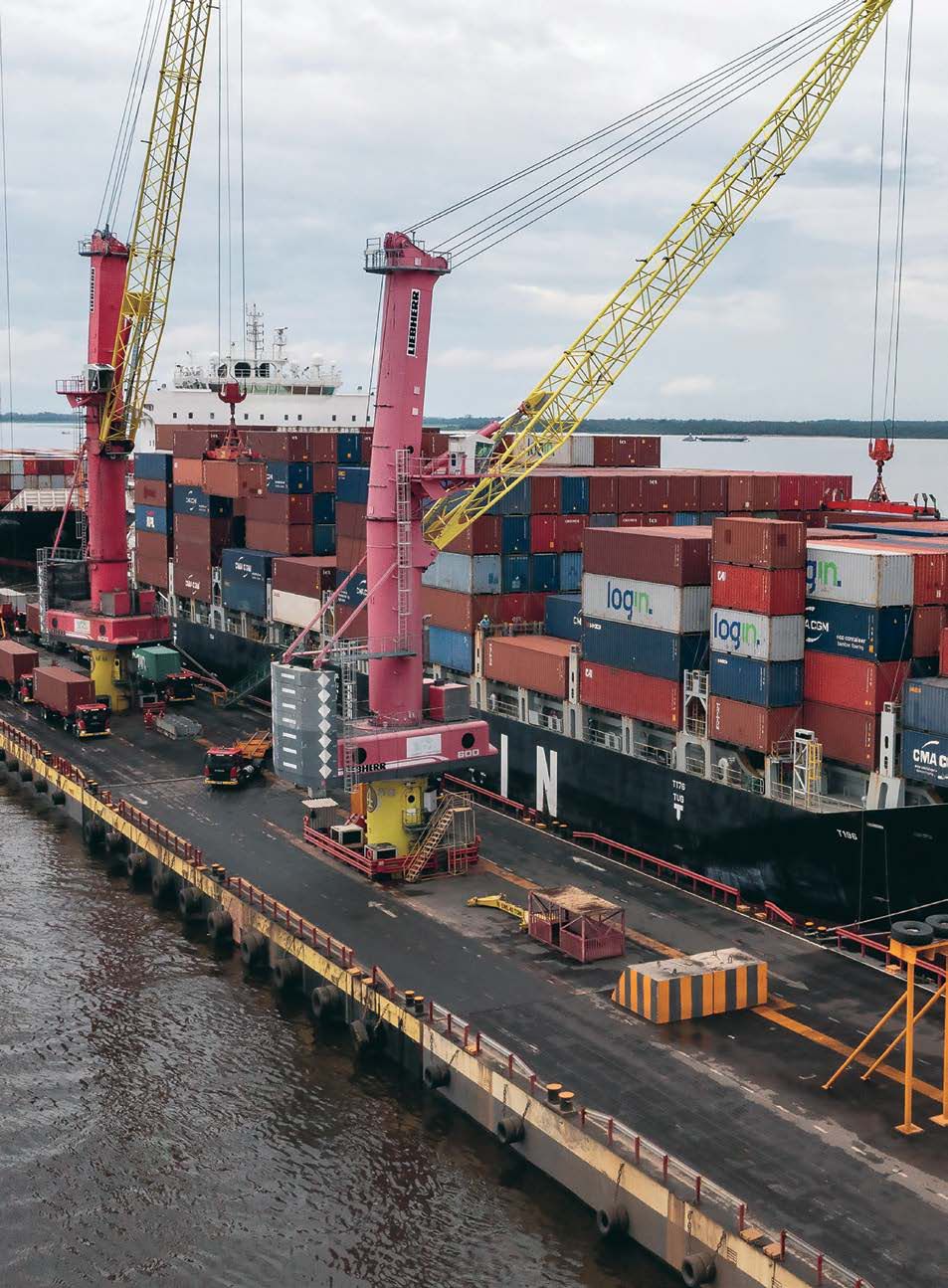
Enhancing technical capabilities is just one aspect of improving logistical operations. Maximizing limited space is another, and portal crane solutions excel in this area. Liebherr’s LPS cranes have been pivotal in port operations for decades. Their rail-mounted configurations and space-saving portal undercarriage, combined with versatile mobile harbor crane technology, ensure efficient cargo handling in tight locations. The LPS series, including models like the LPS 420 E, epitomizes innovation and practicality, handling containers, bulk goods, and heavy lifts up to 308 tonnes with the LPS 800 cranes. This system uses a special energy storage device that combines gas and hydraulic fluid to store and release energy when needed. This clever setup boosts hoisting speeds without requiring a bigger diesel engine, which means less pollution and better performance. The Pactronic system is also known for its quick charging, long lifespan, and recyclability, making it a smart and sustainable choice for the future of port logistics. It has a significantly higher energy capacity than conventionally used electrical energy storage devices, such as high-performance capacitors.
Going all-electric for more sustainable port logistics
One of the standout developments in port logistics over the past decade is the increasing demand for a more sustainable infrastructure. In 2019, the LPS 420 E marked a significant milestone as Liebherr’s first all-electric portal crane. It features permanently excited synchronous motors, significantly reducing energy consumption, especially during idling times. All crane movements – like luffing, hoisting, slewing, and traveling – were done by electric motors, no hydraulics required. The LPS 420 E was designed for high-efficiency bulk and container operations, reflecting the industry’s increasing focus on reducing CO2 footprints. But it was not the first innovation for electric drives. For more than a quarter century now, Liebherr mobile harbor cranes do not emit any CO2 during operation when their electric prime movers are in operation, according to the Scope 1 GHG protocol, and provided that the port has the corresponding infrastructure for it.
Assistance systems help optimist logistics – SmartGrip, Sycratronic, Pactronic
The assistance systems that launched soon after the LHM 550 came to market helped evolve the logistical capabilities of mobile harbor cranes. Smart- Grip, launched in 2014, is an intelligent system that optimizes grab filling rates through self-learning. It offers higher performance and nearly eliminates overloads. Analyses showed that only 70% of the grab’s capacity was typically used due to factors like suboptimal angles and varying material densities. SmartGrip adjusts automatically, recognizing bulk density, compression, granularity, and conditions like depth of impression and grab type. It optimizes filling to maximum capacity within seven cycles, ensuring the rate exceeds 70% from the second cycle.
The need to handle larger and heavier cargo led to a modification in mobile harbor crane performance. To accommodate heavy-lift project cargo, particularly from the wind industry, two LHMs must work together. Sycratronic was developed and released in 2004 to maximize performance and turnover by improving the safety and efficiency of tandem operations. It connects two cranes via a Controller Area Network (CAN bus), allowing their Programmable Logic Controller to communicate and synchronize movements. This enables the leading crane to provide input on slewing angle, hoisting height, and load weight to the following crane, which then adjusts automatically. With advanced algorithms and safety systems, Sycratronic allows full utilization of the cranes’ load capacity, overcoming the typical 75% restriction in tandem lifts. It also enhances safety by monitoring and correcting shifts in the load’s center of gravity, and eliminates communication errors between crane operators, reducing the risk of accidents.
Hybrid technology is playing a crucial role in modernizing port logistics by making operations more efficient and environmentally friendly. Liebherr’s Pactronic system, released in 2010, is a great example of this innovation for mobile harbor
The new LHM series, released in 2022, represents the future of crane technology with its advanced automation capabilities. This crane is prepared for supervised work cycle automation, preparing ports for the future of data-driven logistics and renewable infrastructure.
Innovations guide the future
As the maritime industry continues to evolve, Liebherr remains committed to leading the way in innovation and sustainability. The company’s focus on data-driven logistics and helping to build out a more renewable port logistics infrastructure through its product innovations ensures that its cranes are prepared for the future.
Liebherr’s vision for the future includes more data-driven logistics, which will improve the operations of maritime crane fleets through mastery over data access and optimization. The company also anticipates a significant growth in renewable infrastructure at ports, aiming to reduce local emissions and source more renewable energy. Liebherr’s mobile harbor cranes are already prepared for these trends, characterized by low noise, high precision, high speed, and reduced operational expenses.
The extensive sales and service network of Liebherr guarantees that customers receive the support they need, wherever they are in the world. This commitment to innovation and customer satisfaction drives everything Liebherr does, ensuring that its mobile harbor cranes continue to set the standard for the industry.
“The goals for the next half-century are clear: continuous technical enhancements of the cranes, swift adaptation to new developments, and maintaining the agility of a family-owned business with short decision-making pathways,” remarks Andreas Ritschel, General Manager Sales for mobile harbor cranes at Liebherr-MCCtec Rostock GmbH.