On January 9, 2023, the towing vessel Big D was pushing 19 barges downbound on the Lower Mississippi River, and the towing vessel Carol McManus was pushing 42 barges upbound on the river.
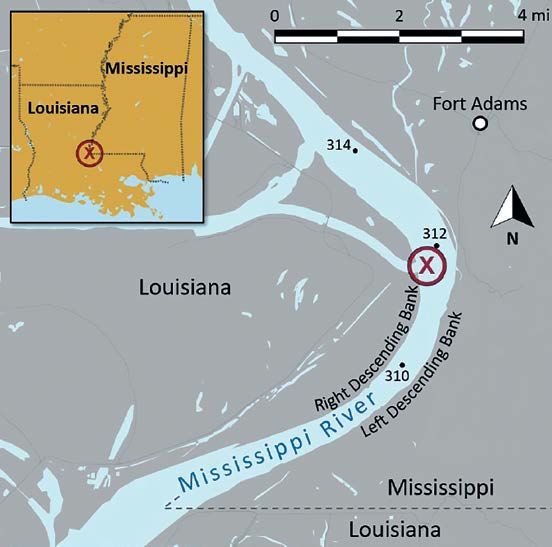
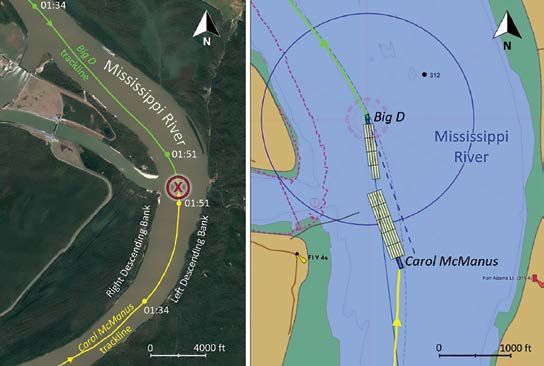
At 0152 local time, the two tows collided at mile 312 near Fort Adams, Mississippi, causing the barges in both tows to break free. Several barges were damaged in the collision, and about 1,380 gallons of ethanol spilled into the waterway. Two minor injuries were reported. Damages to the barges were estimated at $1.36 million.
Background
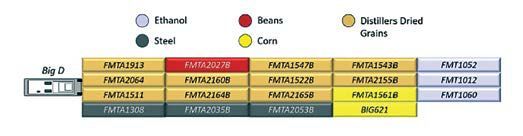
The 133-foot-long towing vessel Big D was constructed of welded steel by Horizon Shipbuilding Inc. in Bayou La Batre, Alabama, in 2012. The vessel was owned by the St. Tammany Parish Development District and operated by Florida Marine Transporters (FMT). Two 3,000-hp diesel engines, each driving a propeller, provided propulsion power. Blade-type rudders behind each propeller, as well as flanking rudders forward of the propellers, provided directional control. At the time of the collision, the Big D was pushing 19 barges, each 200 feet long by 35 feet wide, carrying various dry and liquid cargoes. The tow comprised three strings of five barges and one string with four barges. The towing vessel and tow had an overall length of 1,033 feet. The three tank barges at the front of the tow were carrying ethanol.
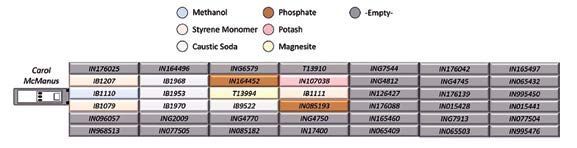
The 163-foot-long towing vessel Carol McManus was constructed of welded steel by Gulfport Shipbuilding Corporation in Port Arthur, Texas, in 1969. The vessel was owned and operated by the Ingram Barge Company. The Carol McManus had three 3,000-hp engines, each driving a nozzled propeller. Three Becker-type steering rudders and three flanking rudders provided directional control. At the time of the collision, the Carol McManus was pushing 42 barges, each 195–200 feet long by 35 feet wide, arranged in six strings of seven barges. The overall length of the towing vessel and tow was 1,563 feet. Twelve of the barges, located on the interior of the tow, were carrying various dry and liquid chemical cargoes. The remainder of the barges were empty.
Event Sequence
Early in the morning on January 6, 2023, the Big D departed Cairo, Illinois, pushing its tow of 19 barges downbound on the Mississippi River. A day later, the Carol McManus got underway upbound on the river from Reserve, Louisiana, with its tow of 42 barges.
At 0134 on January 9, the downbound Big D tow was at mile 314 on the Lower Mississippi River, approaching a bend near Fort Adams, Mississippi, at a speed over ground of 10.4 mph. The upbound Carol McManus tow was about four miles downriver of the Big D tow, below the bend, and making 6.0 mph speed over ground.
According to the Inland Navigation Rules, when two vessels are meeting or crossing, each vessel shall signal its maneuvering intentions by using the vessel’s whistle. One short blast of the whistle indicates, “I intend to leave you on my port side”—a portside-to-portside passage; a vessel would sound two whistles if proposing a starboard-side-to-starboard- side passage. The Inland Navigation Rules also allow mariners to use VHF radio, in lieu of whistles, to make passing arrangements, and it is common for operators to refer to the whistle signals as a shorthand when making these arrangements. For example, when proposing via radio that two vessels meet port to port, a mariner may ask that the other vessel “see me on one whistle.”
Seeing that the vessels would be meeting at the bend, the Big D pilot radioed the Carol McManus to make passing arrangements. (The Inland Navigation Rules state that, on the Western Rivers, which includes the Mississippi River, the downbound vessel shall have the right-of-way over an upbound vessel, shall propose the passing arrangement, and should initiate maneuvering signals.)
The Carol McManus pilot responded immediately, and the following transmission occurred between the vessels:
Big D Pilot: “It’s showing me meeting you right there about…just a little bit above Fort Adams there, man. I got 19 loads there, man.
You want to hold tight on that point, right there where we meet, see me on the two [whistles], or widen out and go for the bend way?”
CM Pilot: “Don’t make a bit of difference to me. Whatever you want the best.”
Big D Pilot: “What you got [in] tow?”
CM Pilot: “Forty-two, at, what do I got, twelve loads in the middle.”
Big D Pilot: “Ok, you want to go ahead and just play that one [whistle], then? I’ll hold tight on the point when you get up there.”
CM Pilot: “Yeah, that’d be fine.” As the tows approached the bend in the river over the next 15 minutes, both pilots maneuvered their tows toward the right descending bank of the river—the inside, or “point” side, of the bend, as described by the pilots in their transmission. (The inland towing industry refers to the shorelines of Western Rivers as the left and right banks when traveling (facing) downriver. The left bank is called the left descending bank, and the right bank is called the right descending bank.) While maneuvering, the Big D pilot reduced the speed on his vessel’s engines for a time, slowing the tow to “give [the Carol McManus pilot] more time to get into a position.” Although there had been some haze and occasional fog in the area, the pilots stated that visibility was not restricted as the two tows converged in the night.
When the Big D tow approached the bend in the river, the Big D pilot sighted the lights on the Carol McManus tow, which indicated that it was not crossing to the left descending bank side of the river (the outside, or “bend” side of the channel), as he expected. He looked at his electronic charting system, which displayed the automatic identification system (AIS) position of the Carol McManus, and saw that the Carol McManus tow was “coming toward me.”
At 0151, when the heads of each tow were about 1,100 feet apart, the Big D pilot radioed the Carol McManus:
Big D Pilot: “You’re still cutting in on me here.”
CM Pilot: “You said two whistle, right?”
Big D Pilot: “No, I said I’d take the point; you said you’d widen out for the one.”
CM Pilot: “Oh [expletive], man, can you pull her down?”
Big D Pilot: “No. I can try and hook her up and dig in.”
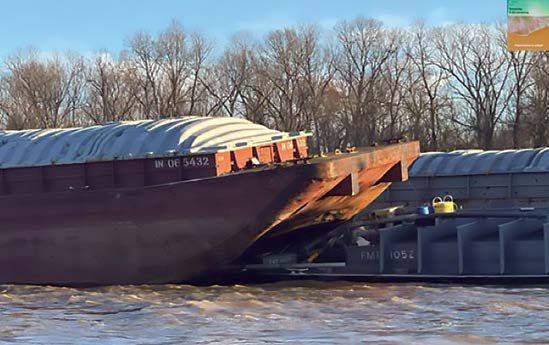
The Big D pilot stated that he attempted to “pull it in” toward the right descending bank, and the tow swung to starboard. About the same time, he sounded the general alarm on the towing vessel and put the throttles to astern. The Carol McManus pilot stated that he moved the throttles on his towing vessel to full astern. Despite the pilots’ efforts, at 0152, the raked bow of the empty hopper barge IN065432, at the head of the Carol McManus tow, struck and ran up on the loaded tank barge FMT1052, at the head of the Big D tow. Several other barges made contact, and the tows broke apart.
The Carol McManus maneuvered the remaining barges in its tow over to the left descending bank, while the Big D, as well as other towing vessels that converged on the scene, worked to recover the barges that had broken away.
During postcasualty interviews, the captains and pilots on the Big D and Carol McManus stated that there were no issues or problems with the propulsion engines or steering before or during the casualty. The pilots of both vessels stated that, when they made passing arrangements, they had agreed on a port-to-port passage. However, the Carol McManus pilot stated that he “got confused” by the discussion of the options for the passing arrangements, and he “forgot” what the pilots had finally agreed to.
Damage
Six barges in the Big D tow sustained damage as a result of the casualty, including indentations of deck and hull plating, distorted framing, and damage to deck machinery and piping systems. Estimated costs to repair the damage totaled $877,000. A breach to an expansion tank and piping systems on barge FMT1052 resulted in the release of about 1,380 gallons of ethanol into the river.
Eight barges in the Carol McManus tow sustained damage during the collision, including indentation of deck and hull plating and damage to deck fittings and piping systems. Estimated costs to repair damages totaled $479,977. There was no reported pollution from the barges damaged in the Carol McManus tow.
Vessel Pilots
The Big D pilot held a valid Coast-Guard-issued merchant mariner credential as a Master of Towing Vessels Upon Great Lakes, Inland Waters, and Western Rivers. He had about 27 years’ experience working on towing vessels and obtained his first merchant mariner credential as a pilot in 1999. The pilot had worked for FMT for seven years, and, at the time of the casualty, he had been a pilot on the Big D for 17 days. Before joining the Big D, he had worked on a similar vessel, the 133-foot-long, 6,000-hp towboat John Grimsley. The results of postcasualty tests of alcohol and other drugs for the Big D pilot were negative.
The Big D pilot stood navigation watches from 1130 to 1730 and from 2330 to 0700 each 24-hour period. The pilot stated that he got about 9 hours of sleep each day, split between his two off-watch periods. He described the quality of his sleep as “really good.” The pilot stated that he did not use his cell phone during the casualty watch, except for using it as an alarm to signal when he needed to make the midnight entry into the Big D’s deck log.
The Carol McManus pilot held a valid Coast- Guard-issued merchant mariner credential as a Master of Towing Vessels Upon Western Rivers. He had over 50 years’ experience working on towing vessels and 30 years’ experience as a pilot or captain of towing vessels. The pilot stated that he had been working on the Carol McManus for about a year and a half when the collision occurred.
The Carol McManus pilot stood navigation watches from 1100 to 1700 and from 2300 to 0500 each 24-hour period. The pilot stated that he got about 5 hours of sleep between each watch, for a total of about 10 hours. He described the quality of sleep the night before the casualty as “pretty good.” The pilot told investigators that he was not using his cell phone during the casualty watch. The results of postcasualty tests of alcohol and other drugs for the Carol McManus pilot were negative.
Waterway
The Mississippi River channel was 2,400 feet wide at the bend near Fort Adams. The bend was in a rural area, and the banks along the Mississippi River were lined with trees and other vegetation. A dike extended into the river from the right descending bank near the casualty site. The Big D pilot stated that passing in that location was “pretty routine,” and the Carol McManus captain said that tows could safely pass, either port-to-port or starboard- to-starboard.
Analysis
About 20 minutes before the Big D and Carol McManus tows met at the bend near Fort Adams, Mississippi, the pilots navigating the tows agreed to a port-to-port passage. The Big D pilot then maneuvered his downbound tow toward the right descending bank to set up for the agreed-upon arrangement. However, the Carol McManus pilot “got confused” and incorrectly recalled the arrangement, and, as a result, he navigated his upbound tow toward the right descending bank. Although visibility was unrestricted as the vessels neared the bend in the darkness, the trees and vegetation along the banks likely obscured each pilot’s view of the other tow until the tows were about 1,100 feet apart. When they saw they were in danger of colliding, the pilots attempted to maneuver to avoid the collision, but there was insufficient time before the tows collided.
The Carol McManus pilot stood a six-hours-on/ six-hours-off watch rotation, which can contribute to operator fatigue, but the pilot showed no signs of impairment during the time leading up to the casualty. He responded to radio calls from the Big D pilot promptly and took immediate action once it became apparent that a collision was imminent. The pilot was not impaired by alcohol or other tested-for drugs, nor was he distracted by cell phone use or other causes. He had over 30 years’ experience as a pilot or captain of towing vessels, and thus was sufficiently experienced and qualified to handle the tow.
After the Big D pilot proposed a port-to-port passage to the Carol McManus pilot, the Carol Mc- Manus pilot agreed to the proposed arrangement without repeating it back. About 20 minutes elapsed between the agreement and the tows meeting. Although the Inland Rules do not require an operator to repeat back a proposed passing arrangement when using radio, verbally repeating or “rehearsing” a piece of information, such as a passing arrangement, serves two purposes: it ensures that both operators understand the arrangement, and it reinforces the storage and maintenance of passing arrangement information in each operator’s working memory until the information is required to be accurately recalled (when the vessels meet). Repeating back a proposed arrangement is critical when there is a long period of time between when passing arrangements are made and when the vessels meet. Had the Carol McManus pilot repeated back the proposed arrangement, he would have been more likely to correctly recall the agreement and maneuver his tow to the left descending bank of the river.
Probable Cause
The National Transportation Safety Board determines that the probable cause of the collision between the Big D tow and the Carol McManus tow was the Carol McManus pilot incorrectly recalling the agreed-upon passing arrangement, which resulted in the Carol McManus tow encroaching on the downbound Big D tow.
Lessons Learned – Repeating Passing Arrangements via Radio
When mariners are making passing arrangements via radio, several factors may impact each mariner’s understanding of the final agreed-upon arrangement. These factors include garbled radio transmissions, strong accents or an unfamiliarity with the English language, a mariner’s preconceived expectation of the event, fatigue, or distraction. When one mariner proposes an arrangement to another, the other mariner should repeat back the proposed passing arrangement to ensure both parties have a shared understanding of the arrangement. The repeat-back also reinforces the agreed arrangement with each mariner.
Reprinted from Marine Construction Magazine, Issue II, 2024.