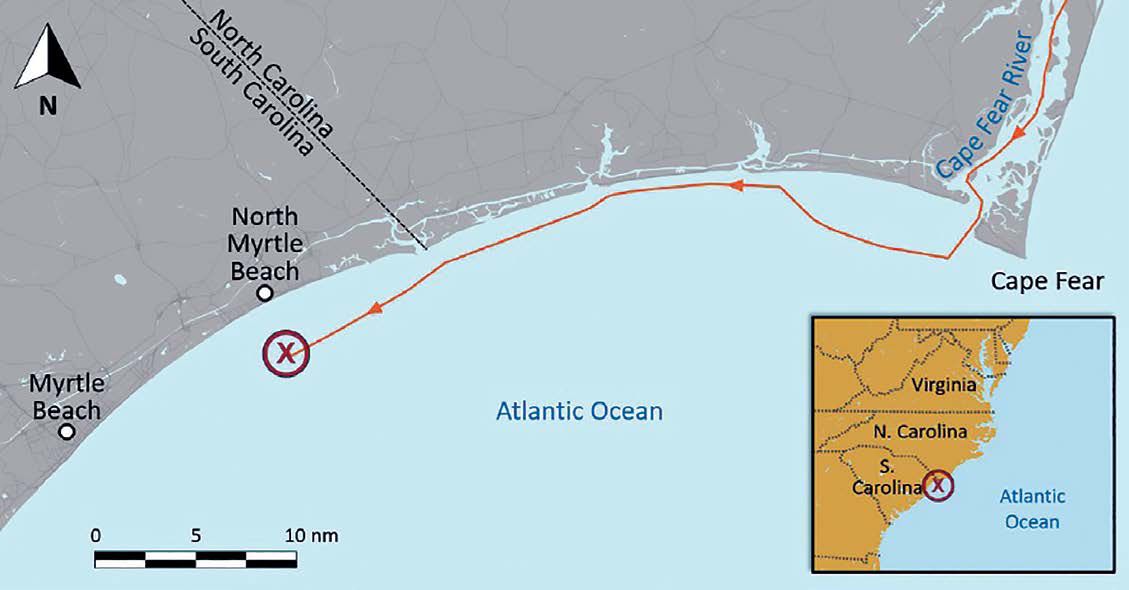
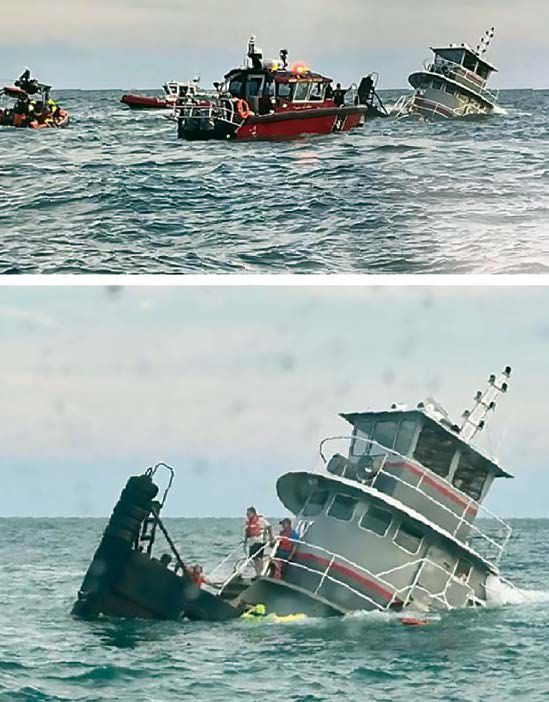
On August 8, 2023, about 1859 eastern daylight time, the towing vessel Jacqueline A sank about 3 miles east of North Myrtle Beach, South Carolina, after taking on water while transiting in the Atlantic Ocean (see figure 1 and figure 2).1 The three crewmembers abandoned the vessel and were recovered by local emergency responders. There were no injuries. Most of the estimated 5,000 gallons of diesel fuel on board the vessel leaked into the sea. Following salvage, the vessel was determined to be a constructive total loss valued at $660,000.
FACTUAL INFORMATION
Background
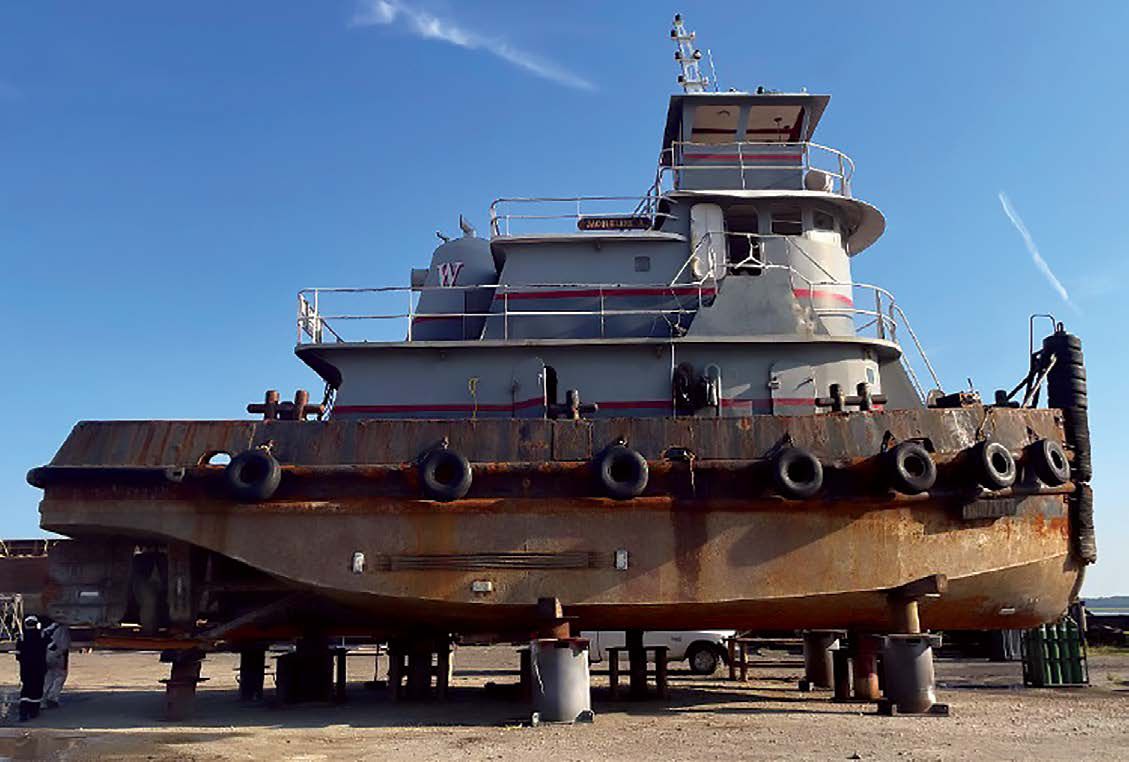
The 60-foot-long Jacqueline A was a towing vessel constructed of welded steel. Built in 1981 by Mikron Shipyard Inc, in Galliano, Louisiana, as the Eric Paul, the vessel was renamed the Jacqueline A following a change in ownership in the 2000s. The vessel’s final owner, Jackson Creek Marine, LLC, located in Weems, Virginia, acquired the vessel in 2012 and used it to tow barges in the Chesapeake Bay.
The Jacqueline A was configured with a deckhouse above the main deck that included a main wheelhouse, an upper wheelhouse, the upper level of the engine room, a galley, and crew berthing areas (see figure 3). During the casualty voyage, the crew conned the vessel from the main wheelhouse. Below the main deck, the vessel was arranged (forward to aft) with a forepeak tank, a stowage space, fuel tanks, the lower engine room, potable water tanks, and the lazarette (a small storage area). The lazarette was accessible via two hand-operated hatches on the aft main deck.
Two 4-inch-diameter steel pipes ran between the aft engine room bulkhead and the forward lazarette bulkhead, through the port and starboard potable water tanks. The open-ended pipes were designed as wire, or cable, runs to connect the engine room and lazarette. The wire runs were located about 5 feet 9 inches from centerline on the port and starboard sides of the vessel and were about 6.5 inches beneath the main deck. Neither of the wire runs were sealed to prevent water or air from moving between the spaces.
The Jacqueline A had two propellers, each driven by a 965-hp diesel engine. Two plate-type rudders aft of the propellers were moved via hydraulic ram mechanisms located on the aft main deck, with the rudder posts passing though the towing vessel’s lazarette in tubes (rudder trunks); the lazarette contained no steering equipment. About 2019, the owner took the Jacqueline A out of commercial service because it was not compliant with new towing vessel requirements under Title 46 Code of Federal Regulations (CFR) Subchapter M, and it did not have a Guard certificate of inspection. (Subchapter M governs the construction, arrangement, installed equipment, and operations of towing vessels.) After being taken out of service, the vessel was operated intermittently to ensure the equipment and machinery were in working order.

Event Sequence
In mid-2023, the owner of the Jacqueline A contracted with a shipyard in Harvey, Louisiana, to make repairs and bring the towing vessel into compliance with Subchapter M regulations.
The owner hired a crew (a captain, a mate, and a deckhand) to transit the vessel from Virginia to the Louisiana shipyard.
On August 5, the crew arrived in Weems and viewed the Jacqueline A for the first time. About noon, they boarded the vessel, and one of the company owners conducted a familiarization tour with the captain and mate. In the engine room, the owner showed the crew members the fuel lines and bilge pumping system. The captain stated that the engine room was “immaculate” and the vessel “looked great inside.” During the vessel tour, no one opened or inspected the lazarette. According to the owner and the vessel’s port engineer, the last time the lazarette was inspected was about three months earlier, during a shipyard period in Newport News, Virginia, between March and May 2023.
About 0630 the next morning, the hired crew got the Jacqueline A underway to Louisiana. This was the first time the crew had been underway on the vessel. During the transit, the captain stood wheel watches from 0500 to 1100 and 1700 to 2300, while the mate stood the opposite watches.
After leaving Weems, the Jacqueline A proceeded south through the lower Chesapeake Bay and then into the Intracoastal Waterway via the Elizabeth River near Norfolk, Virginia. The captain stated that the vessel owners had encouraged the crew to transit via the open ocean to save time, but he decided to use the Intracoastal Waterway to avoid heavy weather and high seas off the coast. The owners said that the choice of route was at the discretion of the captain.
On August 8, the Jacqueline A entered the Cape- Fear River, which forms a portion of the Intracoastal Waterway in southeast North Carolina. Based on improving weather conditions, the captain decided to exit the waterway into the Atlantic Ocean via the Cape Fear River inlet. His intention was to transit in the open ocean to Port St. Lucie, Florida, where the towing vessel would then cross the Florida peninsula via the Okeechobee Waterway. The captain stated that he chose this route to save time and to avoid shallow areas in the Intracoastal Waterway in Georgia.
About 1350, the Jacqueline A exited the Cape Fear River inlet channel, turned to starboard, and began following the coastline in a southwesterly direction at speeds varying between 5 and 8 knots. The seas at the time were from the southeast (on the vessel’s port beam) at 4 feet, with winds 15–20 knots from the south-southwest. The mate, who was at the helm, stated that the Jacqueline A was “rolling pretty good,” and the captain said, “the sea was busting over the sides,” with water washing over the towing vessel’s aft deck. These conditions continued for about 2 hours until the mate turned the Jacqueline A to a more southerly direction. After the turn, the seas were off the port bow, and less water was coming aboard the vessel, although some sea spray continued to wash over it.
At 1700, the captain relieved the mate at the helm as part of the normal watch turnover. The mate told him that the deckhand had conducted a tour of the engine room earlier and found no issues; the captain had not conducted an inspection of the vessel spaces before his watch. At the time the captain took the watch, the seas had subsided to about 2.5 to 3 feet, but sea spray continued to wash over the Jacqueline A as waves hit the fendering tires on the port side of the vessel.
During the captain’s watch, sometime between 1830 and 1850, he looked out at the horizon and noticed that the Jacqueline A had a port list. The captain went out the port wheelhouse door to investigate the list, and, looking aft, he saw that the main deck was immersed in water up to the back of the deckhouse. He yelled to the other crewmembers, informing them that the Jacqueline A was taking on water, and he proceeded to the engine room (the vessel was steering in autopilot). In the engine room, the captain found water in the bilge, on the port side aft, up to the bottom of the engine. Additionally, he saw water flowing into the space through the wire runs that connected the engine room and lazarette. According to the crew, the engine room bilge high-water alarm was not sounding at the time, nor did it sound at any time during the casualty.
The captain went up to the main deck and instructed the two crewmembers to start the installed bilge pump. the captain then went to the wheelhouse to make a mayday call. The mate and deckhand entered the engine room and started the dedicated bilge pump, located on the port side. They did not adjust any valves on the bilge system manifold. The crew then proceeded to the galley to retrieve their lifejackets. The captain and crew stated that moving about the Jacqueline A became difficult because the vessel took on an extreme port list and had significant aft trim.
At 1856, the captain turned the vessel toward shore while he transmitted the mayday call. Coast Guard Sector Charleston received the call, and the captain provided the vessel’s location, number of persons on board, and other information to the Coast Guard watchstander. Shortly thereafter, the towing vessel’s generator shut down, and the radio stopped working. About the same time, one of the vessel’s two propulsion engines stopped.
As the Jacqueline A began to sink by its stern, the captain ordered the crew to gather in the wheelhouse. The captain recalled, “it was just happening so fast.” The vessel sank further, and its second engine stopped. Once the stern of the Jacqueline A struck the ocean floor 31 feet below the water’s surface, with the bow remaining above the water, the rate of sinking slowed. The crew moved from the wheelhouse to the bow to await rescue.
A Coast Guard helicopter and response boat were dispatched to the reported location of the Jacqueline A. A North Myrtle Beach Rescue Squad boat, a Horry County (South Carolina) Fire Rescue boat, and a commercial towing-assistance boat also responded to the mayday call, all arriving about 1940. When directed by rescue personnel, the Jacqueline A crew entered the water from the towing vessel’s bow, and a North Myrtle Beach Rescue Squad swimmer assisted them to rescue vessels. All crewmembers were recovered by 1947 (see figure 4). The crew was taken ashore and evaluated; no injuries were reported. After the crew was rescued, the Jacqueline A fully sank.
Thirteen days later, on August 21, the vessel was raised by salvors and towed to a shipyard.
ADDITIONAL INFORMATION
Damage
The sinking damaged the Jacqueline A’s main propulsion engines and generators beyond repair. Electrical and hydraulic systems, electronics, insulation and paneling, galley and lavatory equipment, and various windows and doors were also destroyed. Diesel fuel, hydraulic oil, and potable water tanks were fouled. The estimated cost to repair this damage (not including salvage costs and any other required work) exceeded the $660,000 value of the vessel, and therefore, it was declared a constructive total loss.
Crew Qualifications
The caption of the Jacqueline A’s held valid Coast Guard-issued merchant marine credentials as a master of towing vessels upon near coastal waters and Western rivers and master of self-propelled vessels less than 100 gross register tons upon near coastal waters. He had over 50 years’ experience in the maritime industry, working on fishing vessels from an early age before transitioning to offshore supply vessels and towing vessels. During the six years before the Jacqueline A sinking, the captain had taken occasional jobs delivering vessels to and from customers along the East and Gulf coasts.
The Jacqueline A’s mate held a valid Coast Guard-issued merchant marine credential as a master of self-propelled vessels less than 100 gross register tons upon near coastal waters. The mate was generally employed in delivering newly built fishing vessels from the Gulf Coast to customers on the East Coast.
Bilge High-Water Alarm and Pumping Systems
A float-type high-water level sensor was installed in the Jacqueline A engine room bilge near the forward bulkhead, about a foot above the bottom plating. Audible and visual alarms for the sensor were located in the engine room and in the wheelhouse. The lazarette did not have high-water level sensors or associated alarms.
An electric-motor-driven bilge pump was installed on the port side of the engine room and took suction from the engine room bilge. The pump could also be aligned to the forepeak tank via a valve manifold in the engine room. The vessel’s port engineer stated that there was no connection to allow the installed bilge pump to take suction from the lazarette. A fire pump was installed on the opposite side of the engine room from the bilge pump and could be configured to pump from the engine room bilge.
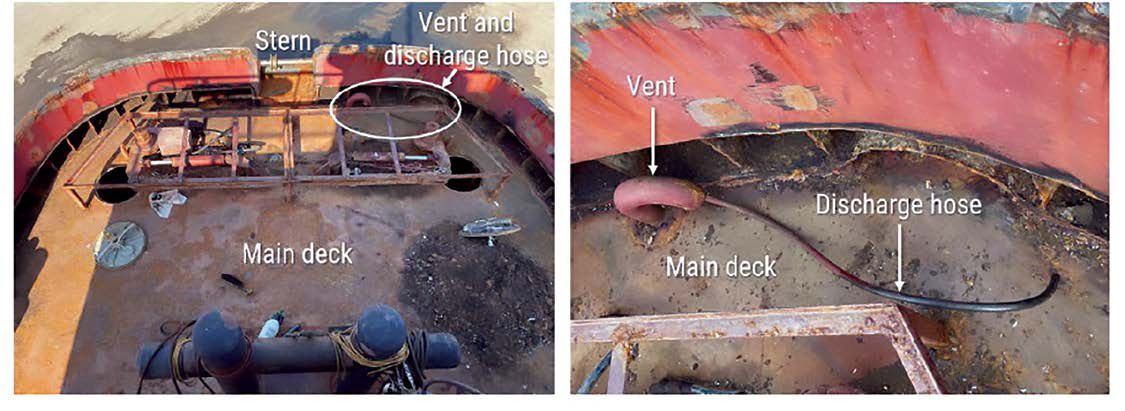
The lazarette could only be dewatered using a portable submersible electric pump that had been placed in the space. The power cord for the pump was rigged to the engine room through one of the wire runs, and the discharge hose was routed to the main deck via a vent in the lazarette overhead (see figure 5).
According to the port engineer, the Jacqueline A never took on water while it sat at its berth in Weems. “That boat was always dry,” he said. He stated that he checked to ensure the lazarette was dry by plugging in the submersible pump from the engine room—he did not enter the lazarette when energizing the pump. The port engineer stated that, whenever he ran the pump, “nothing ever came out, I mean, a cup, if anything.” Although he did not inspect the lazarette before the Jacqueline A’s departure en route to Louisiana, he had plugged in the pump about 3 days before the voyage, and no water was discharged. While the vessel was flooding on the casualty voyage, the crew did not plug in the lazarette submersible pump.
Vessel Bulwarks
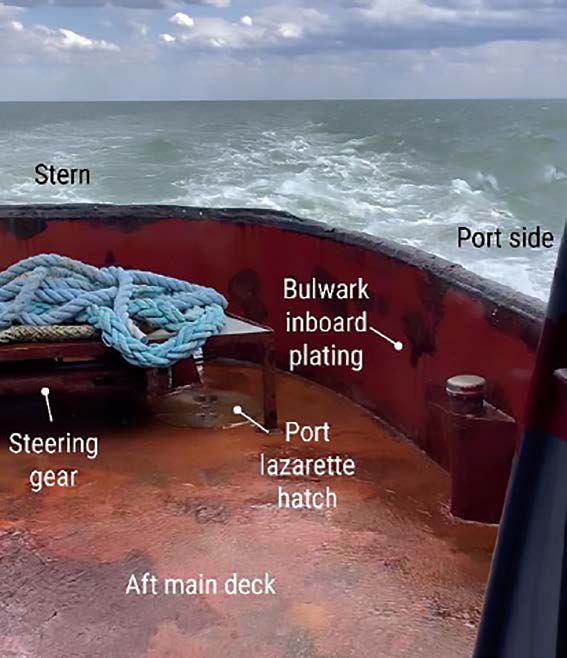
Steel bulwarks surrounded the entire main deck of the vessel. The bulwarks were 2.66 feet tall forward and increased aft of the deckhouse to 3.33 feet at the stern. The bulwarks had three freeing ports along each side of the vessel, with one on each side of the aft deck, as well as two freeing ports on the stern. (A freeing port is any direct opening through a vessel’s bulwarks or hull designed to quickly drain water that has accumulated on exposed decks overboard.) In addition to the typical top rail and outboard steel plating on the bulwark frames, plating was also installed on the inboard side of the frames, creating a series of completely enclosed volumes—small void spaces—between the main deck, the bulwark frames, and the top of the bulwark (see figure 6). The port engineer noted that the “boxing in” of the bulwarks made it easier to clean the vessel, but he said, “they found out over the years that it just caused rust to build up because after you welded all that together, you never could get paint on the insides.” He told investigators that the owners intended to remove the inboard plating at the Louisiana shipyard.
Prevoyage Hull Survey
On March 9, 2023, 5 months before the casualty voyage, one of the Jacqueline A company owners and the port engineer transited the vessel to a shipyard in Newport News, about 60 miles from Weems. At the shipyard, the vessel was hauled out of the water, the hull was pressure washed, and an ultrasonic survey was conducted to determine the extent of metal loss on the hull plating, stern tubes, and aft main deck. The survey found 2 out of 28 tested locations on the hull bottom had greater than 25% loss in metal thickness, with the greatest loss 34%. Half of the 22 locations tested on the hull sides had greater than 25% loss, with a maximum loss of 46%. Two out of 10 locations tested on the stern tubes, one on each tube, had loss exceeding 25%, with maximum loss of 42%. Finally, 2 out of 13 locations tested on the main deck exceeded 25%, with a maximum of 33%.
The Jacqueline A returned to Weems from the shipyard in Newport News on May 1. The port captain stated that, during the return transit, winds were “blowing pretty good” and “we were taking water all over the boat.” Figure 6 is a screen capture from video taken during the voyage to Weems, showing water on the aft deck of the vessel. The port engineer stated that the lazarette was “dry when we got back [to Weems].”
Postsalvage Survey and Examination
After the Jacqueline A was salvaged, a commercial surveyor examined the vessel for possible sources of water intrusion. He found no apparent seawater ingress points in the engine room or potable water tanks. The surveyor found that the access hatches and rudder trunks in the lazarette were “in apparent good order.”
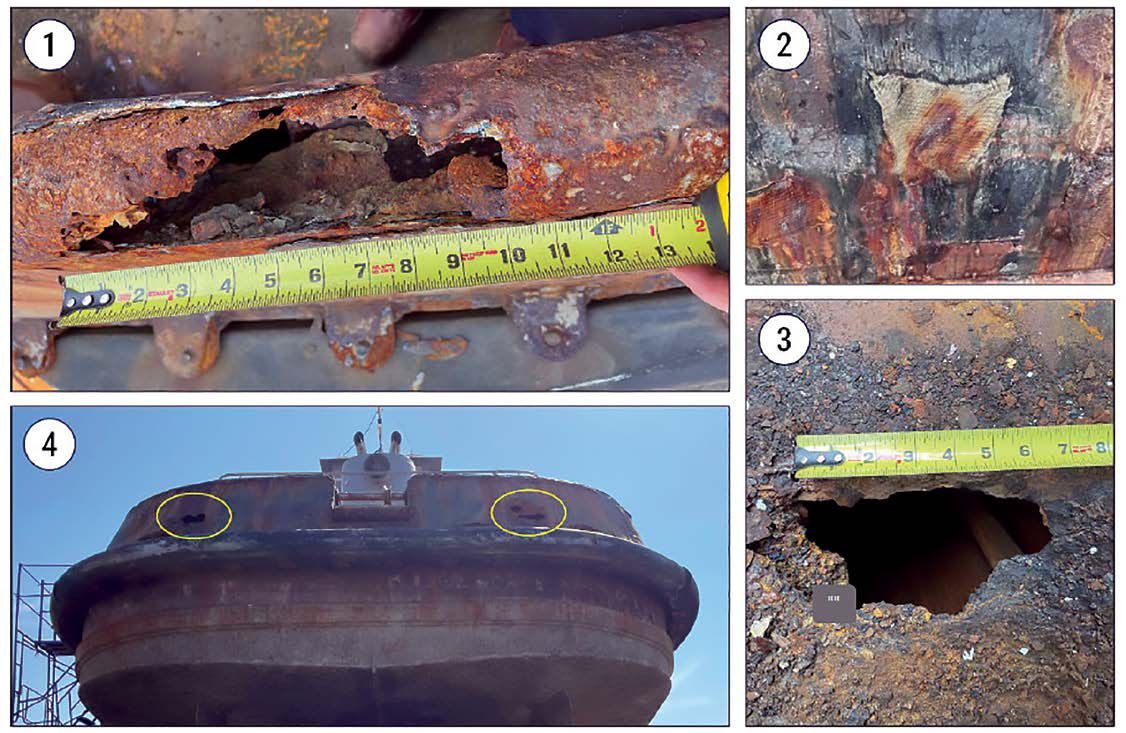
The inboard plating of the bulwarks above the aft deck was cut away for examination of the formerly enclosed volumes (voids) in the bulwarks. The surveyor found “significant deck plate wastage” above the lazarette, with holes ranging in size from 2 to 8 inches in diameter. The surveyor also discovered a hole, less than 1 inch in diameter, on the stern hull plating (forming the aft bulkhead of the lazarette), about 2 inches below the main deck. The surveyor noted that this hole had been hidden from exterior view by a rub rail on the stern.
Coast Guard and National Transportation Safety Board (NTSB) investigators examined the vessel and found that the hull’s bottom and side plating appeared to be intact, although doubler plates were visible on the side plating above the waterline near the bow and on the starboard side aft. A small leak was discovered around the fathometer transducer, which was fitted in the hull at the forward end of the engine room. On the main deck aft, investigators identified corrosion holes that had been patched with epoxy. Both hatches to the lazarette appeared to be in good condition, with serviceable gasket material.
On the bulwarks, investigators found corrosion, with wastage holes up to 12 inches in length along the tops and exterior side plating, notably along the bulwarks surrounding the aft deck and stern (see figure 7). Some of the wastage holes on the exterior plating had been covered with patches made from fiberglass or other materials. Patches that remained in place postsalvage were degraded.
Investigators identified several areas of corrosion and wastage on the deckhouse. Three weathertight doors (port, starboard, and aft) on the deckhouse provided access to the main engine room, and a fourth door on the starboard side accessed the galley; gaskets were missing from all of these doors.
Coast Guard Marine Safety Center Assessment
Following the casualty, the Coast Guard Marine Safety Center (MSC) conducted an analysis to determine the Jacqueline A’s intact stability before the casualty and the progressive flooding rate during the casualty.4 (Intact stability is the tendency of an undamaged vessel to return to its original upright position when a disturbing force [e.g., wind or wave] is removed.) No drawings of the vessel were available, so the MSC took measurements of the salvaged vessel and used the results to develop a computer model of the Jacqueline A.
Although Jacqueline A had not been inspected under 46 CFR Subchapter M at the time of casualty, the MSC referenced the stability requirements outlined in Subchapter M for partially protected routes for new towing vessels in order to assess the vessel’s intact stability. The MSC analysis showed that, based on an assumed loading condition at the time of the casualty, the Jacqueline A satisfied the Subchapter M intact stability criteria.
The MSC used the measured area of the corrosion holes between the main deck and the lazarette and the dimensions of the steel-pipe wire runs between the lazarette and the engine room to evaluate the progressive flooding of the vessel. The MSC calculated the freeboard of the Jacqueline A at the stern to be between 10 and 14 inches, and the analysis assumed that the vessel’s motion and waves would have gradually filled the lazarette with seawater. As the stern sunk lower into the water, the wastage holes in the deck would have eventually submerged, quickly filling the remaining unflooded space in the lazarette.
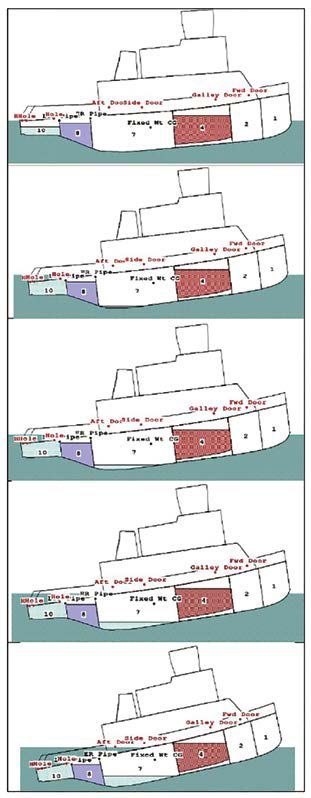
The MSC found that, because of the aft trim and the location of the unsealed wire runs near the top of the lazarette (6.5 inches beneath the main deck) at the forward bulkhead of the space, no engine room flooding would have occurred until the lazarette was completely full. However, the MSC analysis showed that once the lazarette was full, progressive flooding through the 4-inch wire runs would have begun and the engine room would have quickly flooded (see figure 8). In one example analysis, the flooding rate in the engine room began at 460 gallons per minute and, as flooding continued, increased to 1,100 gallons per minute within 9 minutes.
The MSC analysis concluded that once the wastage holes in the main deck above the lazarette were submerged, progressive flooding led to a sinking of the Jacqueline A by the stern in 9-16 minutes. While transiting in the Atlantic Ocean about 3 miles off the coast of South Carolina, the towing vessel Jacqueline A sank after taking on water.
The manner that the Jacqueline A sank, stern first with the bow remaining above the water for a period of time after the stern contacted the ocean floor, indicates that the flooding originated in the aft portion of the towing vessel—either in the lazarette or engine room.
After the vessel was salvaged, a commercial surveyor and Coast Guard and NTSB investigators found no obvious points of water ingress in the engine room (the small leak around the fathometer transducer would not have resulted in the flooding that caused the sinking). In the lazarette, there were no apparent leaks around the rudder trunks, and the access hatches to the space were in good condition, including the gaskets. However, investigators found several large wastage holes in the main deck plating above the lazarette. The wastage holes were located within the voids formed by the enclosed bulwark framing on the main deck. Investigators also found wastage holes along the top and side plating of the bulwarks.
The mate stated that, when the Jacqueline A entered the open ocean waters at Cape Fear Inlet, the vessel was “rolling pretty good.” Given the vessel rolling, the reported seas of about 4 feet, and the combined freeboard and bulwark height of 4.5 feet along the aft deck and the stern, the Jacqueline A was likely taking significant quantities of seawater over the bulwarks and deck. The captain recalled that during this time “the sea was busting over the sides.” Under these conditions, seawater would have entered the bulwark voids through the wastage holes in the side plating and top, and flowed down through the wastage holes in the main deck plating to the lazarette below. Also, seawater on the aft main deck inboard of the bulwarks would have created a small head pressure on the deck plate, allowing water to seep into the lazarette through other openings, such as the epoxy patches on the deck. The small hole in the stern plate just above the water line would have further contributed to the gradual flooding of the space.
The bulwarks on the Jacqueline A had been modified by adding plating to the inboard side of the bulwark frames, creating small void spaces within the bulwarks. The voids on the Jacqueline A were inaccessible spaces in which corrosion cells developed, and eventually progressed into large wastage holes in the bulwark top, sides and deck plating. The port engineer had previously identified the hazard created by the enclosed bulwarks, and the owners planned to remove the inboard playing in the Louisiana shipyard.
CONCLUSIONS
Probable Cause The National Transportation Safety Board determines that the probable cause of the flooding and sinking of the towing vessel Jacqueline A was a lack of watertight integrity due to the poor material condition of the vessel’s bulwarks and main deck plating, which allowed water to ingress through wastage holes into the lazarette, and unsealed penetrations in transverse bulkheads, which led to progressive flooding forward into the engine room. Contributing to the sinking was the lack of a high-water bilge sensor in the lazarette, which prevented early detection of flooding into the space.
Lessons Learned
Corrosion Hazards in Inaccessible Void Spaces Inaccessible voids or difficult to reach pockets or crevices that are poorly ventilated and provide no access for maintenance pose a risk to vessels due to the potential for severe rusting/corrosion. Because these spaces are inaccessible, corrosion can grow undetected. Operators and manufacturers should keep these risks in mind when designing, constructing, or modifying a vessel. Ensuring all spaces are accessible enables maintenance personnel to check for and remediate any potential hazards, such as corrosion.
Sealing Watertight Bulkhead Penetrations
For the safety of a vessel and all on board, the integrity of the hull and watertight bulkheads must be maintained, and any deficiencies must be appropriately addressed. Known issues with watertight integrity, including unsealed watertight bulkhead and deck penetrations and deck and hull plate wastage, need to be addressed by permanent means. The Coast Guard advises, “Ensure electrical cables and conduits, piping runs, remote valve actuators, and other components that penetrate watertight bulkheads, decks, and compartments are inspected frequently and properly maintained. Each may have a unique sealing method involving glands with packing assemblies, penetration seals, or other methods. Frequent inspection and proper maintenance of these various fittings and assemblies will assist in minimizing the possibility of progressive flooding.”
Installing Bilge High-Water Level Alarms and Sensors Automatic high-water bilge alarms are intended to provide crews with an early warning of vessel flooding. Manual detection (e.g., visually) often occurs only after flooding is underway and the crew has detected excessive rolling or listing, leaving little time for mitigating action. In inaccessible spaces, or small spaces that are difficult to inspect underway (such as a towing vessel’s smaller compartments, voids, or lazarette), bilge-level monitoring alarms are often the sole means to alert operators of flooding. Sensors installed in all spaces where flooding may have a significant effect on the vessel’s stability and buoyancy can prevent undetected flooding. The Coast Guard advises that “high level bilge alarms should be set as low as possible to the deck or bilge well and positioned along the centermost area of the compartment or in a location at which the fluids will gravitate to first. In areas where bilge water routinely accumulates, the bilge high-water level alarms should be placed just above the point where under normal working conditions the accumulation would be pumped to a holding tank, overboard, or through an oily water separation system if required.”