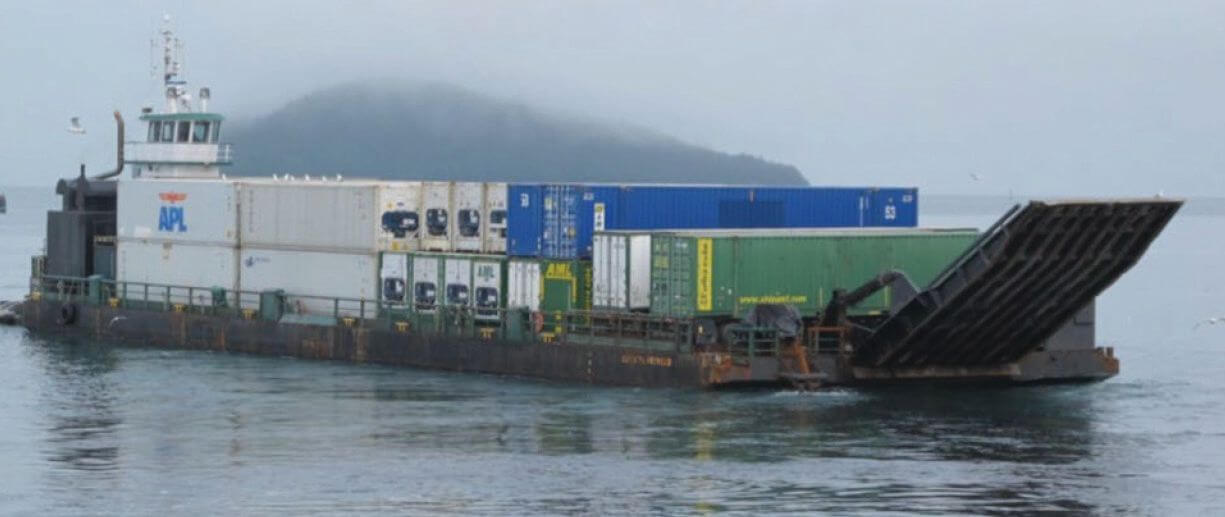
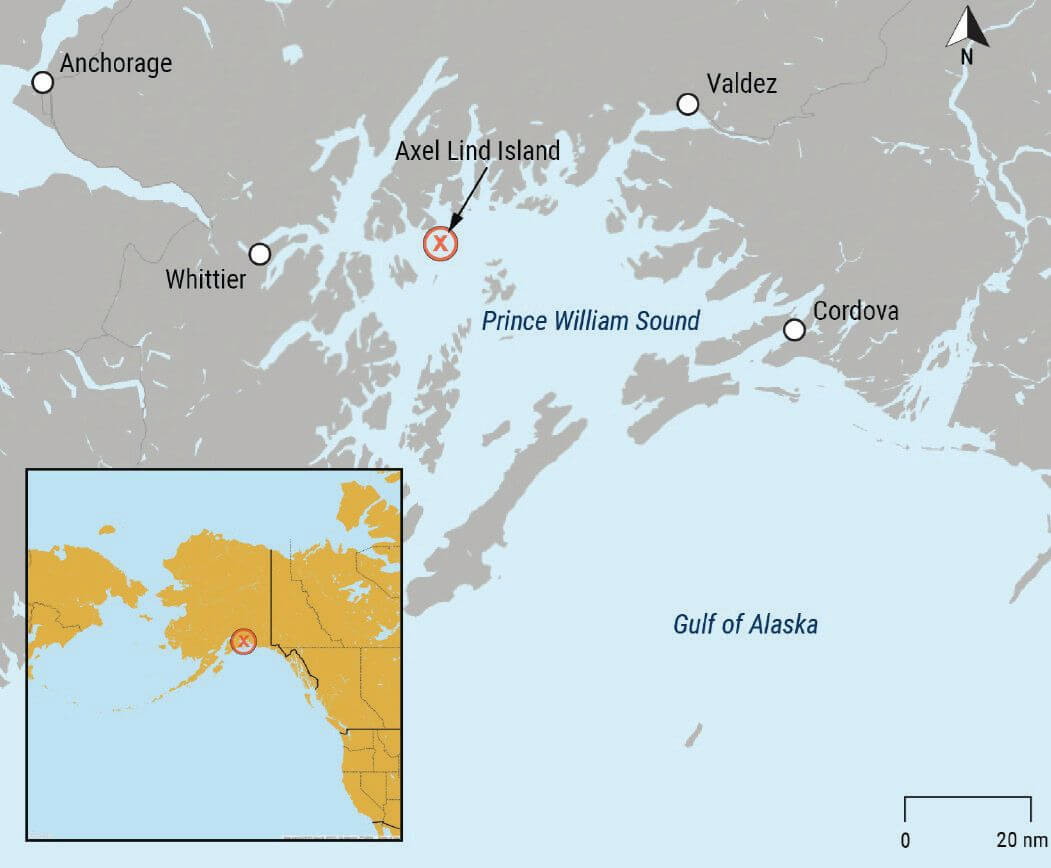
On January 11, 2025, at 0250 local [Alaska standard] time, the integrated tug and barge Krystal Sea/Cordova Provider was transiting Prince William Sound when the four lines connecting the tug to the barge parted, causing the barge to uncouple from the tug (In this report, all miles are nautical miles [1.15 statute miles].) The barge drifted, eventually grounding on the coast of Axel Lind Island, Alaska, about 0635. There were no injuries, and no pollution was reported. The barge Cordova Provider, valued at $2.9 million, was declared a constructive total loss by the vessel’s owner. The Krystal Sea was not damaged.
Background
The freight barge Cordova Provider was built in 1981 at Tacoma Boat Building as an oil recovery barge with an ice-strengthened hull for operations in waters around Alaska. In 2005, the barge was converted to also carry freight and had a custom-designed notch installed on the stern so it could become part of an integrated tug and barge (ITB) with the tug Krystal Sea. The barge was equipped with an auxiliary generator to supply power to refrigeration containers and the motors for the bow ramp and anchor winch. This generator could also provide power to the Krystal Sea, via an electrical power cable between the tug and barge.
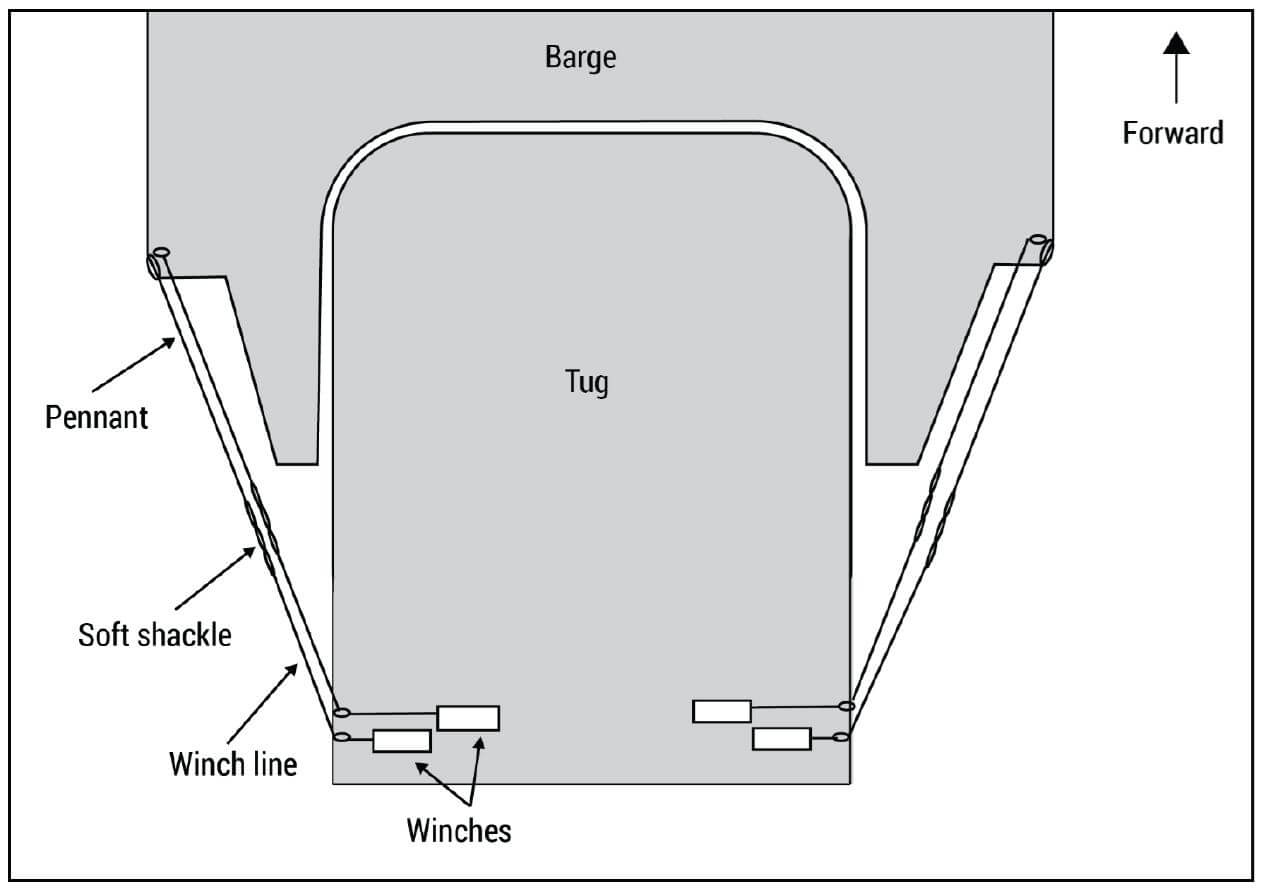
The tug Krystal Sea was built in 2005 at the Western Towboat Duwamish Shipyard, and it was specifically designed and built to fit into the stern notch on the barge Cordova Provider and operate as an ITB. The tug was connected to the notch of the Cordova Provider via three wedges—one each on the port side, starboard side, and bow—that fit into three recesses within the notch of the barge. In addition to the wedges and recesses, there were also four lines, also referred to as push lines, connecting the tug to the barge—two each on the port and starboard sides. After the wedges of the barge were lined up within the recesses of the barge, the push lines were attached to the barge. Then, four winches, each connected to a separate push line, were used to increase the tension of the lines to hold the tug and barge together (see figure 3).
The ITB was capable of loading and transporting containers and vehicles. In addition, the barge was certified by the US Coast Guard to serve as an oil recovery barge. The Krystal Sea/Cordova Provider operated in the Prince William Sound area primarily among the ports of Whittier, Cordova and Valdez, all in Alaska.
Event Sequence
On January 10, 2025, at 0717, the Krystal Sea/Cordova Provider departed Valdez with a crew of four, including the captain, mate, and two deckhands. Before getting underway, no discrepancies were noted with the lines, and the lines were properly rigged. The ITB docked in Cordova at 2013, and workers offloaded cargo. After the cargo operations were completed, the ITB departed at 2110, with the captain at the helm, to cross Prince William Sound for Whittier. The forecast for the transit at the time of departure predicted wind from the southeast at 45 knots with seas at 6 feet, increasing to 10 feet after midnight. At 2350, when the captain turned over the watch to the mate, the weather conditions near Red Head Point included wind from the east at 35 knots and seas at 3 feet. The ITB passed Red Head Point at 0001. At 0200, the seas were 4-6 feet as the vessel proceeded across Prince William Sound with the wind and waves on the vessel’s port quarter. At 0250, the mate and the deckhand, who were in the wheelhouse, and the captain, who was awake in his cabin, all heard what sounded like a line snapping, followed immediately by the sound of three other line snaps. All four of the lines attaching the tug to the barge had parted. After the lines parted, the tug separated from the barge, and the electrical power cable connected between the two vessels also parted. Coast Guard Vessel Traffic Service personnel contacted the Krystal Sea after noticing that the vessel had changed course to about 180°. The captain informed Coast Guard personnel of the situation and requested assistance with recovering the barge. After the crew recovered the parted lines and electrical cable, the captain maneuvered the Krystal Sea toward the drifting Cordova Provider to try to put a line across and regain control of it. The Krystal Sea caught up with the drifting barge about 0325. The barge was drifting at 2.7 knots in a northwest direction, generally along a course of 282°. The captain maneuvered the tug near the barge and visually assessed it, noting no signs of damage. The captain then moved the tug to the stern of the barge to evaluate if it was possible to recover it. The captain determined that, due to the weather conditions, it was too dangerous to attempt to recover the barge.
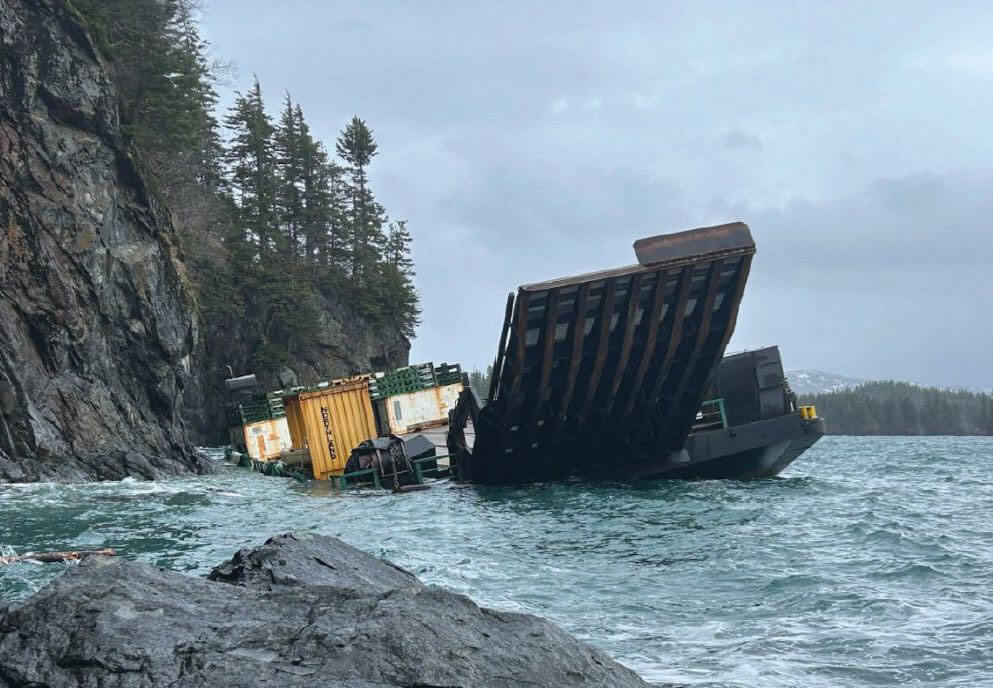
The Coast Guard put the captain in contact with Edison Chouest Offshore, the owner of the tug Latouche, which was moored nearby in Outside Bay on Naked Island, Alaska; the tug owner agreed to assist in barge recovery efforts. The Latouche departed about 0500 and arrived on scene at 0550. After evaluating the situation, the Latouche owner and captain agreed to attempt to retrieve the barge. The crew of the Latouche first tried to attach a line to a bitt on the stern. The first two attempts failed. On the third attempt, they were able to secure a line, but the line parted. By that point, it was no longer safe for the Latouche to continue because the barge was nearing the shoreline of Axel Lind Island. The Cordova Provider grounded on Axel Lind Island about 0635 (see figure 4). After the grounding, the Krystal Sea and Latouche proceeded to Whittier and arrived at 1104.
Damage
A damage survey of the Cordova Provider was conducted while the barge remained grounded on the eastern coast of Axel Lind Island. Based on the extensive hull and structural damage sustained by the barge from running aground on the rocky shore, the Cordova Provider was declared a constructive total loss. The barge was towed offshore and scuttled on January 23.
Lines
When interviewed, none of the Krystal Sea/Cordova Provider crew expressed concerns with the four push lines before the casualty. Since it was dark when the lines parted, the personnel in the wheelhouse did not see which line parted first. In addition, the vessel crew did not consider the weather the vessel encountered as it was transiting Prince William Sound to be severe.
When the ITB went into operation in 2005, it used four 1-inch galvanized steel wire ropes for the push lines. However, the company switched to Dyneema synthetic lines in 2022 due to safety concerns that the crewmembers were at risk of falling overboard while handling the heavier, stiff wire rope. (Dyneema is a fiber made of ultra-high-molecular-weight polyethylene.)
At the time of the casualty, the Krystal Sea and the Cordova Provider were connected by four synthetic push lines, each comprised of a 1-inch-diameter, 12-strand winch line; a 0.75-inch-diameter soft shackle; and a 1-inch-diameter, 12-strand pennant. The breaking strength of the 1-inch line was 96,390 pounds, and the breaking strength for the 0.75- inch soft-shackle line was 101,000 pounds.
In addition, the three eyes on each push line were covered with double-braided jacketing that extended 4 feet on the line to protect against chaffing. The soft shackles in the push lines were not covered with double-braided jacketing.
The winch lines were installed in 2022, the soft shackles were installed in 2022–2023, and the pennant lines were installed in 2023–2024. The captain of the ITB visually inspected the four push lines on January 6, 2025, about 5 days before the casualty, in compliance with the company’s line inspection policy; he assessed that the lines were in serviceable condition. According to the general manager, company policy required the winch lines, soft shackles, and pennants to be replaced as needed.
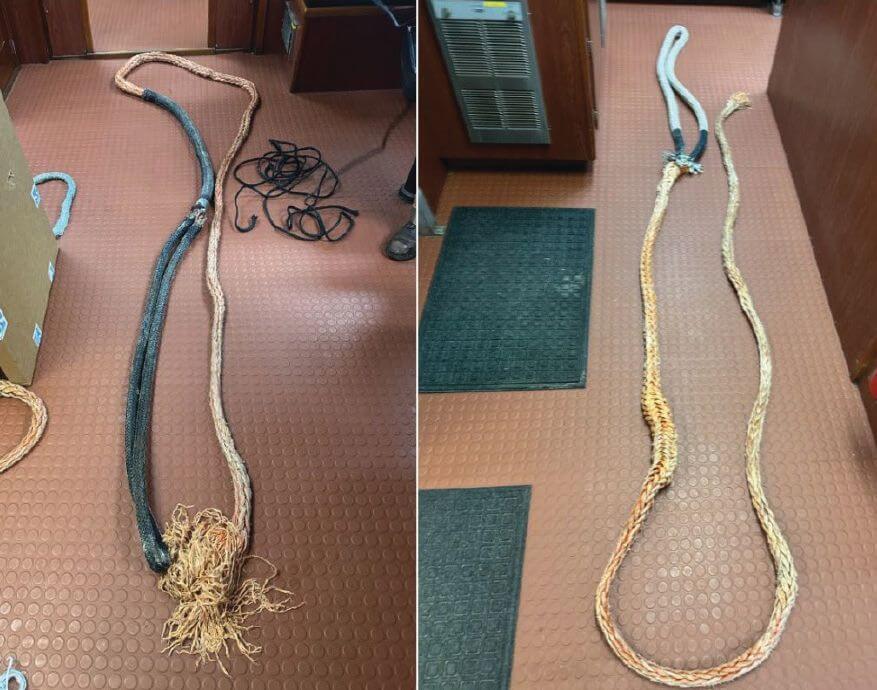
Following the separation of the tug and barge, the crew recovered all the lines except the starboard outboard pennant section. A technician from a local industrial and maritime supply company that assembled the push lines—creating the eyes and adding chafing gear but not manufacturing the lines— visually examined the recovered lines that had parted (see figure 5). The technician found that the lines were in fair to good condition with some light abrasions. The port inboard, port outboard, and starboard inboard push lines all parted at the pennant section, between the soft shackle and line eye connected to the barge. The starboard outboard line parted at the soft shackle. The technician determined that all the push lines and the soft shackle parted due to the lines exceeding their breaking strength (due to a shock or surge load). The exam did not identify any defects or excessive wear that could have contributed to the parting of the push lines.
Analysis
On January 11, 2025, the ITB Krystal Sea/ Cordova Provider was transiting Prince William Sound toward Whittier, Alaska, when one of the four push lines securing the tug to the barge parted. Shortly after the parting of the first line, the remaining three push lines also parted.
Since it was nighttime when the incident occurred, the mate and crewmember in the wheelhouse did not see what caused the lines to part or which line parted first. Five days before the casualty, the captain visually inspected the four push lines and noted no deficiencies. A postcasualty visual inspection of the recovered lines by a technician from a local industrial and maritime supply company found that the lines were in fair condition with no visible deficiencies and determined that all the push lines and the soft shackle parted due to the lines exceeding their breaking strength, likely due to shock loading.
Given that the ITB was in regularly encountered conditions and the lines were reported as properly rigged, it is undetermined how the first push line that parted was shock loaded. Once the first push line parted, this likely began a cascading failure as the remaining three push lines took up the additional strain.