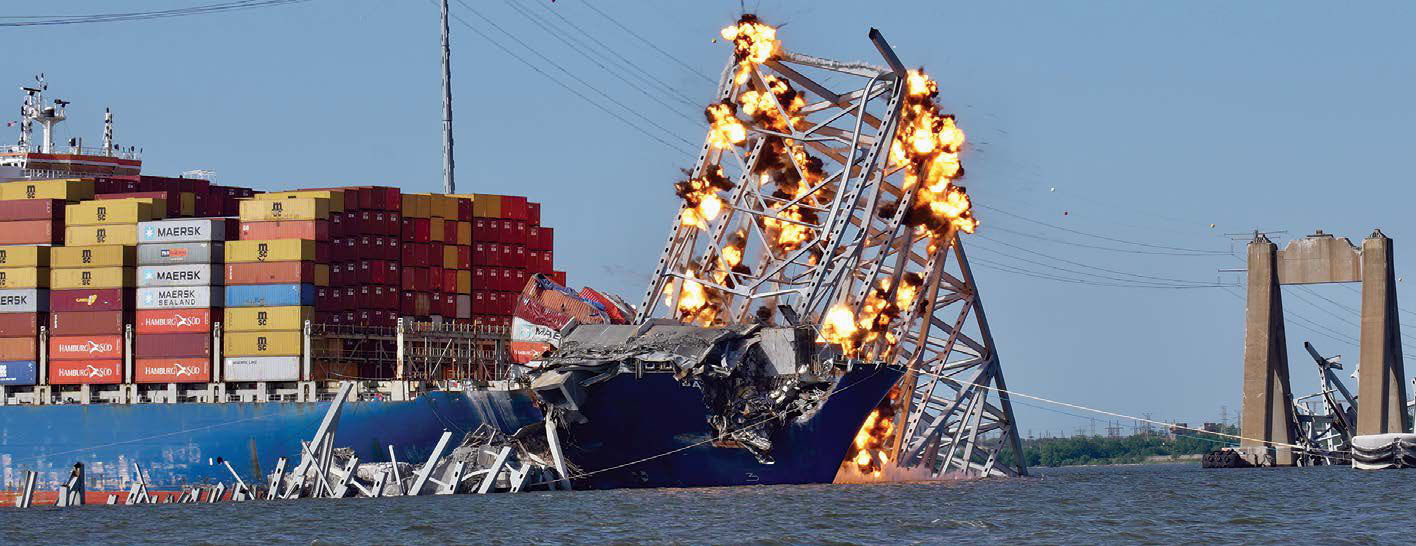
The World Association for Waterborne Transport Infrastructure found that between 1960 and 2015, 35 major bridge collapses occurred worldwide due to a ship or barge collision – 18 of which were in the United States. In just the first half of 2024, the United States has suffered two more. The March collapse in Baltimore cost six people their lives and will be a well-over $400 million rebuild. The collision in Galveston, Texas, in May didn’t take the bridge down, but an oil spill occurred. The U.S. Coast Guard estimates that the barge may have spilled up to 2,000 gallons of its 23,000 barrels of oil into the Galveston Channel.
In the aftermath of these accidents, many manufacturers who make bridge-related products have been asked questions such as “What are ‘fenders’ and ‘dolphins’?” shortly followed by, “Would they have prevented this?” as people search to understand what may have avoided these events or reduced their impact.
The short answer is “probably.” But these and most other bridges would require a major retrofit to add fenders or dolphins.
Many bridges in the United States lack protections like fenders and dolphins because, at the time of their design, the vessel size we see today simply didn’t exist and the level of water traffic was much less. The Key Bridge in Baltimore was built between 1972 and 1977, and the Pelican Island Bridge in Galveston was built in 1960. Engineers half a century ago couldn’t plan for something impossible at the time.
But now that vessel and load sizes have increased, bridge protection measures have evolved. These available retrofits are not (yet) nationally required, however. This means the majority of U.S. bridges have yet to adopt these protections. Neither the Francis Scott Key Bridge nor the Pelican Island Bridge had protective dolphins or fenders of any material protecting their piers.
Let’s look at the difference between fenders and dolphins and the types of loads bearable by different materials. Fenders and dolphins made of lighter materials like wood and Fiber Reinforced Polymer can protect bridge piers like bumpers in a bowling lane and are suitable for small- to medium-sized vessels like passenger boats and small commercial ships. But for large- and over-sized vessels like cargo ships and tankers, only huge, concrete dolphins or walls can provide adequate protection, like a shield blocking a blow from a gladiator. The protective structure and the vessel will be damaged in the collision, but the bridge and its passengers will be safe.
Fenders are often the most cost and structurally effective choice, but their effectiveness depends heavily on the waterway shape and bridge pier location.

When Lighter Fenders and Dolphins are Appropriate
Fenders and wood or FRP dolphins are most effective for smaller waterways that handle smaller vessels. The physics of an impact dictate the blows these materials can reasonably provide. For example, heavy-wall FRP fenders and dolphins provide great protection from vessels with impact energies up to 3,000 kip/ft, 36-inch outside diameter (OD). These products are used for ferry terminal guide walls and impacted daily by automobile ferries carrying 70 cars and weighing 1,650 tons when fully loaded.
Adding a concrete cap to a large number of 36-inch OD FRP piles can yield a maximum 20,000 kip/ft, but even this would likely not stop a huge container ship moving at high velocity. For these cases—that is, larger waterways that handle outsize ships— huge concrete dolphins or walls are often the most, if not only, appropriate solution.
As a rule, fenders are made of “lighter” materials like wood or FRP, as these are more flexible than concrete and have a better ability to absorb and dissipate impact energy. A vessel can glance off these materials, rather than experiencing the sudden, severe deceleration that it would experience from a hard material like concrete.
Why FRP?
Perhaps most importantly, Fiber Reinforced Polmer is inherently corrosion-resistant. FRP will not rust or rot when exposed to water or salt. Wood (as well as concrete and steel) is subject to degradation from water and brine. This shortens the material’s service life and requires more frequent maintenance and health checks to ensure adequate protection. To resist rot for longer, wood structures are treated with chemicals like creosote, which can leach into the water. Some highly saline environments degrade wood structures so fast that yearly replacement is necessary even with this treatment.
FRP is also an engineered material. It’s not limited by nature and has been improved over time to give it the performance characteristics it now has.
FRP materials rival the strength of grade 50 steel in bending but at a fraction of the weight. FRP’s modulus of elasticity—a measure of the ratio of stress to strain, describing a material’s ability to resist deformation—is considerably less than steel. FRP’s ability to take impact and absorb energy (sometimes called “work energy”), which is defined by the area under the load-displacement curve when the material is subject to bending loads (like an FRP fender being hit by a boat), is above that of steel, in some cases more than 10 times as much. FRP protection systems “bend but don’t break.” FRP is designed to take the full energy of a hit and either stay standing or be the sacrifice that keeps the bridge itself standing.
FRP Fenders and Dolphins at Work
Coastal New Jersey has many bridges. In Cape May, a bridge intersecting Beach Creek on NJ Route 147 has been protected by an FRP fender system and larger-diameter dolphin piles at the end of the fender line and at high-impact zones. The system has not required replacement or significant maintenance since its installation in 2018.
Further down the Atlantic coast, the Virginia Department of Transportation replaced its wood pile dolphins with FRP ones. Fewer were needed to replace the wooden dolphins, and when tested by a microburst, a 50,000-pound Jamestown-Scotland ferry rested on the piles with no damage to the poles or the vessel.

What Concrete Dolphins Do
A large-diameter concrete dolphin or wall provides the fullest protection for any bridge from a massive impact. These structures are intentionally sacrificial, designed to take the full impact of a major hit and to protect the bridge they guard, even if they damage or destroy the vessel. The concrete dolphins can then be repaired or replaced as needed.
Baltimore, for example, added a power transmission tower system in the early 2020s that ran parallel to the Key Bridge, and the project included a large, closed-cell dolphin system to protect the grid. The stakes were too high for engineers to want to risk the grid in the event of an impact. The concrete barriers stand between essential infrastructure and any possible threat.
“What if …?” What could have happened—but didn’t—if either of these bridges had a concrete dolphin system guarding their piers?
The size of the Key Bridge, the distance between piers and the types and sizes of vessels that float beneath it would have required three to five concrete dolphins per pier. These would likely be arranged in front of one another to add layers of protection.
When Dali lost power, she continued traveling toward the Key Bridge at around six knots. If the bridge had had concrete dolphins in place, Dali’s hull would have smashed into the dolphins, sustaining major damage. The concrete dolphins would be partially or fully destroyed but would have significantly slowed or even stopped Dali before she could reach the bridge pier.
Dali’s hull would likely be crushed, though punctures could have occurred. If the hull were breached, watertight bulkheads would likely have contained the water in the vessel long enough to give the crew time to send distress signals and prepare lifeboats for the crew. While there is a chance the hit could cause the bulkheads to leak and flood the vessel faster, vessels of Dali’s size have crews trained in emergency preparedness to maximize safety.
The outcome of the Pelican Island Bridge would likely have been very similar: Concrete dolphins could cause a breach that would lead to an oil spill, but they would have protected the bridge itself from the impact, allowing the Pelican Island Bridge to remain safe and open until its scheduled 2025 replacement project could begin.
Bridge Protection is Part of Infrastructure Modernization
Many question marks remain about the Key Bridge and Pelican Bay Bridge crashes—and lots of finger-pointing. Those investigations will need time to play out. But the reality is that the United States’ bridges are handling traffic (on and below them) that has far outpaced the technology civil engineers could have imagined when the bridges were designed and built. Advancements like fender systems and dolphins can prolong the safe operation of aging bridges until it’s time for a total upgrade.