Collapse of Chalmette Refinery Dock Section During Docking of Ovide J Tow
On April 25, 2023, about 0004 local time, the towing vessel Ovide J was maneuvering two loaded crude oil barges to the Chalmette Refinery crude oil dock near mile 89 on the Lower Mississippi River in Chalmette, Louisiana, when the starboard barge contacted the dock, after which about 150 feet of the dock collapsed into the water.
There were no injuries, and no pollution was reported. There was extensive damage to the dock’s pipelines, bridges, and pilings. The estimated cost of repairs to the dock was about $7 million.
Background
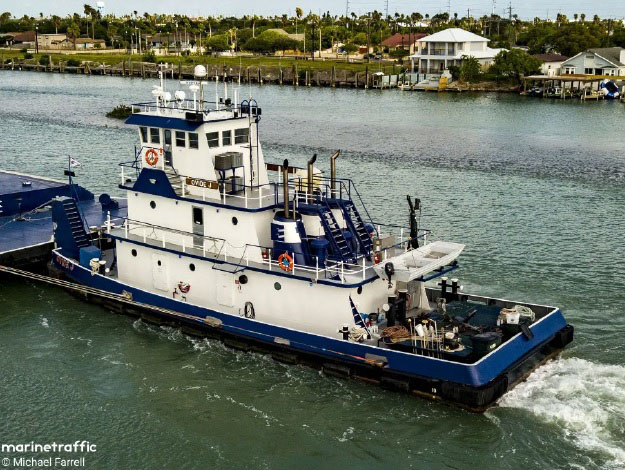
The 76-foot-long towing vessel Ovide J (figure 1) was originally owned by Cenac Towing Company Inc. of Houma, Louisiana, and named Ovide J
Cenac. In 2008, Teppco Marine Services Incorporated of Houma acquired the vessel. In 2009, Enterprise Marine Services of Houston, Texas, acquired the vessel and renamed it Ovide J. The Ovide J was retrofitted and repowered in 2010. Three Cummins KTA19 diesel engines, with twin disc reduction gears, provided 1,920 hp to three fixedpitch propellers. The vessel was outfitted with three rudders and two flanking rudders for maneuvering.
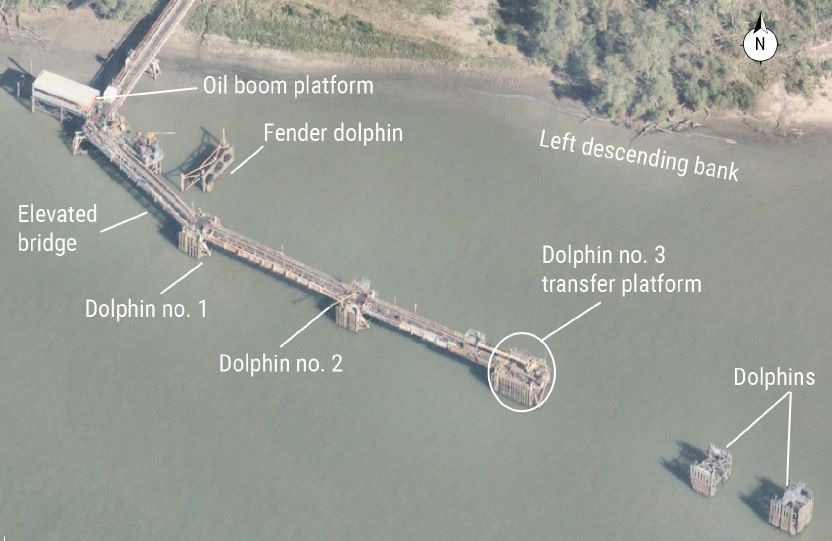
The Chalmette Refinery crude oil dock, constructed in 1967, was located on the left descending bank of the Lower Mississippi River and consisted of wood and steel pilings, dolphins, and elevated bridges (figure 2). The elevated bridges were connected in series to a transfer platform located on dolphin no. 3. Three 16-inch crude oil pipelines ran the length of the dock to the transfer platform on dolphin no. 3, which contained a boom crane, an associated pipe manifold, and shore-provided hose connections. The dock had two berths: one inshore berthing with a forward fendering dolphin and one offshore berth.
Event Sequence
On April 23, 2023, at 1233, the towing vessel Ovide J departed the Plains All American Oil Terminal in St. James, Louisiana, near mile 158 on the Lower Mississippi River, pushing two loaded crude oil barges (EMS 348 and EMS 321) downriver to the Chalmette Refinery crude oil dock, in Chalmette, Louisiana, near mile 89. The tow was arranged with two 297-foot-longby- 54-foot-wide tank barges side by side, with the EMS 348 to starboard and the EMS 321 to port, for a total (vessel and tow) of 373 feet long and 108 feet wide. There were five crewmembers on board: a captain, relief captain, tankerman, and two deckhands.
When the tow arrived in the area of the Chalmette Refinery dock later that evening about 2130, it temporarily moored at the nearby Turn Services fleeting area, located on the left descending bank, 1.6 miles north (upriver) of the crude oil dock, because another tow was at the dock discharging crude oil to the refinery.
The following day, on April 24, about 2200, the lead wharfman at the Chalmette Refinery dock contacted Ovide J’s captain to confirm the intended discharge quantity of 50,000 barrels of crude oil and provide docking instructions. The captain told the lead wharfman that the tow would arrive around midnight. The lead wharfman acknowledged the captain’s arrival time and told him that they would have a dock operator at the pier.
At 2228, the Ovide J tow departed the fleeting area for the crude oil dock. The captain and a deckhand were on watch in the wheelhouse. The weather was clear, with light winds from the north-northeast at 4.5 mph. The river current was about 3.7 mph. The captain noted no issues with the mechanical condition of the vessel.
The relief captain told investigators he woke up about 2245. Just before 2330, the relief captain arrived in the wheelhouse for his 2345 scheduled watch. The relief captain and the captain completed a watch changeover and discussed the plan to proceed downriver past the Chalmette Refinery dock, and then “top around” to bring the head of the tow into the current and approach the dock from downriver, to dock starboard side to the pier.
According to the relief captain, this was his 20th time maneuvering to the Chalmette Refinery crude oil dock in the past year, with the most recent docking occurring three days before, on April 21 at 0334. The relief captain had been with the company for over a year and a half at the time of the contact, and he had sailed in the capacity of relief captain on similar towing vessels for about 11 years.
At 2347, the relief captain assumed the watch. The captain remained in the wheelhouse, and the oncoming deckhand relieved the offgoing deckhand of the watch.
The oncoming deckhand proceeded to the head of the tow to call out distances to the dock via VHF radio and prepare for line handling. The tankerman had been awakened to assist with the tow’s arrival at the dock. He was positioned on the stern of the Ovide J for line handling and to call out the tow’s distance and position from the dock to the relief captain via VHF radio.
All three engines were clutched in reverse, slowing the vessel’s headway in anticipation of performing the top around maneuver. After the relief captain confirmed the area was clear of vessel traffic, he began the top around maneuver on the left descending bank side of the river, orienting the head of the tow toward the center of the river.
At 2356, the tow was facing upriver, positioned about 400 feet out from the crude oil dock and 150 feet downriver from the transfer platform where the tow would dock. The relief captain next began to slow the tow to prepare for docking at the platform. He clutched the three propulsion engines in and out of forward and reverse while using both the main rudder and flanking rudder. According to the relief captain, “I come on the dock the same way every single time. I come in slow and as even as possible . . . using the river.”
Shortly after midnight, at 0001 on April 25, the tow was approaching the dock at a speed of 0.46 mph. An onboard video recording system in the wheelhouse showed the relief captain getting up from the seat at the helm and sitting back down. He later told investigators that he was attempting to obtain a better line of sight of the head of the tow and starboard barge alignment with the transfer platform and shoreside manifold. The video also showed that the flags on the tow knees were moving in a direction from starboard to port (off the dock) and that floodlights illuminated the dock.
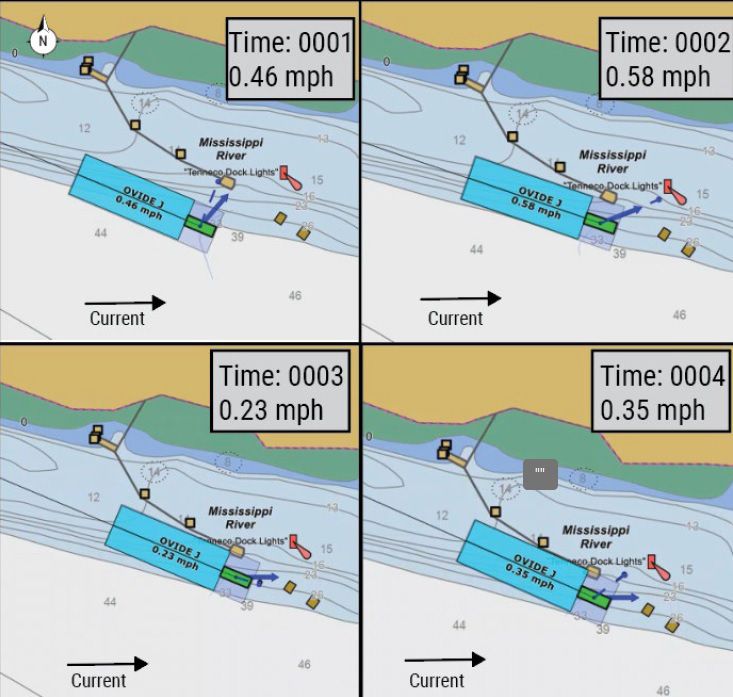
At 0002, the speed of the tow was 0.58 mph, and the onboard recording system showed the tow at an approach angle of 3–5° off the dock, with the starboard quarter of the starboard barge closest to the dock. At 0003, the speed of the tow was 0.23 mph, and the onboard recording system showed the tow traveling toward dolphin no. 3 with the head of the tow about 4° off the dock (figure 3).
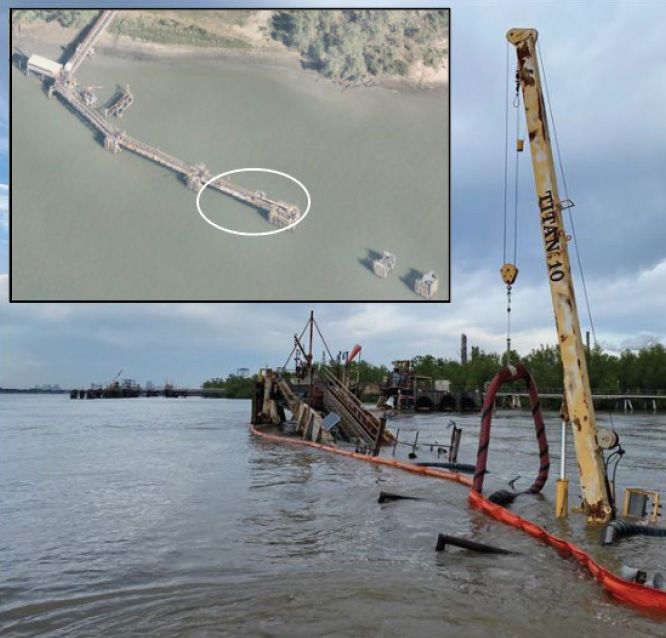
At 0004, as the tow moved downriver in the current (while still facing upriver), at a speed of 0.35 mph, the starboard quarter of the starboard barge (EMS 348) contacted the wooden fendering of the transfer platform at dolphin no. 3, and part of the dock collapsed into the river toward the shoreline (figure 4). The onboard recording system captured the dock section falling into the water; the recording also showed that, in the wheelhouse, there were no signs of any movement from the contact (such as people getting jolted or VHF radio cables moving). The relief captain immediately placed the starboard engine in neutral to avoid entanglement of the starboard propeller with the fallen dock and floating hoses and lines on the submerged transfer platform.
After the contact, the relief captain ordered the deckhand, who was forward on the starboard barge, to secure as many lines as he could to dolphin no. 1 and dolphin no. 2, which had not collapsed.
The deckhand and tankerman secured five lines and one wire rope to the dolphins, and then they proceeded aft and boarded the towing vessel.
The relief captain continued to position the tow, which remained intact, parallel to the pier, while the captain notified the company and refinery.
Damage
The Ovide J and barges sustained no reported damage from the contact with the dock. A US Coast Guard inspection following the casualty noted that no fendering timbers or pilings were damaged from the contact with the barge EMS 348.
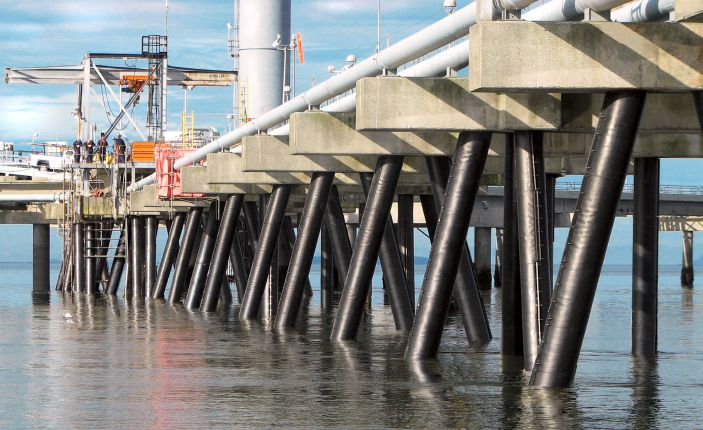
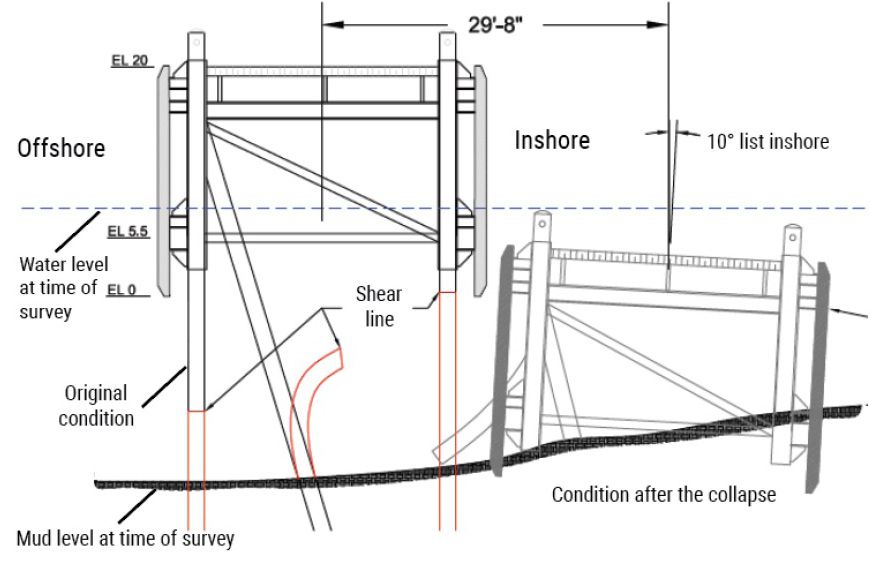
The contact caused 150 feet of the dock to collapse inshore (figure 4). A postcasualty survey revealed shearing of dolphin no. 3 support pilings 5 to 20 feet below the waterline (figure 5). The dock settled to the riverbed, 10 feet below the river height at the time of the casualty. The transfer platform moved about 30 feet toward the shoreline and had a 10° inshore list. The elevated bridge remained connected to dolphin no. 3 but was about 17° closer to the shoreline than its original position. The estimated cost to repair the damage to the crude oil dock was $7 million.
Structural Integrity of the Dock
A July 2017 inspection report from a third-party engineering firm classified several horizontal braces between dolphin no. 3 pilings as having major deterioration. Three braces were observed broken, and one horizontal brace had impacted another, compromising the weld at the jacket. The report further stated that two pilings were severely deteriorated, and all no. 3 dolphin pilings were shifted toward the shoreline.
In October and November 2021, another engineering firm performed a visual above-water inspection of the Chalmette Refinery crude oil dock, including the dolphin no. 3 transfer platform. The structural inspection form for the dolphin no. 3 transfer platform listed seven findings corresponding to damage, including disconnected header joints, bent beams, and significant corrosion. The firm documented four priority one (highest urgency) categories of damage as a result of the inspection: The structure exhibited (1) visible damage to the longitudinal lateral force-resisting system, (2) visible damage to the transverse lateral force-resisting system, (3) visible damage to the vertical gravity system, and (4) significant corrosion.
The third-party engineering firm advised, as part of its inspection report, that the dock owner follow up this visual, above-water inspection with a structural assessment of the piles and the dock. According to the dock owner, the recommendations from this inspection report had “not been progressed” as of the date the dock collapsed.
Postcasualty Actions
The dock owner stated that actions they were taking after the dock collapse included: conducting a marine structure survey, integrating results from the most recent structural engineering review and inspections of marine facilities into the mechanical integrity program, reviewing dock procedures to reinforce expectations of the person in charge during vessel dockings, and developing an asset management system for dock integrity to ensure structural inspection of docks with specified frequencies for above water and below water, to include a workflow process for actionable items.
Probable Cause
The National Transportation Safety Board determines that the probable cause of the collapse of a section of the Chalmette Refinery crude oil dock during the docking of the Ovide J tow was the degraded condition of the no. 3 dolphin transfer platform structure.
LESSONS LEARNED:
Maintaining Waterfront Infrastructure It is important for dock owners to inspect, evaluate, maintain and rehabilitate facilities, piers, docks, and other infrastructure to minimize the risk to the environment and the vessels that traverse the waterways. Scheduling inspections, as well as maintaining and replacing waterfront infrastructure and components, is critical to continued safe operations.