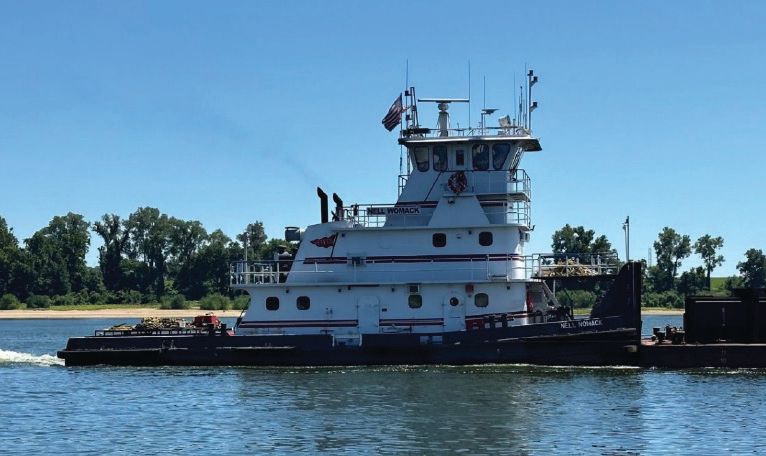
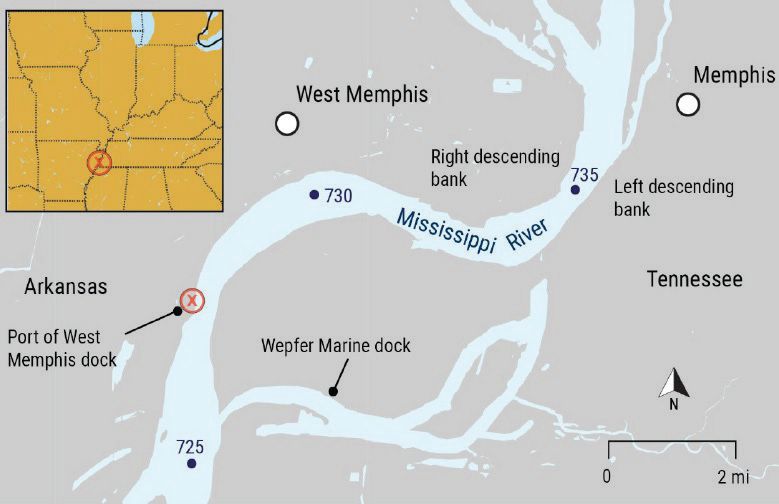
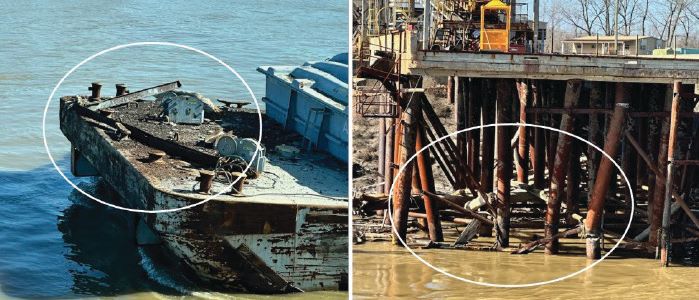
On January 29, 2024, about 1230 local time, the towing vessel Nell Womack was pushing hopper barges ACL23401 and ACBL2549 upbound on the Lower Mississippi River when one of two facing wires connecting the towing vessel to barge ACL23401 parted. When it became unsafe for the towing vessel to remain attached by one facing wire, the crew released the wire. Both barges drifted downriver, and, at 1240, barge ACBL2549 struck the Port of West Memphis dock in West Memphis, Arkansas (see figure 1 and figure 2). There were no injuries, and no pollution was reported. Damage to the dock and the barge ACBL2549 was estimated at $500,000.
Factual Information
On January 29, 2024, about 1135, the 69-foot-long towing vessel Nell Womack departed the Wepfer Marine dock in Memphis, Tennessee, with a captain, a steersman, and two deckhands, and maneuvered to a barge staging area located about 2,000 feet away. The deckhands prepared the towing vessel to push a string of two hopper barges, the ACL23401 and the ACBL2549, which were both loaded with steel coils.
The Nell Womack was connected to the ACL23401 with port and starboard facing wires and a center bow line, and the ACBL2549 was the lead barge (see figure 3). The length of the facing wire from the winch on the towing vessel to the bitt on the barge was about 40 feet. The deckhands visually inspected the 1.5-inch-diameter facing wires and ensured that the tow was properly secured and ready for transit, as per the company’s operating procedure. The winches were controlled from the wheelhouse, and the wires were reported as tight before the tow got underway.
About 1144, the captain got the tow underway and navigated it upbound on the Lower Mississippi River, toward its destination, the Fullen Dock, located about 16 miles away. The Nell Womack was pushing the two barges against a 3-to-5-knot current. At 1230, while the tow was approaching a bend (to the right), the captain, who was at the helm in the wheelhouse, heard a loud “pop.” The vessel operator stated that, due to a sandbar at this point in the river, there was a current differential that created a cross current, resulting in a bottleneck that put more force on an upbound tow’s starboard side. The captain looked out and saw that the starboard facing wire had parted. The current caused the two barges, which were now secured by only a bow line and one facing wire instead of two, to begin turning to port. The captain slowed the towing vessel and steered it to starboard in an attempt to counteract the barges’ turn to port. Shortly after, the bow line between the Nell Womack and barge ACL23401 also parted, leaving only the port facing wire connecting the towing vessel to the barges.

The captain and the deckhands tried to gain control of the barges, which continued to swing to port. However, the current pushing the barges to port and downriver caused the towing vessel to roll to port and be dragged by the barges—a situation the captain determined to be dangerous—so he directed the deckhands to disconnect the port facing wire.
After the deckhands disconnected the port facing wire, the two barges, still connected to each other, drifted downriver with the current. The captain maneuvered the vessel in an attempt to regain control of the barges, but, about 1240, roughly 1,200 feet from where the tow became disconnected, barge ACBL2549 struck the southern corner of the Port of West Memphis dock, located on the right descending bank, in West Memphis, Arkansas. (The inland towing industry refers to the shorelines of Western Rivers as the left and right banks when traveling (facing) downriver. The left bank is called the left descending bank, and the right bank is called the right descending bank.)
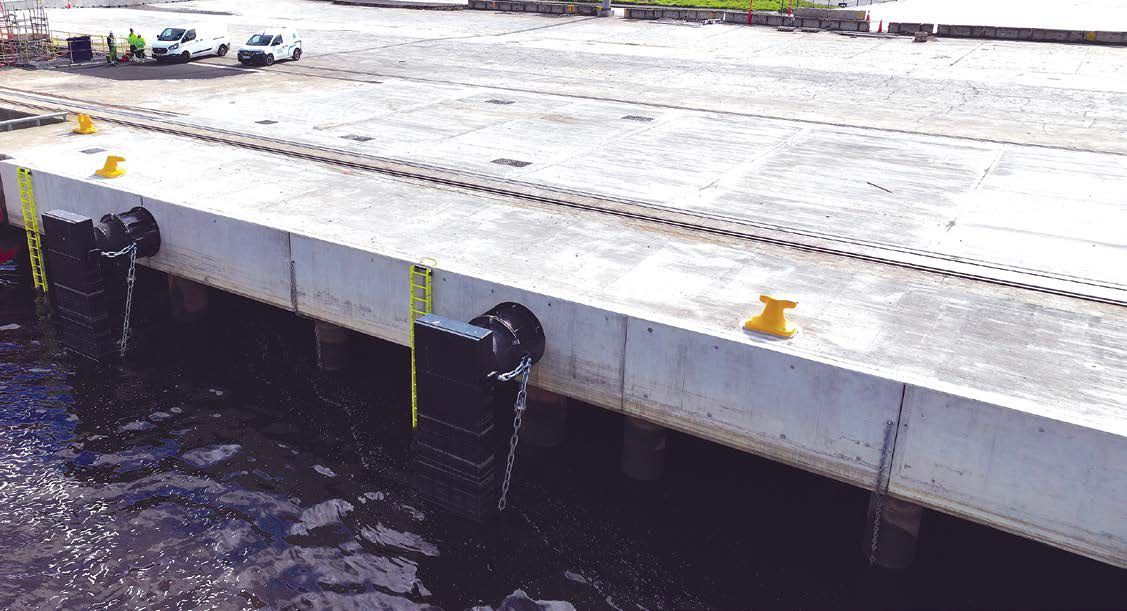
The ACBL2549 sustained minor damage, and the ACL23401 was not damaged. The Port of West Memphis dock sustained damage to eight structural pylons: three were severed, and five were severely damaged (see figure 4). The starboard facing wire parted around the halfway mark between the winch and the bitt. A visual inspection of the starboard facing wire conducted by the US Coast Guard and the company after the casualty did not identify any deficiency that may have contributed to the parting. The wire was not available for further testing.
The company normally took wires out of service based on observations of wire damage (such as crimping, fishhooks, or flattening) during inspections (crewmember inspections per operational procedures and company quarterly inspections). There was not a set schedule for taking wires out of service. The company informed investigators that it did not normally document wire replacement unless it occurred during a company quarterly inspection. In the most recent quarterly inspection of the Nell Womack, on September 12, 2023, the 1.5-inch facing wires were documented as having been replaced.
Analysis
At the time of the breakaway, the facing wires used by the crew of the Nell Womack had been in service for about 4 months. The crewmembers visually examined the facing wires each time the towing vessel was moving a barge, in accordance with company policy. The 1.5-inch wires were the correct size for the towing operation and, based on interviews with the captain and crew, the wires were properly connected to the barge and tightened (no slack) before the tow got underway. Before departing, the crew raised no concerns about the starboard facing wire’s condition. As the towing vessel and the barges transited upriver and approached a right bend in the river, the 3-to-5-knot current, acting disproportionately (stronger force) on the starboard side of the lead barge, would have placed additional stress on the point where the ACL23401 was connected to the Nell Womack on the starboard side. Given that there were no visible indications of problems with the condition of the starboard facing wire, it likely parted due to deterioration to its wire strands that was not detected during visual inspections.
Probable Cause
The National Transportation Safety Board determines that the probable cause of the breakaway of the barges ACL23401 and ACBL2549 and subsequent contact of the barge ACBL2549 with the Port of West Memphis dock was the parting of the starboard facing wire connecting barge ACL23401 to the towing vessel Nell Womack, likely due to undetected damage to its wire strands.