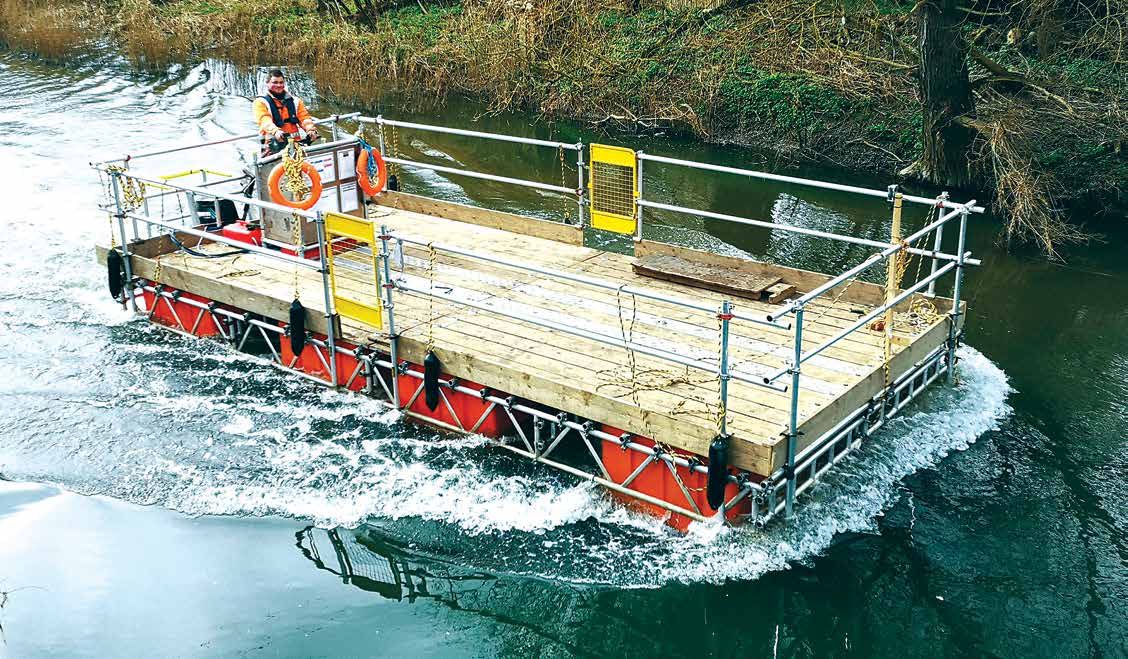
In an industry first, floating scaffolding has been used to complete a specialist contract lift on the river Severn, England, U.K. The job further expands the capabilities of the innovative ScaffFloat system, which combines patented plastic floats with standard scaffold beams, tubes and clips to make temporary pontoons and workboats for inland and coastal projects.
Working in partnership with Attridge Scaffolding, one of their approved installers, the partnership was able to provide a full scope of works that included full access to the vertical concrete pen-stock face of the riverside water works using traditional scaffold, as well as providing two large floating scaffold pontoons for storing and lifting the new eel screens, weighing 2.2 tonnes each.
“This project was almost 12 months in the planning,” James Attridge said. “After an initial site visit with the client, it was a case of putting together a scheme utilizing past experience from other projects. The exception was the floating lift rig. This is where our professional working relationship with ScaffFloat enabled both parties to work together to develop a solution. “
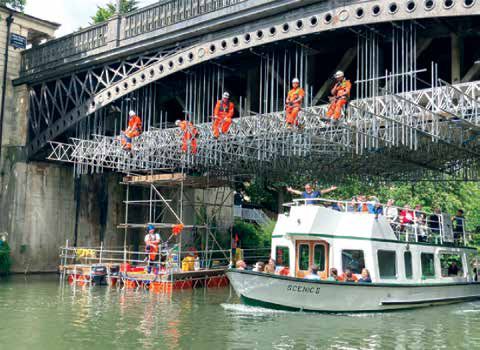
As one of the main approved installers of the floating scaffold system in the U.K., Attridge worked with the ScaffFloat team to develop a custom design to meet site-specific client requirements. Access to the water was very limited, so both pontoons were built shoreside as a skeleton framework, which kept the weight for the crane lift down to one tonne. Once afloat, additional tubes, clips and boards were craned down and both pontoons were completed afloat, bringing their weight up to around three tonnes each. The first pontoon was used as a storage pontoon. With a six-tonne payload, it was used to store components afloat before they were fitted by the team from Edwards Diving.
The second pontoon was fitted with a custom lifting A-frame that was designed specifically to lift the 2.2-tonne, 6-by-3-meter eel screens. Designed and built to Eurocode standard with a suitable dynamic application and safety factor, it was also proof-tested on site to over three tonnes. In addition, the U.K. engineering firm Richter provided an independent assessment to provide further safety assurances.
Toby Budd, managing director of ScaffFloat said, “One of the challenges for this lift was water depth. The eel screens were installed just below the surface so there was not enough draft or water depth to have the pontoon directly above. This meant the 2.2-tonne lifts had to be done over the bow of the pontoon at a distance of three meters. It was a great project and we are proud that we achieved the six lifts ahead of time and without any accidents. This is another example of how quickly the ScaffFloat system is developing. Customers love the versatility and we have a number of other lifting jobs in the pipeline.”
For more information about ScaffFloat, please visit www.workfloat.co.uk